The Pleasure of Being Enough
November 9, 2026 Leave a comment
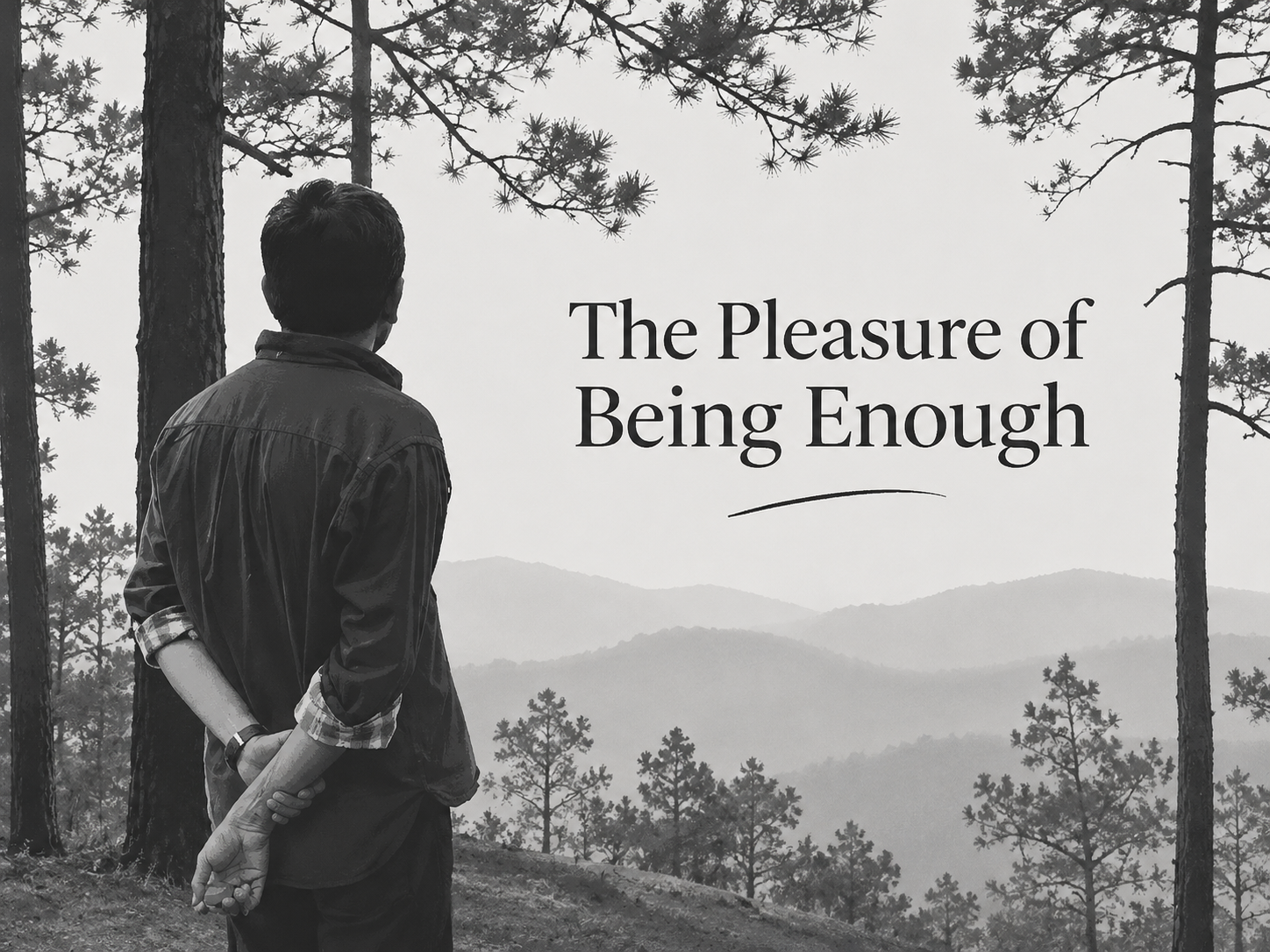
I have always found my own company deeply satisfying, whether to introspect, ideate, read, explore intellectual curiosity, or enjoy the small things that make life interesting. I like sitting alone with a cup of cappuccino, a book, reading blogs or playing a game on my smartphone, or following a thought that often leads me somewhere unexpected, imagining possibilities that might never materialise, or simply enjoying something I like without interruption. There are no specific occasions to celebrate and nothing extraordinary is happening around me. Yet, in those moments, I feel a sense of contentment that is difficult to explain to anyone who equates happiness with being surrounded by people.
I have never felt that every empty hour needs filling with plans or that every interesting thought needs an immediate audience. Sometimes, an idea is enjoyable simply because I can explore it at my own pace, allowing it to grow, change direction leading me down a completely unexpected path. Sometimes, I want to do something as ordinary as read, listen to music, or sit quietly with my thoughts without having to account for my time. I enjoy the freedom of these moments and the absence of interruption, the luxury of following my curiosity, and the comfort of not having to be anything other than myself. Being alone has rarely felt like waiting for life to begin. More often, it has felt like being fully present in my own life.
I have come to realise that this contentment with solitude can be difficult for others to understand. When you are comfortable spending time by yourself, people sometimes assume you must be lonely, that you are missing out on something, or that your preference for your own company is a sign of withdrawal. Questions like, “Don’t you get bored?” Why don’t you go out more? are often asked with genuine concern, but they reveal an assumption that a person who enjoys being alone must somehow be deprived of something essential.
Perhaps this is because we have learned to recognise happiness most readily when it is visible. Shared laughter across a coffee table, photographs from a holiday with friends, or the excitement of a crowded gathering are familiar expressions of a life well lived. The quiet pleasure of an uninterrupted afternoon, or the simple ease of doing something alone, is less visible. There is no audience to witness it and no photograph that can adequately explain it, but its invisibility does not make it any less real.
Over time, I have come to appreciate a distinction between being alone and feeling lonely. One describes the circumstances in which we find ourselves, while the other describes how we experience them. They can overlap, of course, but they are not the same. It is possible to feel lonely in a crowded room and entirely content in an empty one. It is possible to long for meaningful connection while still cherishing the hours we spend by ourselves. And it is possible to build a life in which solitude is not something we endure between social engagements, but something we genuinely look forward to. This is the art of being alone without feeling lonely is learning to recognise solitude not as an absence that must be filled, but as a space in which life can unfold on its own terms.
We have become accustomed to treating being alone and being lonely as though they were interchangeable experiences, but they are not. Being alone is a choice, whereas loneliness is an emotional experience. The former describes the absence of other people, while the latter describes the absence of a connection we need or desire. One can be alone and feel entirely content, just as one can be surrounded by friends, colleagues, family members, and acquaintances and still feel profoundly lonely. Anyone who has attended a crowded gathering and felt like an outsider or sat at a dinner table full of people while wishing for a more meaningful conversation understands this distinction intuitively. Physical proximity does not guarantee emotional intimacy, and the presence of company does not automatically create a sense of belonging. The important question, therefore, is not how much time we spend alone but how we experience that time. Does solitude feel like a space we have chosen, or a condition imposed upon us? Does it offer freedom, or does it reinforce a sense of exclusion? The same empty room can become either a sanctuary or a prison, depending on what is happening within us.
Perhaps my appreciation for solitude has something to do with being an INTJ, a personality type often associated with introspection, independent thinking, strategic imagination, and a preference for depth over superficial social engagement. Though personality classifications are imperfect maps of human complexity, no four-letter combination can fully explain an individual. Still, the description resonates with an aspect of my experience. There are ideas to examine, connections to discover, questions to pursue, and possibilities to imagine. Sometimes a passing observation becomes an intellectual rabbit hole, and sometimes an unresolved problem occupies the mind long after the practical demands of the day have ended. At other times, there is no grand intellectual pursuit at all, only the pleasure of doing something without interruption or obligation. Solitude offers the freedom to follow one’s curiosity without having to explain it, justify it, or make it useful to anyone else. It creates room for a particular kind of mental wandering that is difficult to sustain amid constant conversation, notifications, meetings, and the expectations of everyday life. For a mind that enjoys thinking, being alone can feel less like withdrawing from the world and more like entering it through a different door.
There is, too, something restorative about not having to perform. Much of adult life involves inhabiting roles of professionals, partners, parents, children, friends, colleagues, mentors, and caregivers. Each role carries its own responsibilities, expectations, and unspoken rules. We learn when to speak, when to listen, when to be agreeable, when to be decisive, when to offer reassurance, and when to suppress our own concerns because somebody else needs our attention. Relationships and responsibilities give life meaning, and caring for others is an important expression of being human. But even meaningful roles can become exhausting when we never step outside them. Solitude provides a temporary release from the obligation to respond. Nobody needs an immediate answer, nobody expects us to maintain a conversation, and nobody requires us to be entertaining, helpful, available, or emotionally present. We can be uncertain without explaining ourselves, unproductive without feeling guilty, and quiet without having to reassure anyone that we are not upset. In our own company, we can simply exist without turning existence into a performance. Sometimes the most restorative thing we can do is spend a few hours being nobody in particular.
Society is not always comfortable with people who are content in their own company. We are taught early that happiness is something we experience collectively. Birthdays, festivals, holidays, weddings, dinners, and celebrations are organised around togetherness. Our milestones are marked by the people who witness them, and our experiences often seem to acquire legitimacy when they are shared. Even leisure has become social: a restaurant visit, a holiday, a concert, or an afternoon spent outdoors can appear incomplete unless there is a photograph proving that we were there with somebody. Social media has amplified this tendency by making other people’s visible togetherness a constant backdrop to our private lives. We see groups travelling, couples celebrating, friends gathering, and families posing for photographs. What we rarely see is the boredom, awkwardness, emotional distance, or quiet dissatisfaction that can coexist with those apparently perfect moments. The result is an unspoken hierarchy of experiences in which being socially connected appears desirable and being alone requires justification. A person eating alone may be assumed to have no friends. Someone travelling solo may be pitied for having nobody to accompany them. Someone who declines a social invitation may be suspected of being unhappy, antisocial, or difficult. We have become so accustomed to interpreting solitude through the lens of social deprivation that we sometimes struggle to recognise it as a legitimate preference.
Of course, there is a difference between choosing solitude and using it to avoid the difficult work of human connection. It would be too convenient to romanticise every form of withdrawal as independence or intellectual depth. Sometimes we stay away from people because we are tired; sometimes because we are disappointed; sometimes because vulnerability feels uncomfortable or the risk of rejection seems greater than the reward of intimacy. A preference for solitude can occasionally conceal fear, unresolved hurt, or an unwillingness to accommodate the imperfections of other people. Independence can become a flattering name for emotional avoidance. The distinction matters because a fulfilling solitary life does not require us to reject relationships. It requires us to stop depending on constant company to feel whole. Healthy solitude is chosen freely and can coexist with meaningful intimacy. Unhealthy isolation, by contrast, may gradually narrow our world until we no longer know how to reach out, even when we want to. We should be able to enjoy our own company without feeling compelled to prove that we need nobody, just as we should be able to seek companionship without feeling that we have somehow failed at independence. Emotional maturity lies not in choosing one extreme over the other but in having the freedom to move between them.
The ability to enjoy solitude also depends on the relationship we have with ourselves. When external stimulation disappears, we encounter the contents of our own minds more directly. For some people, that experience is uncomfortable. Silence allows anxieties to become louder, regrets to resurface, and unresolved questions to demand attention. In such circumstances, constant company can become a convenient distraction from thoughts we would rather not examine. This is one reason solitude cannot automatically be assumed to be restorative. Its quality depends partly on what we bring into it. Learning to be alone comfortably involves developing a degree of inner companionship: the ability to observe our thoughts without immediately judging them, tolerate uncertainty without urgently seeking reassurance, and acknowledge difficult emotions without treating them as emergencies. It means learning that an unpleasant thought does not necessarily require an immediate solution and that a quiet evening need not be filled simply because silence makes us restless. Introspection can help us understand ourselves, but it can also become rumination if we repeatedly circle the same worries without reaching new insights. The art is to create enough mental space for reflection without turning every moment of solitude into an interrogation of our own lives.
One practical way of cultivating this relationship with ourselves is to reclaim small, ordinary experiences from the expectation that they must be shared. Go for a walk without arranging to meet anyone. Visit a bookstore and spend as long as you like browsing its shelves. Sit in a café with a book, a notebook, or nothing more ambitious than a cup of coffee. Watch a film without needing to discuss it afterwards. Take a short trip in which the itinerary can change according to your mood. Spend an evening cooking, listening to music, reading, or following an idea that serves no purpose beyond satisfying your curiosity. These activities may sound unremarkable, but they offer something valuable: the experience of being the author of our own time. When we are alone, we can move at our own pace, change our minds without negotiation, and pay attention to things that might otherwise be overlooked. The objective is not to turn solitude into another self-improvement project. It is to discover that time need not always be productive, memorable, or socially approved to be worthwhile. A life that allows for unstructured pleasure is often a life with more room to breathe.
It is equally important to develop a life that feels rich enough to sustain periods of solitude. Enjoying one’s own company becomes easier when that company is not merely an absence of other people but an active engagement with the world. Curiosity is an excellent companion. So are books, music, art, nature, writing, learning, making things, and pursuing questions that have no immediate practical value. A person who continues to learn and explore does not have to wait for someone else to make life interesting. There is always another idea to examine, another place to discover, another perspective to consider. This is especially relevant as we grow older, when social circles can become smaller, friendships may require more deliberate effort, and the familiar structures of work and family life may change. If our sense of fulfilment depends entirely on other people’s availability, we may find ourselves vulnerable to circumstances beyond our control. But when we cultivate interests, habits, and sources of meaning that belong to us, we develop a more resilient relationship with life. We can appreciate company without being dependent on it, enjoy a busy week without fearing a quiet weekend, and welcome an unexpected free afternoon rather than treating it as a problem that needs to be solved.
There is also a deeper freedom in learning not to seek constant validation for our preferences. Not everyone needs to understand why we enjoy spending an afternoon alone. Not everyone will appreciate the pleasure of a solitary meal, the satisfaction of an uninterrupted train of thought, or the excitement of pursuing an idea that nobody else finds particularly interesting. That is perfectly fine. The desire to be understood is human, but the need to have every preference understood and approved can become its own burden. We can explain ourselves when we wish to, but we do not have to turn our temperament into a defence case. Being comfortable alone means accepting that our lives need not resemble the lives of our friends, colleagues, or neighbours. Some people come alive in crowds; others thrive in smaller gatherings. Some draw energy from constant interaction; others need quiet intervals to recover and think. Most people occupy a position somewhere between these descriptions, with their needs changing according to circumstances. There is no moral superiority in being an introvert, just as extroversion is not evidence of greater emotional health. The goal is not to celebrate one personality type at the expense of another but to stop treating difference as deficiency.
And yet, even those of us who cherish solitude need other people. We need the friend with whom a conversation can wander into unexpected territory, the person who challenges an assumption we have held for years, the companion who makes an ordinary experience unexpectedly joyful, and the relationship in which we can be understood without having to translate every part of ourselves. Human connection provides things that introspection alone cannot: the opportunity to encounter perspectives outside our own, to practise empathy, to be surprised, to love, and to be changed. There are experiences that become more meaningful when shared, just as there are experiences whose meaning depends on being lived privately. A fulfilling life makes room for both. It does not turn independence into a wall against intimacy or companionship into an obligation to remain perpetually available. It lets us be present with others without losing ourselves and to return to ourselves without abandoning others. Perhaps the healthiest relationships are those in which solitude is not interpreted as rejection, where two people can occupy the same room without needing to fill every silence, and where time apart strengthens rather than threatens the connection. To love someone well should not require us to surrender the parts of ourselves that flourish in solitude.
Ultimately, the art of being alone without feeling lonely is the art of building a life in which our own presence is welcome. It is knowing that an empty evening is not necessarily a wasted one, that a solitary journey can be an adventure rather than a compromise, and that silence can hold possibility rather than absence. It is understanding that happiness need not always arrive through an invitation, a conversation, or somebody else’s attention. Sometimes it arrives quietly, in the middle of an ordinary afternoon, when we are reading something fascinating, following a thought to its conclusion, enjoying a meal at our own pace, or simply feeling at ease with the person we have become. This does not mean that we will never feel lonely, nor should we expect ourselves to. Loneliness is part of being human and recognising it can remind us to seek the connections we need. But we need not interpret every moment alone as evidence of loneliness waiting to happen. There is a difference between wishing someone were beside us and believing that our experience is incomplete without them. The first can be a tender expression of connection; the second can become a lifelong dependence on external circumstances for our own sense of wholeness.I have come to believe that one of the privileges of growing comfortable with oneself is that it changes the nature of companionship. When we no longer seek people merely to escape our own company, we can choose them for the richness they bring to our lives. We can appreciate a conversation without needing it to fill a void, enjoy a gathering without fearing the silence that follows, and care deeply for others without expecting them to be perpetually available. We can be alone because we want to be, not because we have nowhere else to go. And when we do feel the desire for company, we can honour that desire without treating it as a contradiction of our independence. Perhaps that is the balance worth striving for: a life in which we are capable of genuine intimacy but not frightened of solitude, connected to the world but not dependent on its constant noise, and curious enough to keep discovering things even when nobody is watching. In the end, the measure of a complete life may not be how many people surround us at any given moment, but whether we can find meaning both in the company we keep and in the quiet company we keep with ourselves. To be alone and feel at home is not to have less of a life. Sometimes, it is to have made peace with the life that is already ours.
Discover more from Manu Mayank
Subscribe to get the latest posts sent to your email.
 About Manu Mayank

