Microenterprises, Macro Impact: The transformative social impact by rural women entrepreneurs

Across India’s villages, a quieter and powerful transformation is unfolding, led by women entrepreneurs building microenterprises that are changing not just their lives but also contributing towards local prosperity.

In rural India, microenterprises (and many a time, even termed as nanoenterprises) are typically small-scale and often home-based ventures. These include tailoring shops, grocery stores, food processing units, poultry farms, handloom or handicraft businesses, among many others. They usually operate with minimal capital, often under INR 1 lakh, and rely on family support systems. While these businesses may appear modest on the surface, they’re laying the foundation for grassroots economic resilience and social transformation.

When a woman in a village starts a business, she’s not just earning an income, she’s stepping into a position of agency. She becomes a decision-maker, a provider, and importantly, a role model.

In Jharkhand, Shashi, a determined and resilient woman, has become a role model of empowerment in her village of Kura. With knowledge, financial and device support, she started her Digital Business, which became a hub of convenience and accessibility for people in her village and neighbouring villages. Her journey as a digital entrepreneur empowered her and gave her the agency to make a meaningful contribution to her community. Today, she’s also a Mukhiya (village head) and fondly known as “Digital Mukhiya”, continuing to be the voice of women’s empowerment.

Microenterprises help address the rural employment gap, especially for women who often can’t migrate or work outside the home due to social norms and family responsibilities. These businesses absorb local labour, retain economic value in the village, and reduce dependence on urban employment.

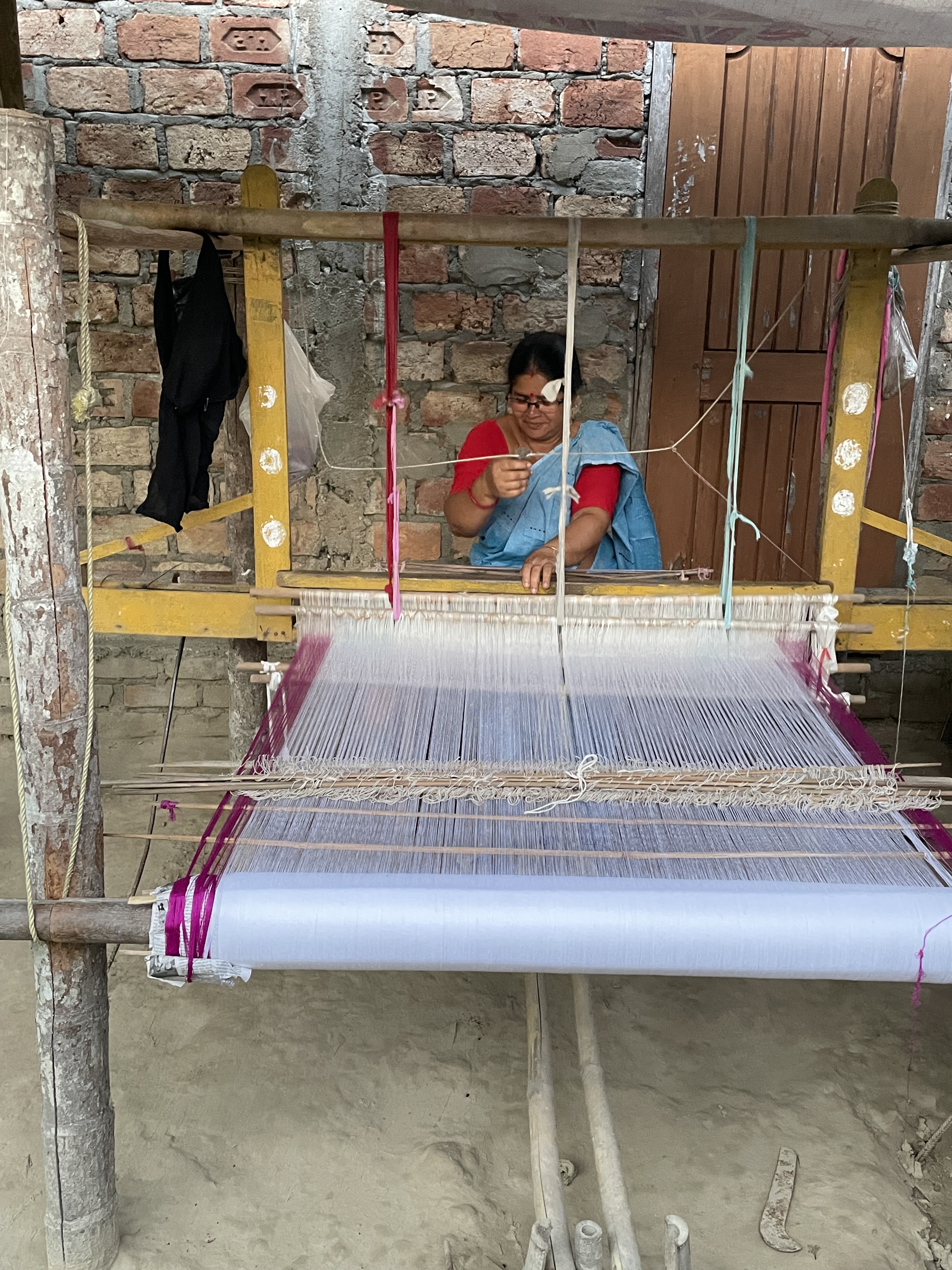
In Assam, Mintai’s Jacquard Handloom Weaving business now employs 3-4 local women who were previously unemployed. They earn and save, and for the first time, imagine futures that include good education for their children or owning a business.

This kind of bottom-up economic activity contributes to local economic resilience, the ability of communities to survive and thrive even during external shocks. The social impact generated by women entrepreneurs is profound. This often translates into higher educational aspirations for children, especially girls staying and completing their school education; increased income leading to better nutrition, access to healthcare and sanitation leading to improved health outcomes; acceptance and shift in gender norms; and financial independence gives women negotiating power within households leading to lower rates of domestic violence.

Despite their success, rural women entrepreneurs continue to face systemic challenges like, (a) collateral requirements and credit histories disqualify many from accessing formal loans, (b) getting products to larger and fairer markets remains a logistical challenge, (c) stifling social norms due to resistance from family or community, (d) accessing business education to develop ‘aptitude’ matching their entrepreneurial ‘attitude’, and ( e) digital divide due to limited access to smartphones and digital tools. While schemes like Stand-Up India and MUDRA loans have made progress, implementation gaps persist.

Rural women’s microenterprises are not side projects. They are economic engines, social change-makers, and community stabilizers. When one woman is empowered to start a business, a ripple begins, touching families, uplifting communities, and reshaping rural India from the ground up.

If you’re a policymaker, social investor, donor, or even just a storyteller, your support can help expand that ripple into a wave and finally a movement of economic security and resilience.

(All views are personal)

(Cover image generated using AI)

#Stand-upIndia #LetsDoMore

Who are urban marginalized people

Photo Credit: https://humana-india.org/

In last 2-3 years, I have been part of several discussions to define and build a consensus on understanding of urban marginalised and vulnerable population (UMVP) in the context of India, and how this population group has been evolving and growing in numbers. India’s rapid urbanization over the past few decades has transformed its cities into economic powerhouses contributing 60% of India’s GDP. While in 2023 around 37% of India’s population lived in urban areas, it is estimated that by 2036, half of India’s population will live in cities. However, this growth has also led to the marginalization of a significant portion of the population. Cities Alliance estimated that 25% of the population living in urban areas are below the poverty line. By this estimate, a shocking 125+ million people are marginalised and vulnerable living in the urban areas. The urban marginalized and vulnerable groups comprising of slum dwellers, informal workers, migrant labourers, women, children, and the homeless face numerous challenges like access to basic citizens’ rights, services, and opportunities. As India continues its urban transition, addressing the vulnerabilities of these populations is critical to achieving inclusive development.

The UMVPs live in precarious conditions, often lacking access to basic services like clean water, housing, sanitation, healthcare, and education. Their vulnerabilities are shaped by socio-economic, cultural, political, and structural factors that leave them excluded from mainstream urban life. They often lack the necessary documentation to access government schemes and services, such as ration cards, Aadhaar cards, or voter identification. This exclusion prevents them from benefiting from welfare programs like the Public Distribution System (PDS), healthcare subsidies, or housing schemes. The UMVPs can broadly be classified in five sub-groups,

  1. Slum Dwellers: According to the 2011 Census, about 65 million people in India live in urban slums. Slums across India have poor housing, lack of sanitation, overcrowding, and a high risk of diseases, especially communicable. People living in the slums often have insecure tenure, making them vulnerable to eviction and displacement due to urban development projects. Displacement not only disrupts their livelihoods but also pushes them further into poverty. Poor living conditions contribute to health problems, including respiratory diseases (especially TB) and waterborne infections.
  • Homeless Population: India’s urban homeless population is particularly vulnerable, facing extreme marginalization. With no permanent shelter, the homeless are exposed to harsh weather conditions, violence, and health risks. They have limited access to government welfare schemes and often fall outside the purview of census data, making it difficult to design targeted interventions. HLRN estimates that there could be more than 3 million homeless individuals. Extreme poverty, unemployment, displacement due to natural disasters, mental illness, substance abuse, runaways, are often the causes of homelessness, and their numbers are continuously increasing in urban India.
  • Informal Workers: The informal sector accounts for nearly 80% of India’s urban workforce. This includes daily wage labourers, street vendors, domestic workers, and construction workers, among others. Informal workers lack job security, social protection, and access to formal financial systems, leaving them vulnerable to economic shocks. The COVID-19 pandemic exposed the extreme vulnerability of informal workers, who faced sudden job losses and had low-to-no access to financial aid. Informal workers often are slum dwellers, or live in low income housing colonies, or are even homeless.
  • Migrant Laborers: Migration to cities in search of employment and better life is common in India. However, migrant labourers, often from rural areas both intra- and inter-state, face significant challenges in urban settings. They often find employment in low-paying jobs with little to no benefits, live in temporary or inadequate housing, and struggle to access public services due to a lack of local identification documents. Temporary migratory population is also a sub-set of this group, who come to cities for seasonal work, migrate from one place to another, also migrate within the cities in search of work. Construction workers and artisanal nomadic groups can be good examples of migratory population.
  • Women and Children: Women and children within urban marginalized communities living in slums or informal settlements often work in low-paid informal jobs while managing household responsibilities. They are more likely to experience gender-based violence, discrimination and exploitation, limited access to healthcare, and lack of educational/skilling opportunities. Children in these settings suffer from malnutrition, poor schooling, and limited opportunities for social mobility. They often attend poorly equipped government schools or are forced to drop out to contribute to household income.

India’s urban marginalized and vulnerable populations represent a significant and often overlooked segment of society. Ensuring their inclusion in the country’s urban development is essential for sustainable and equitable growth, while bestowing opportunity and dignity for all citizens as their Right.

Unbroken

Genre: War/Action | Year: 2014 | Duration: 138 mins | Director: Angelina Jolie | Medium: DVD | Trailer: HERE | Language: English | My rating: 5/5

Favorite Dialogue: “A moment of pain is worth a lifetime of glory.”

Unbroken is based on an inspiring true story of Louis Zamperini, a World War II bombardier, and an Olympic athlete whose remarkable life story is chronicled in Laura Hillenbrand’s bestselling book, Unbroken: A World War II Story of Survival, Resilience, and Redemption (2010). The film is a powerful tale of human spirit and forgiveness.

The story follows Zamperini (Jack O’Connell), who survives a plane crash in the Pacific Ocean, captured by the Japanese navy and endure years of brutal treatment in prison camps. The film spans Louis’s early life, childhood and his troubled youth, athletic achievements, and his experiences during the war, first as a Bombardier and then as a POW. 

Jack O’Connell delivers a compelling performance, capturing both the vulnerability and strength of Zamperini as he faces unimaginable hardships. The supporting cast, including Domhnall Gleeson as fellow soldier Phil, and Takamasa Ishihara as the sadistic camp commander “The Bird,” contribute significantly to the film’s emotional weight.

Angelina Jolie’s direction is visually stunning, emphasizing the stark contrast between the beauty of nature and the brutality of war. The cinematography portrays the vastness of the ocean and the starkness of the prison camps, effectively immersing the audience in Zamperini’s harrowing journey, combined with Alexandre Desplat’s evocative score.

“Unbroken” excels in showcasing the inspiring and intensity of Zamperini’s ordeal, making it a powerful portrayal of the strength of the human spirit. However, the film differs from the original book in balance. While the book is more focused on his post-war journey of forgiveness and healing, the film focuses more on his suffering.

Overall, Unbroken is a visually compelling and emotionally charged film that pays homage to Louis Zamperini’s extraordinary life, and is certainly a must watch. For me, the DVD of this film is a collectible too.

Jungle Nama: A Story of the Sundarban

Jungle Nama: A Story of the Sundarban

by Amitav Ghosh | 88 Pages | Genre:  Literary Fiction | Publisher: Fourth Estate | Year: 2021 | My Rating: 8.5/10

“All you need do, is be content with what you’ve got, to be always craving more, is a demon’s lot.”
― Amitav Ghosh, Jungle Nama

“Jungle Nama” by Amitav Ghosh is a captivating verse adaptation of a Bengali folktale from the Sundarbans, the world’s largest mangrove forest shared between India and Bangladesh. Written in a lyrical, rhythmic style, and illustrated by Salman Toor, the book tells the story of “Bon Bibi,” a benovelent goddess of the Sundarbans who safeguards the jungle and its people, and her conflict with Dokkhin Rai, a powerful demon-like figure who seeks to exploit the forest’s riches.

Ghosh’s decision to render this ancient tale in verse brings a unique musicality to the story, echoing the cadence of oral storytelling introducing music to current speech that has kept the folktale alive for generations. His prose is imbued with both reverence for the source material and a contemporary sensibility that makes the story accessible to a modern audience. Accompanying the text are hauntingly beautiful illustrations by artist Salman Toor, whose work enhances the mystical and otherworldly atmosphere of the Sundarbans and its lore.

Beyond its enchanting style, Jungle Nama explores timeless themes of balance between nature and humanity, the perils of human greed, and the importance of respecting natural boundaries. Ghosh subtly draws parallels to modern issues like climate change and environmental degradation, suggesting that the ancient wisdom in the Bon Bibi story holds valuable lessons for today’s world. Through Bon Bibi’s character, he raises questions about stewardship, sustainability, and the price of human ambition.

The book is more than a poetic retelling; it’s an immersive experience that connects readers to both nature and folklore. Ghosh’s evocative language and Toor’s illustrations work in harmony to capture the spirit of the Sundarbans and its lore, making this book a visually and intellectually rich addition to Ghosh’s body of work. The poem-like style of the book follows twelve syllables in each line, and each couplet has twenty-four syllables. After each line there is a natural pause or a caesura, replicating the cadence of the original legend.

This book by one of my all-time favourite authors is a mesmerizing read for anyone interested in myth, poetry, linguistic hybridity, and environment, offering a rare glimpse into a world where nature and spirituality are deeply intertwined.

10,000 BC

Genre: Action/ Adventure | Year: 2008 | Duration: 109 mins | Director: Roland Emmerich | Medium: VCD (BIG Home Video) | Trailer: HERE | Language: English | My rating: 2.5*/5*

Favorite Dialogue: ” D’Leh (Steven Strait) [in the pit, to Saber-tooth]: Do not eat me when I save your life!”

Roland Emmerich takes the sciences of evolutionary biology and anthropology and turns them into fiction. This film was actually so historically inaccurate that not even the giant ostrich attack & sabre-tooth scene made up for it. As the film progressed with the voice-over of the narrator (the legendary Omar Sharif) telling that this is a “story of blue eyes” and all the trappings that come along with magical realism, it became clearly obvious that 10,000 BC is a bad ripoff of Mel Gibson’s Apocalypto. It seemed as if Emmerich had lost all sense of time in 10,000 BC, as the film showed Egyptian pyramids being built using woolly mammoths, ships, horseback riding, and Steel. It’s ice age in 10,000 BC, and then the hero D’Leh (Steven Strait) walks over a hill and suddenly he’s in the Nile Valley of 2,000 BC! Was Emmerich trying to put in a further taste of science fiction through time travel?

After an attack on their village Yagahl, by ‘four-legged demons’ (horse-riding slave raiders), D’Leh and his mentor, Tic’Tic (Cliff Curtis), brave the snow-capped mountains, forests with dinosaur-like ostriches, wide savannah and parched desert in search of those who were abducted along with D’Leh’s beloved Evolet (Camilla Belle). In between this journey, D’Leh has to learn to fulfill his destiny as a leader to save his people. 

This awfully directed and archaeologically inaccurate drama can be avoided.

Stay informed with curated content and the latest headlines, all delivered straight to your inbox. Subscribe now to stay ahead and never miss a beat!

Skip to content ↓