Hateship, Friendship, Courtship, Loveship, Marriage
November 2, 2026 Leave a comment
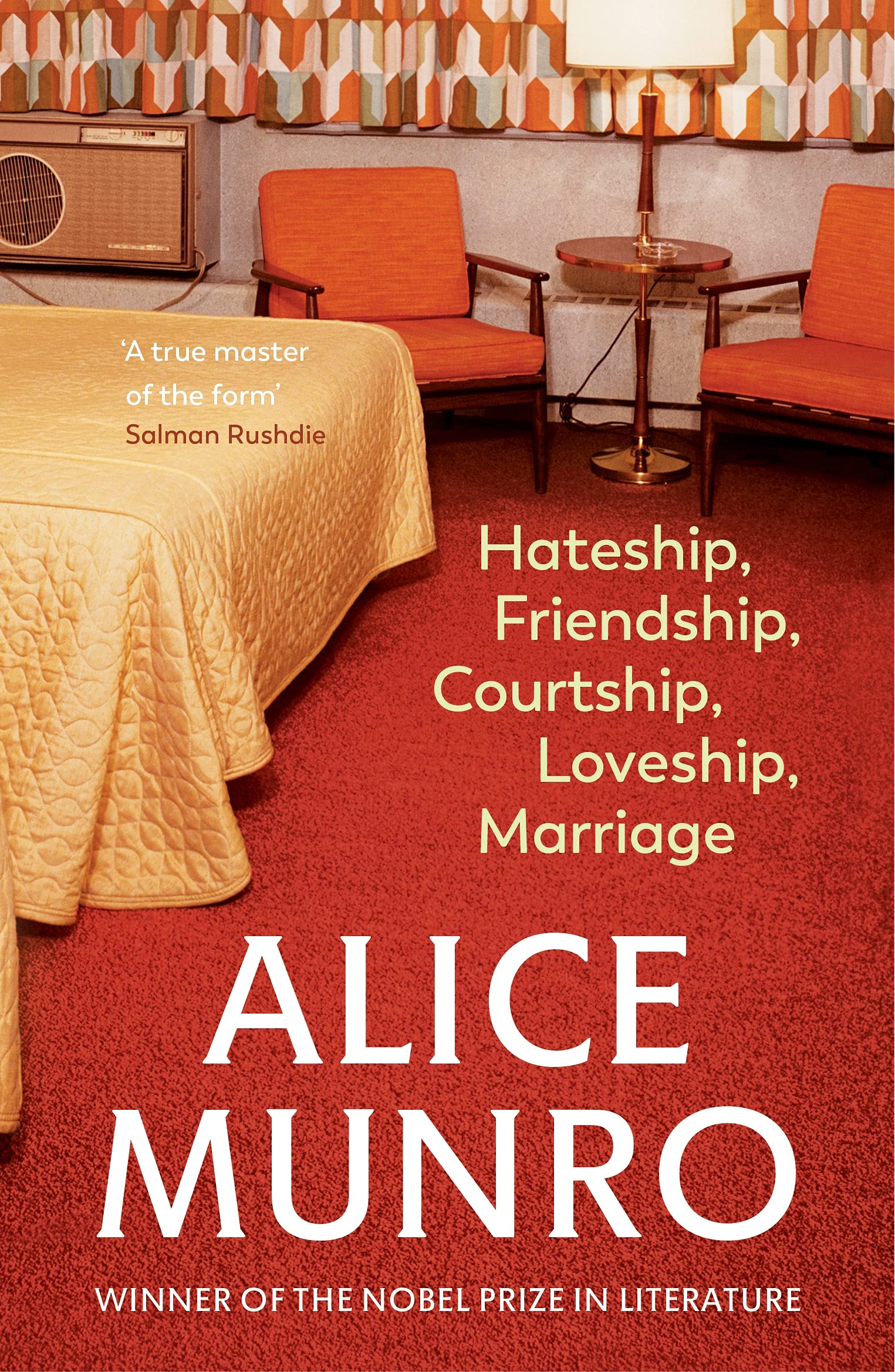
Author: Alice Munro | 336 Pages | Genre: Fiction | Publisher: Vintage | Year: 2013 | My Rating: 9/10
“There’s the intelligent sort of love that makes an intelligent choice. That’s the kind you’re supposed to get married on. Then there’s the kind that’s anything but intelligent, that’s like a possession. And that’s the one everybody really values.“
― Alice Munro, Hateship, Friendship, Courtship, Loveship, Marriage
The novel, Hateship, Friendship, Courtship, Loveship, Marriage, offers a complex look at human relationships with devastating emotional precision. This collection of short stories reads less like a set of plots and more like a series of lived lives, paused at moments where something small tilts and changes everything.
Munro’s genius lies in her attention to the invisible emotions like the subtle humiliations, everyday compromises, half-spoken longings that slowly harden into habit. Her characters are often ordinary people in small towns and unremarkable houses, women tending to domestic routines, men locked into moral inertia, children looking on and misunderstanding. Yet what emerges from these ordinary settings is a startling emotional depth that feels intimate and uncomfortably real.
The title story, “Hateship, Friendship, Courtship, Loveship, Marriage,” begins with mischief and deception and slowly transforms into something almost miraculous. These are stories on resilience and the baffling ways in which people stumble into love. Munro does not romanticise happiness; instead, she portrays it as something awkward, delayed, and often born out of misunderstanding, which somehow makes it feel more true.
Reading this collection feels like being allowed into private rooms of consciousness. Munro’s stories don’t depend on climaxes in the conventional sense. Instead, they accumulate meaning through small gestures like a pause before a sentence, a memory resurfacing at the wrong moment, a realisation that arrives too late. The emotional power of these stories lingers long after you have completed reading the book. It remains with you like a bruise that only begins to ache after you’ve forgotten how you got it.
One of the remarkable qualities of Munro’s writing is her treatment of time. She moves across decades within a few pages, slipping effortlessly from youth to old age, from memory to present, from imagined lives to the ones her characters never lived. In stories like ‘Floating Bridge’ and ‘Family Furnishings,’ time is fluid, looping back on itself in ways that feel closer to the way memory actually works. The past is not a closed chapter; it is a constant, restless presence that presses itself into every decision made in the present.
The women in this collection are particularly memorable because they are not rendered as symbols, but as fully contradictory human beings. They are passive and courageous, bitter and generous, trapped and defiant, and often all at once. Munro does not offer easy feminist triumphs or moral clarity. Instead, she shows the true complexity of women’s lives and the ways they adapt, endure, and sometimes betray themselves in order to survive emotional, social, and economic constraints.
What makes these stories so piercing is Munro’s refusal to provide comfort. There are no tidy resolutions, no sweeping redemptions. People make the wrong choices and live with them, opportunities are missed and cannot be recovered, and love arrives too late or in the wrong shape, and yet there is a strange tenderness in her writing. She does not condemn her characters but describes them with a kind of grave, compassionate clarity.
The prose is clean, restrained, and almost modest. But within this apparent simplicity lies a tremendous control of rhythm and emotional pacing. She knows exactly when to withhold and when to reveal, when to let a scene breathe and when to cut it short. Reading her feels like walking through a quiet house where every floorboard holds a memory, every closed door suggests a life not fully examined.
Hateship, Friendship, Courtship, Loveship, Marriage is also a book about the violence of loneliness. Many of the characters exist in emotional isolation, even when they are surrounded by family. Marriage, in these stories, is not always a sanctuary, and sometimes it is simply a structure people inhabit because there is nowhere else to go. Friendship is fragile, courtship is awkward, laced with misunderstanding, and love is unpredictable and often arrives in disguise.
And yet, what ultimately makes this collection so moving is its deep belief in human endurance and the way people survive suffering. Her characters are not heroes in the usual sense, but they persist, adapt, sometimes fail, sometimes surprise themselves. Life, in Munro’s vision, is not a straight line toward fulfilment, but a winding path of accidents, compromises, moments of clarity, and long stretches of confusion.When you finish this book, there is no dramatic sense of closure. Instead, there is a haunting awareness of how much of life happens in the margins, in rooms like the ones on the book’s cover, in conversations that never quite reach the truth, in choices that seem trivial but reshape an entire future. Munro leaves you with the unsettling knowledge that ordinary lives are not simple; they are vast, complicated, and full of unspoken stories. Reading this collection can leave you with a softened, sharpened sense of what it means to be human. In the end, the novel changes the way you look at lives that resemble, disturbingly closely, your own. And that is its greatest, most unsettling achievement.