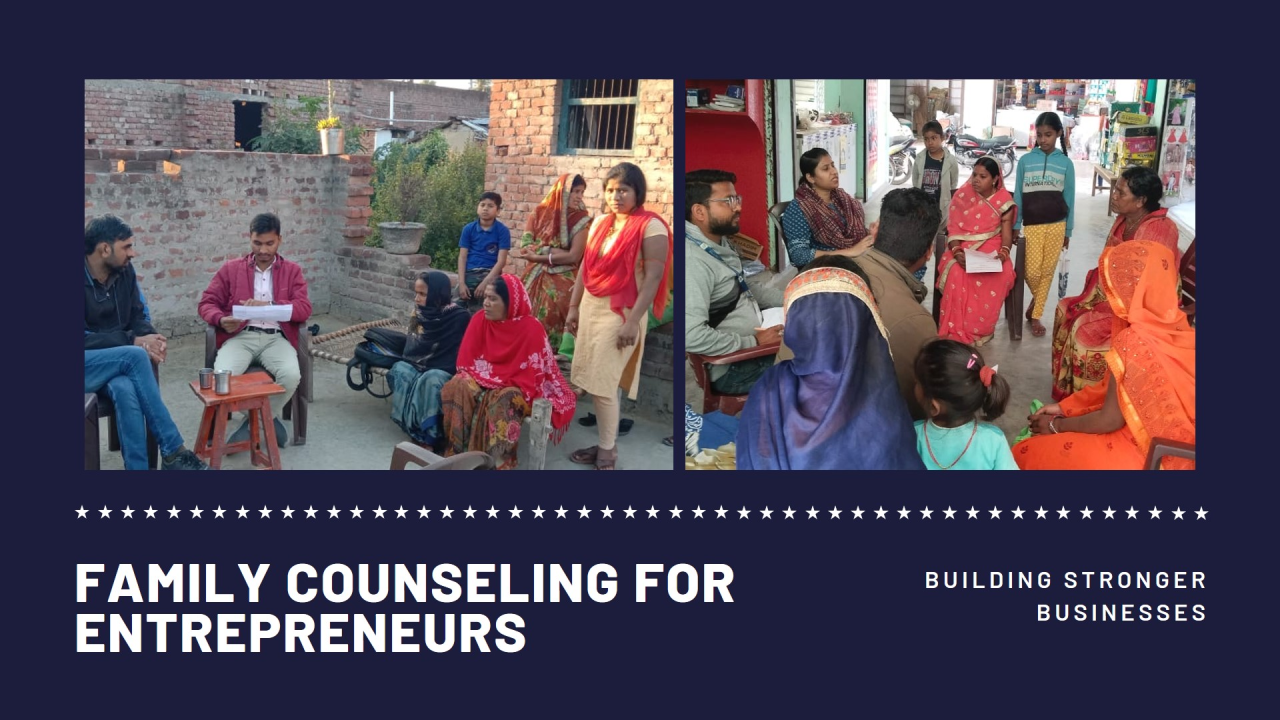
Importance of family counseling in entrepreneur selection

A person requires to possess both ‘can do’ attitude and aptitude for business to start on an entrepreneurial journey. But is that enough? Often an entrepreneur’s success is celebrated as an individual, but seldom the support system in the form of family and friends are discussed due to which the entrepreneur has achieved success. This is irrespective of the nature and size of business, geography, gender and backgrounds of the entrepreneur, and investment that goes in the venture.

While there’s no age to starting a business, the development programs I am working with focuses on women and girls in the age group of 18-50 years from poor and low-income households in the rural areas, with a desire to be self-employed and in future create employment for the youth in their respective villages. Selection processes of such aspiring entrepreneurial women vary depending on the model and approach of the programs. For the conventional businesses existing vocational skills and basic business acumen is analyzed, for others apart from these qualities, level of confidence, ability to invest their time, efforts, and money, general awareness, and other aptitude tests are conducted to measure the eligibility. What remains common across, and I believe is one of the most crucial factors for them to succeed from the word go is the support of their families, which remains the backbone of their ventures during and after the programmatic support. Therefore, post shortlisting of a potential entrepreneurial candidate, family counselling becomes the ultimate decider for her to join the program. And no, it has nothing to do with patriarchy. It’s same for any gender, and I think anywhere in the world. I have been a serial entrepreneur in my past, and have experienced in firsthand that without family support, I could have only done so much.

Family background including the size, type, and economic status can influence entrepreneurs’ and, therefore, entrepreneurship development. Even if the entrepreneurial spirit doesn’t necessarily run in the family, their support plays a vital role in an entrepreneur’s journey. Through their belief, encouragement, constant motivation, and involvement, families provide a nurturing environment for entrepreneurial growth.

In the process of meeting the family at their house in the village and discussing about their current livelihood and income sources, level of education in the household, aspirations and future plans, nature of relationship with the potential entrepreneurial candidate, sharing about the program, and earning their commitment of being the wind  beneath the wings of their daughters, daughters-in-law, wife, and in turn building trust is the main agenda of the family counselling. This support is the most important step and measure for induction of an aspiring candidate in our entrepreneurship program. Garnering this support is half the battle won for the aspiring entrepreneur.

The hard work has to be of the entrepreneur, but families give financial assistance and provides the seed capital for the start-up, provides emotional assistance keeping the morale high during those challenging and difficult times that every entrepreneur undergoes, promote the venture in their long curated networks both within and outside their villages through word-of-mouth, volunteer their time at the business to attend to customers and promotion, and more importantly celebrate even the small moments of joy together.

Apart from money and market, family support is the third pillar of the tripod, which drives entrepreneurial success.

If you want to know more about designing rural women entrepreneurship projects and/or learn about family-counselling for rural entrepreneurship, feel free to connect.

(First published on LinkedIn on 6th March 2024)

Kabul Disco

kabul-discoKabul Disco

by Nicolas Wild | 148 Pages | Genre: Graphic Novel | Publisher: HarperCollins India | Year: 2009 | My Rating: 8/10

“What do I draw?” he asks.

“Make it symbolic by representing the ethnic balance: 45% are Pushtuns, 36% are Tajiks, 12% are Uzbeks, 14% are Hazaras, And then there are a few Nuristanis, of course. Draw some wearing shalwar kamiz with turbans, patoos or pakols. Then others wearing three piece suits. Out of the 300 members, 25% are women.”

“Of course,” he says. Only: “I just wanted to know, what do Pushtuns, Tajiks, Uzbeks, Hazaras, Nuristanisshalwar kamiz, patoos, pakols and women look like?”

– Nicolas Wild, Kabul Disco

Nicolas Wild has written a marvelous satire on the big global business that is Afghanistan and its reconstruction post American bombing of the Country to get rid of Taliban and Osama. This novel thus is an entertaining account of the French graphic artist’s life in the Afghanistan working with a development agency, of international NGOs, coalition forces, nascent democracy and the not-so-diminished Taliban. At times hilariously ridiculous, and at others poignant in its observation of the prevalent times, the book brings to life the contrasting mindsets of the two cultures. Wild captures the pretentious, privileged, vaguely Eurotrash existence of the professional expat do-gooder with a suitably wicked eye. He has hilariously portrayed the protected lifestyles, the local “utility men”, the SUVs, the suspiciously connected American and, of course, the expat party scene. Skillfully he has kept the political references limited to comments on the Bush administration, and sexual tension is kept to a minimum.

This ironical and hilarious graphic novel is my Read of the Week.

Competitive Practices of NPOs

Perhaps the dominant force shaping the non-profit sector at the present time is the widespread commercialization or “marketization” of social and economic life. While commercialization is nothing new to the non-profit sector, in recent years the sector has not only reacted to the market but also embraced it on a scale not previously seen, integrating market impulses into non-profit operations in often creative ways, though with consequences that are not completely clear.

Sources of Market Pressures. the pressures propelling non-profit organizations towards greater engagement with the prevailing market system are multiple. They include declining government financial support, slow growth in private giving, increased service demands from widely disparate population groups, growing competition from for-profit and non-profit organizations, increased accountability demands, and the increasing presence of potential corporate partners.

Growth of Fee Income. In response to this combination of push and pull factors, many more non-profit organizations seem to be reaching out to the market, and on a much broader front. Perhaps the most obvious evidence of this is the growth of non-profit reliance on fees for service charges. But non-profits are also deriving money from the sales of ancillary goods and services, such as merchandise in gift shops and facility rentals.

Social Purpose Enterprises. Non-profits are also integrating the market more directly into the pursuit of their social missions through the formation of “social purpose enterprises,” or “social ventures.” These hybrid organizations use market means to pursue non-profit objectives. Here the market is not simply a source of revenue but a preferred vehicle through which to achieve a social purpose.

Corporate Partnerships. Non-profits are being drawn further into the commercial orbit by alliances with the corporate world. Businesses have found that teaming up with non-profits adds respectability and trust to their images while cultivating new markets, new sources of employees, and new pools of research and expertise. In exchange, corporations donate money, form employee volunteer programs, sponsor events, loan out executives, and provide equipment, space and contacts.

Incorporation of the Market Culture. As they have come to operate in an increasingly competitive, market-oriented environment, non-profits have also increasingly absorbed the culture and manner of the market into their internal structures and operations. Non-profits are no longer bashful about aggressively advertising their services or competing for charitable contributions. Indeed, they have become increasingly “entrepreneurial,” worrying about their “market niche” and engaging in “strategic planning.” Agencies are increasingly adopting performance measurement techniques, adopting smaller, corporate-style boards, and building more elaborate organizational structures.

A New Enterprising Social Sector. Emerging from these various developments is a new picture of the “social sector,” a picture of a self-propelled set of organizations loosened from their original moorings in charity or as a passive agent of government and much more closely connected to the market system, while still somehow tied, however tenuously, to the pursuit of public benefit. Unquestionably, the non-profit sector has gained many advantages from this closer association with the market. Marketization has offered the non-profit sector access not only to an enlarged resource base but also to the energy and creativity that the market system has long represented. Armed with earned income, non-profits may become more fully independent than either government support or private charity has made possible. Engagement with the market also opens possibilities for leveraging enormous private resources and talents for social purposes, and for erasing widespread images of non-profit ineffectiveness, establishing instead the image of a set of organizations that has learned how to bring the most efficient means to the service of the most valued ends.

But if the potential advantages of the non-profit sector’s embrace of the market are considerable, so too are the risks. Market pressures can undermine non-profits’ commitments to their core values, to doing what is right as opposed to what is popular or commercially viable. They can also threaten the sector’s public support if efforts are not made to keep the public engaged and informed.

The solution to these problems may not lie either in restricting the commercial involvement of the non-profit sector or in relying blindly on the restriction on distribution of profits to ensure appropriate non-profit performance. Rather, more direct mechanisms of control may be desirable—performance measurements and mechanisms that empower key stakeholders, such as donors or the users of non-profit services. Under any circumstances, while it is essential to keep the challenges posed by the market clearly in view, it would be foolhardy to let the opportunities it presents to the non-profit sector go unexplored.