Quantum Impact
November 23, 2026 Leave a comment
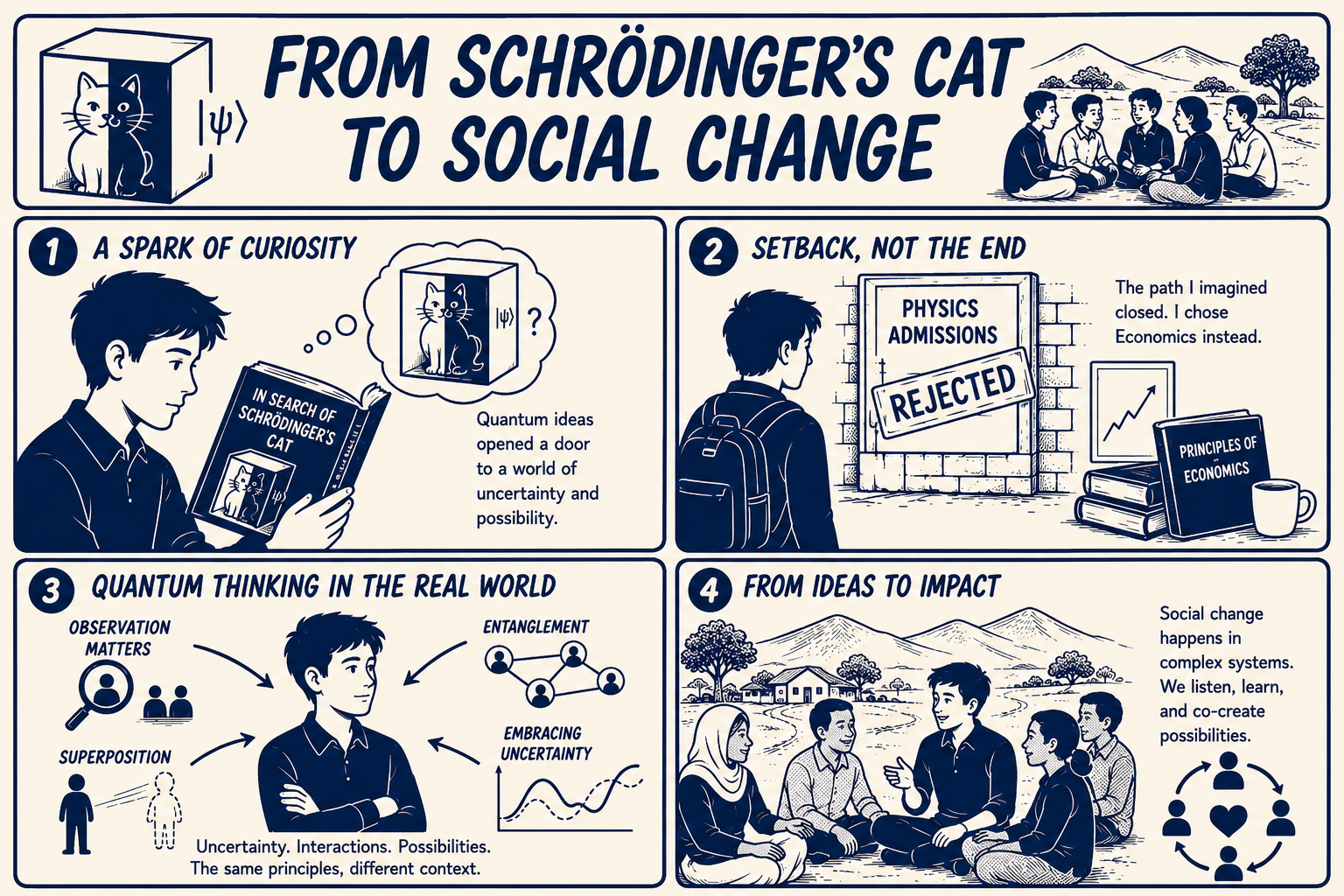
As a Grade XI student in 1993, I came across a book, In Search of Schrödinger’s Cat, that permanently altered the architecture of my mind. The book opened a door to a world where certainty dissolved, where particles could exist in multiple states, and where reality itself seemed negotiable. For a teenager raised on the deterministic logic, this was fascinating! What began as curiosity soon developed into an obsession. Over the next two years, I devoured every book on quantum theory I could find in my school library. I was not satisfied with the surface-level wonder of paradoxes, as I wanted to understand the underlying mechanics.
Looking back, I realise that my engagement with Quantum Mechanics was not entirely conventional. I was less interested in solving textbook problems and more drawn to the foundational questions, such as, Why does this framework work? Where does it break? What lies beyond it? At some point, perhaps driven by my youthful audacity, I concluded that the existing mathematical tools had not evolved sufficiently to fully capture the quantum reality. I filled my notebooks with equations, diagrams, and speculative constructs. I wrote what I believed were papers on field theory, attempting to unify ideas I barely understood but deeply intuited. There was no mentor, no peer group, no formal validation, just a teenager with a set of ideas, and an overwhelming sense that something profound was within reach.
When the time came to pursue undergraduate studies, I was unable to secure admission into the Physics program of the University I wanted to attend. It was a defining moment as the path I had imagined for myself, of becoming a quantum physicist, closed with a dramatic failure overnight. I chose to study Economics instead, and at that time, it felt like a compromise, perhaps even a detour. But life has a way of revealing continuities where we once saw disjunctions. While I moved away from formal engagement with physics, the mode of thinking that quantum theory had instilled in me migrated instead of disappearing.
Economics, especially as it is practiced in the real world of development, is far from the neat equilibrium models of textbooks. It is messy, dynamic, and deeply uncertain. Years later when I began working in social and economic development, particularly in rural contexts, I encountered systems that defied linear logic. Interventions did not produce predictable outcomes, human behaviour was not always rational, and small changes could trigger disproportionate effects, while large investments sometimes yielded little.
In other words, I was no longer dealing with particles, but I was still dealing with uncertainty, probability, and complex interactions. Over time, I began to recognise that my early engagement with quantum theory had given me a cognitive advantage in terms of comfort with ambiguity. Where others sought deterministic answers, I was more willing to engage with probabilistic thinking. I looked for underlying patterns of interaction rather than linear cause-and-effect, where systems appeared chaotic.
This orientation became particularly significant in my work on social development programs. One of the persistent challenges in this field is achieving sustainable behavioural change. Traditional approaches often assume that providing resources or information will lead to predictable outcomes, but reality resists such simplicity. Communities are not passive recipients, rather they are dynamic systems with their own internal logics, histories, and feedback loops.
At its core, quantum theory teaches us that observation matters, that the act of measurement can influence the system being observed. In social development, this translates into a recognition that interventions are not neutral. The presence of an external actor, be it a government agency, NGO, or researcher, alters the dynamics of the community. Outcomes are co-created and not merely delivered.
Similarly, the idea of superposition, the coexistence of multiple potential states, finds an echo in human behaviour. Individuals and communities often exist in a space of latent possibilities. They are not fixed in a single state but can transition under the right conditions. Development, then, is not about imposing change but about enabling transitions between states. Even the concept of entanglement, so central to quantum theory, has a metaphorical resonance in social systems. Individuals are not isolated units, and their choices and outcomes are deeply interconnected. A change in one part of the system can ripple through the network in unexpected ways. This is where fields like Complex Systems and Network Theory intersect with development practice, and where my intellectual journey seems to come full circle.
Of course, I am careful not to overextend these analogies. Social systems are not quantum systems, and metaphors can only go so far. But they serve as cognitive bridges, helping us think differently about persistent problems. There is also a more personal dimension to this story. For many years, I carried a sense of an unfinished business, a feeling that I had come close to something meaningful in my teenage years, only to have it slip away. But with time, that narrative has softened, and I no longer see my early engagement with physics as a failed beginning. Instead, I see it as a foundational layer, one that developed a scientific temper in me and shaped how I perceive, question, and engage with the world. The teenage boy trying to invent a new mathematics was, in his own way, grappling with complexity, uncertainty, and the limits of existing frameworks. The adult me working in social development is engaged in a similar struggle, just in a different domain.
The lesson I carry from this journey is that our early passions do not disappear, they just evolve over time. They may not always find expression in the forms we initially imagine, but they leave subtle, persistent, and often transformative imprints. The language of my teenage years was quantum physics, and of my professional life is social and economic development. But beneath both lies a shared grammar, a way of thinking that embraces complexity, question assumptions, and remains open to the possibility that reality is far richer than our current models can capture. Perhaps the true purpose of my deep interest in Physics was to train a young mind to think beyond boundaries, to be comfortable at the edge of the known, and to venture, however imperfectly, into the unknown. In that sense, the journey did not end, it simply changed domains.
If this article made you think differently about your own journey, interests, love for physics, or social impact, subscribe to my blog for one article every week in your mailbox. It’s free!
(Cover image has been generated using AI)