Economics of Diwali

As we celebrate the sparkle of Diwali festivities with lights, the Indian economy, too, is glowing with festive energy. Diwali is not only a cultural and spiritual event but also an economic phenomenon that mobilizes consumption, trade, and emotion on a scale unmatched by any other festival in India. It is a festival where faith, finance, and family come together to illuminate not just homes but entire markets.

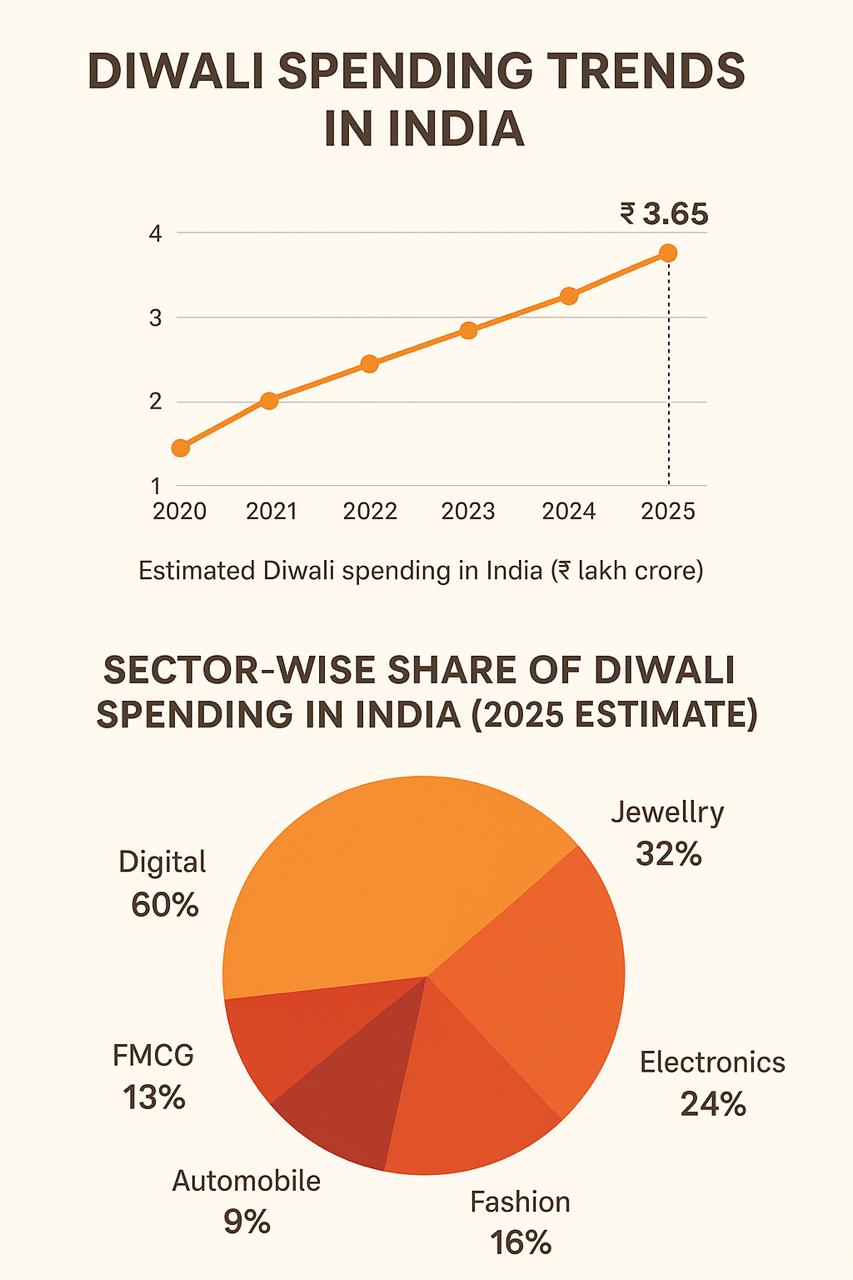
Diwali blends culture and commerce. Traditionally marking the return of Lord Ram to Ayodhya after 14 years of vanavasa (exile), the festival has evolved into India’s largest consumption cycle. According to industry estimates, Diwali season alone accounts for 30–40% of annual sales in sectors like jewellery, automobiles, electronics, apparel, and consumer goods.

In 2024, India’s festive spending during Diwali week was estimated at INR 3.2 lakh crore, reflecting a 17% rise over 2023, driven by rising disposable incomes, pent-up post-pandemic demand, and digital retail penetration. Retail chains, e-commerce platforms, and even microenterprises depend on this period to recover annual profits. For small traders, Diwali is often the difference between a good year and a bad one. The festival also synchronizes the Indian economy’s emotional rhythm—consumer sentiment peaks as the festival approaches, heightened by work bonuses, gifts, and an almost cultural belief that new purchases bring prosperity.
Two days before Diwali, Indians celebrate Dhanteras, considered the most auspicious day to buy gold, silver, or anything of value. Historically, this practice was rooted in agrarian prosperity cycles during which, farmers who had completed the harvest season invested their earnings in tangible assets like metals. Today, the sentiment remains, but the scale has exploded. The symbolism has migrated from the vault to the marketplace, aligning tradition with modern consumption.

Diwali’s economic landscape has been radically redrawn by digital commerce. In 2024, online festive sales crossed INR 90,000 crore, driven by e-commerce platforms like Amazon, Flipkart, and Meesho. Tier-II and Tier-III cities accounted for more than 60% of new shoppers, an indication that India’s digital inclusion is now deeply linked with its festive economy.

Algorithms have replaced astrologers in predicting purchasing patterns. AI-driven recommendations, influencer marketing, and digital payment ecosystems like UPI have made the act of buying faster and impulsive. While urban consumers enjoy massive discounts, small offline retailers struggle to match online prices. Many traditional businesses like sweet shops, garment stores, and gift outlets are now adapting with hybrid models, selling on WhatsApp or through community platforms. The local bazaar is not dying; it is simply going online.

Behind the glitter of malls and advertisements lies a quieter but equally powerful story of the informal and rural economy that powers Diwali. Across India, millions of artisans, potters, weavers, and small manufacturers depend on the season for a significant portion of their income. From handmade diyas in Bihar to terracotta idols from Bankura, paper lanterns in Maharashtra, and bamboo crafts from Northeastern states, Diwali sustains local creative economies that embody both tradition and entrepreneurship. In recent years, several NGOs and social enterprises have helped rural producers connect directly with urban buyers through digital platforms. For instance, self-help groups (SHGs) supported by government programs like NRLM (National Rural Livelihoods Mission) and private CSR initiatives now sell festive handicrafts on e-commerce sites and social media. The “Make in Village” movement during Diwali is becoming a quiet counter-narrative to imported mass-produced goods. Every diya sold is not just a source of light but a livelihood.

Gifting is central to Diwali’s economic ecosystem. From corporate gift hampers to sweets exchanged among families, the ritual symbolizes goodwill, reciprocity, and status. In 2024, India’s corporate gifting industry was valued at ₹12,000 crore, with strong growth projected for 2025. Beyond sweets and dry fruits, companies now gift experiences like wellness vouchers, eco-friendly hampers, and handmade products to reflect social consciousness and sustainability. The gifting economy also reveals deeper social psychology. Gifts during Diwali are not just commodities; they are currencies of relationship. In economic terms, they create “social capital”, the trust and goodwill that sustain business and personal networks alike.

In last decade or so, Diwali’s environmental impact has come under scrutiny. Delhi is the best (or worst) example of this intense air pollution from firecrackers making the environment unbreathable, plastic waste from packaging, and excessive electricity consumption have led to rising calls for a Green Diwali. The market is responding with conscious choices. In 2025, the sale of eco-friendly crackers and biodegradable decorations is expected to grow by 30%. Solar-powered lighting, organic sweets, and recycled packaging are becoming mainstream. Conscious consumers, especially younger urban Indians, are now demanding sustainable alternatives that align celebration with responsibility. The shift from conspicuous consumption to conscious consumption marks a new chapter in the economics of Diwali, one where prosperity is measured not just by spending, but by sustainability.

However, Diwali’s prosperity is not evenly distributed. Inflation affects the purchasing power of lower-income families who often face higher food and fuel prices during the season despite the recent GST reforms, which has significantly brought down the prices of most of the consumer goods. While the urban affluent splurge on gadgets and gold, many households cut back on essentials.

This divergence reflects the broader K-shaped recovery post-pandemic of the Indian economy, where upper segments surge ahead while those on the lower segments struggle. The festive glow, though radiant, hides shadows of inequality. For small retailers, rising input costs and competition from online giants have squeezed margins. For daily wage earners, the festival may mean temporary income spikes but little long-term security. Diwali illuminates both the promise and paradox of India’s growth story.

At its core, Diwali celebrates renewal of hope, homes, and human spirit. Economically too, it acts as a reset button for the nation’s consumer sentiment. The act of cleaning homes, buying new things, and lighting lamps mirrors the cyclical nature of economic optimism. For policymakers and economists, the festive season is a real-time barometer of demand. For families, it’s a reminder that prosperity is not just about wealth, but about togetherness and gratitude. In many ways, Diwali teaches an enduring lesson in economics that growth is sustainable only when it is inclusive, joyful, and mindful.

The economics of Diwali is not just about expenditure, but it is also about the exchange of energy, emotion, and enterprise. It reflects India’s evolving story of modernization rooted in tradition, digital transformation anchored in ritual, and capitalism softened by culture. The future of India’s festive economy will shine brightest when it balances profit with purpose, growth with gratitude, and consumption with conscience.

Gold Rush

As the festive season in India is ongoing, jewellers across India are ready, investors tracking bullion prices, and families waiting eagerly for the most “auspicious” day of the year to buy gold. Dhanteras, celebrated two days before Diwali, has long been associated with the purchase of the precious metal, a tradition believed to bring prosperity and good fortune. Similar buying frenzies occur during Akshaya Tritiya, weddings, Karwa Chauth, and harvest festivals, when gold is not merely an adornment but a cultural marker of wealth and status.

Market reports celebrate the crores spent, but beneath the sparkle lies a complex story of culture, aspiration, and economics. Is festival gold-buying a timeless symbol of financial prudence and cultural continuity, or is it a cycle of consumption propelled by social pressure, marketing, and habit?

India’s love affair with gold is centuries old. From the time of the Indus Valley civilisation to the Mauryan emperors to our modern nuclear families, gold has been a medium of exchange, a store of value, and a token of spiritual significance. For millions, gold is not just metal, it is Lakshmi, the goddess of wealth herself. Dhanteras literally means “the thirteenth day of wealth,” and families believe that buying gold on this day invites abundance.

This cultural reverence made economic sense in a pre-banking era. Gold’s intrinsic value and portability provided a hedge against famine, emergency, and currency devaluation. Rural households, lacking access to formal savings mechanism, used jewellery as insurance and collateral. Even today, India remains the world’s second-largest consumer of gold, with annual demand often exceeding 700–800 tonnes. For many, gold remains the most trusted form of intergenerational wealth transfer.

Yet, today’s festival buying is no longer just about family heirlooms or prudent savings. It has evolved into a multi-billion-rupee economic event. According to trade bodies like the All-India Gem and Jewellery Domestic Council, Dhanteras sales often spike by 20–25% year-on-year, depending on price trends. In 2024, for example, despite gold hovering at record highs of around INR61,000 per 10 grams, jewellers reported robust demand, with many urban consumers opting for lighter designs or digital gold to keep up with tradition.

Specific estimates for festival (especially Dhanteras) sales in recent years help show the proportion of demand tied to ritual buying. During Dhanteras in 2024, around 20-22 tonnes of gold were sold, worth nearly INR 16,000 crore. The full jewellery sector during the festival period saw sales in the INR 18,000-20,000 crore.

The annual figures show India’s gold demand continues to be immense, though shifting in nature,

  • In 2024, India’s total gold demand rose to around 802.8 tonnes, up from 761 tonnes in 2023.  
  • The value of gold purchases in 2024 was estimated at INR 5.15 lakh crore (~US$60-70 billion depending on gold price).  
  • Jewellery demand in 2024 was ~ 563 tonnes, with the non-ornamental purchases (coins/bars) making up ~ 239 tonnes.   

These numbers reflect overall demand, not just festival or Dhanteras purchases, but festivals remain a major driver. The data show that although overall demand has often crept upward in value terms (driven by price inflation), the volume of jewellery demand has at times fallen or stagnated. For example, in 2024 jewellery tonnage demand dropped ~2% compared to 2023 even as value increased.

Targeted marketing plays a huge role. Advertisements link gold to auspiciousness and emotional milestones, “Gift prosperity,” “Secure her future,” “Start your Diwali with gold.” Social media influencers and celebrity endorsements reinforce the message that a festival without gold is incomplete. This creates a powerful psychological loop: buying gold is not just desirable, it is expected.

The Dhanteras gold rush is fuelled by a mix of fear and aspiration. Gold retains a near-mystical aura as a hedge against uncertainty. Global financial instability, inflation, and geopolitical tensions often send prices higher, reinforcing the perception of gold as a “safe haven.” For middle-class families, a few grams bought every year feels like both a celebration and a safety net.

But there is also the quieter pressure of status. Weddings, festivals, and social gatherings often showcase jewellery as a measure of success. The fear of “falling behind” relatives or neighbours can nudge families, especially in smaller towns and rural areas, into stretching budgets and even getting into debt trap to maintain appearances. What was once a hedge against uncertainty can change into a source of financial strain.

From a macroeconomic perspective, India’s gold obsession is a double edged sword. While the jewellery industry supports millions of jobs, from miners to artisans to retailers, it also represents a massive outflow of capital. India imports more than 90% of its gold, spending billions of dollars in foreign exchange each year. Economists have long argued that this “dead investment” locks up household savings in a non-productive asset, diverting funds from sectors like manufacturing, infrastructure, or technology that could generate higher returns and employment.

For individual households, the opportunity cost is equally significant. A family buying gold at festival-time may forgo investing in equity markets, mutual funds, or even bank deposits that could provide compounding growth. Gold prices, while generally stable over the long term, are not immune to volatility as we are witnessing now with gold prices rising to INR 120K+ per 10 grams. The metal offers no dividends or interest; its value lies only in resale or emotional satisfaction.

Beyond economics lies an often-ignored cost, the environmental impact of gold mining. Extracting gold is an energy-intensive process that generates toxic waste and contributes to deforestation, soil erosion, and water pollution. Globally, gold mining is associated with mercury contamination and significant carbon emissions. While India imports much of its gold, domestic refining and artisanal mining also pose environmental challenges.

Consumers rarely connect their festival purchases to these ecological consequences. The cultural narrative of purity and prosperity masks the fact that every bangle and coin carries a hidden footprint. Ethical sourcing, such as recycled gold or fair-trade certifications, is slowly gaining traction among urban, environmentally conscious buyers, but remains a niche segment.

As India’s economy digitises, a quiet transformation is underway. Younger consumers, especially in cities, are exploring alternatives to physical gold. Digital gold platforms, gold exchange-traded funds (ETFs), and sovereign gold bonds (SGBs) allow individuals to invest in gold without worrying about purity, storage, or theft.

These products offer flexibility and sometimes better returns. Sovereign gold bonds, for instance, pay annual interest and are exempt from capital gains tax if held to maturity. Yet they also challenge the cultural core of gold-buying: there is no ornament to wear, no glitter to display, no festive ritual of walking into a jewellery shop on Dhanteras. For many families, the emotional experience is as important as the investment itself. Still, the shift is undeniable. Digital gold platforms have reported double-digit growth during recent festivals, particularly among younger investors who value convenience and liquidity over tradition.

So where does this leave the Indian consumer? To dismiss festival gold-buying as mere superstition would be simplistic. Traditions provide continuity, identity, and joy. For rural households with limited access to financial products, gold remains a practical and trusted savings tool.

But to ignore the economic, environmental, and social pressures embedded in this ritual is equally shortsighted. When a practice once rooted in prudence becomes a compulsive annual expense, it risks becoming a trap. The symbolism of prosperity can mask financial strain, and the celebration of abundance can conceal environmental degradation. Festivals can retain their joy without becoming economic burdens. A few grams of gold bought with intention, rather than compulsion, can honour tradition while respecting modern realities.

Dhanteras will always hold a special place in the Indian calendar. The sight of families entering jewellery shops, and elders blessing the new purchase is undeniably heartwarming. Yet it is worth remembering that true prosperity lies not in the weight of gold but in the wisdom of choice.

As India strides into a digital, climate conscious future, perhaps the most auspicious act is not buying more gold, but buying it mindfully acknowledging its beauty, its history, and its hidden costs. The goddess of wealth, after all, smiles brightest on those who balance tradition with thoughtfulness.

Buy thoughtfully. Celebrate responsibly. Live consciously.

Algorithmic Self

In today’s digital landscape, our identities are increasingly shaped by algorithms. These complex sets of rules and calculations determine the content we see on social media, the advertisements we encounter, and even the news we consume. This phenomenon, often referred to as the ‘algorithmic self,’ highlights the interplay between technology and personal identity. Algorithmic mechanisms on digital media are powered by social drivers, creating a feedback loop complicating the role of algorithms and existing social structures. 

At the core of the algorithmic self is the idea that our online behaviours and interactions feed into algorithms that, in turn, influence our future actions. Are we becoming the people our feeds want us to be? Scroll long enough on social media platforms like Insta, Tube, or FB and you’ll notice that the content feels uncannily tailored to you. Your feed seems to know what you crave before you do, an oddly perfect mix of travel destinations, recipes, memes, news, workouts, and political takes. This can lead to a more personalised online experience, but it also raises questions about the extent to which our choices are truly our own. What began as a convenience has evolved into something far more consequential. We are not merely using algorithms anymore; we are slowly becoming the selves they design for us.

Algorithms are built to predict and keep us engaged. Every click, pause, like, or scroll is recorded and analysed. In return, the system feeds us more of what we have already consumed. This sounds harmless. After all, who wouldn’t want relevant recommendations? But personalization is never neutral. When a platform rewards the content that hooks us, it amplifies our biases and shrinks our curiosity. Over time, the feedback loop begins to define our worldview, narrowing the range of opinions, art, music, or even relationships we encounter.

The unsettling part is that the algorithm’s goal is not truth, diversity, or personal growth. It is engagement. If desire makes you scroll, it will serve you love. If envy fuels your clicks, it will curate envy-inducing lifestyles. What feels like a reflection of your taste is often a reflection of what keeps you online.

Human behaviour is always shaped by culture, but algorithmic influence is different in speed and precision. Traditional media might set trends, but it never recalibrated itself in real time for every individual. Today, AI systems track micro-reactions—how long your eyes linger on a video frame, how quickly you swipe away, and adjust instantly.

This raises a disturbing question. When you decide to buy a product, support a social cause, or adopt a new hobby, how much of that decision is you, and how much is a carefully engineered nudge? We still feel autonomous because the algorithm rarely forces choices. Instead, it quietly limits what enters the realm of possibility. You can’t choose what you don’t see. Is this the erosion of free will?

Living in an algorithmic world also reshapes identity. Our “digital selves” are rewarded for consistency. The more we like certain posts, the more similar content we receive, and the more we feel pressure to maintain that version of ourselves, whether it’s the fitness enthusiast, the foodie, the activist, or the minimalist. The feed trains us to be predictable because unpredictability breaks the machine’s efficiency.

The rise of the algorithmic self also brings about ethical considerations. There are concerns about privacy, as the data collected to fuel these algorithms often includes personal and sensitive information. Additionally, there is the issue of transparency. Many algorithms operate as ‘black boxes,’ with their inner workings hidden from users. This lack of transparency can make it difficult to understand how decisions are being made and to hold platforms accountable for their actions.

Many people feel a subtle dissonance, their offline preferences drift, but their online persona stays fixed. We perform for the algorithm, optimizing captions, hashtags, even our emotions, to remain visible. Our feeds don’t just reflect who we are, they encourage us to stay who we were yesterday.

But then how do we break the loop?  The answer is not to reject technology altogether. Algorithms are not inherently evil; they can help us discover music, connect with communities, find a job we want, or learn skills we might never find on our own. The challenge is to reclaim agency within the system.

Practical acts of resistance can be quite simple, like, disrupting the feed by clicking on unfamiliar topics or following people outside your cultural bubble; time-box social media use or schedule ‘algorithm-free’ days; read newsletters or listen podcasts where engagement isn’t the primary metric. There could be several other ways to disrupt and reintroduce randomness. However, the most important step, is awareness. Algorithms will always evolve faster than regulations or ethical guidelines. The only lasting defence is a conscious user, someone who understands that every scroll is a form of training data.

The algorithmic self represents a significant shift in how we navigate our identities in the digital age. The question is not whether technology shapes us. It always has. As we continue to integrate technology into our daily lives, it is essential to remain mindful of the ways in which algorithms shape our identities and to advocate for greater transparency and ethical considerations in their design and implementation. The real question is whether we allow a handful of opaque systems to quietly define what we desire, believe, and become. If we don’t actively resist, our algorithmic selves may thrive while our authentic selves quietly disappear into the feed.

Bamboo: The Green Gold for Poverty Reduction and Rural Growth

India has huge natural bamboo stocks that have been an integral part of Indian culture for many millennia. Bamboo in many ways is the mainstay of the rural Indian economy, sparking considerable social and ecological spin-offs. In the early part of the century, large tracts of bamboo occurred in many parts of the country but were treated by the forestry sector (which was then cast in a production forestry mode) as a weed of little economic value and was used mostly by the rural communities for crafts, making implements and as housing material. It was the discovery of bamboo as a source of long-fiber by the Forest Research Institute in Dehradun that started the process of using bamboo in a variety of industrial applications, so far unexplored, with several paper mills and rayon mills being set up. But in the absence of a clear policy there was rapid degradation and decimation of the resource in much of the country. Bamboo resources plummeted so alarmingly that at present the resource is limited to few pockets in the country. Two-thirds of the bamboo in the country is restricted to the North-Eastern Region (NER) while the remaining one-third is spread across the country.

But there is hope for the resurgence of bamboo, and this is based on evidence of significant new and contemporary economic opportunities that have emerged over the past decades. A bamboo revolution that holds the potential of reversing economic downturns and ensuring profitability, is very much possible.  Bamboo is an untapped avenue of economic growth, and a burgeoning bamboo sector can rope in prosperity, profits, and sustainable livelihoods.

Despite the severe degradation of the resource in the past, India still has a considerable growing stock of bamboo, and comparative annual harvest figures[1] still place India at the top of the global league. It is important to realize the considerable latent potential that bamboo has to contribute to economic growth, poverty alleviation, generating employment, rehabilitating vast tracts of degraded land generated due to past agricultural and industrial practices and policies, and revitalizing the social, economic and ecological well-being of rural economies.

In line with this, goals should be aimed at focusing on recovering the resources lost to the rural poor as it has been a natural capital that has helped them to keep their economies afloat even in times of significant cash crunches. Attempts should be made to replenish bamboo stocks, make it economically beneficial to rural communities in a way that it provides them opportunities to earn a sustainable income and improve their standard of living. Efforts should also be made to increase the economic opportunity from the use of bamboo as an industrial raw material, to raise employment opportunities (especially for the educated and unemployed rural youth), and to rehabilitate the degraded lands across the country (making available and productive a natural resource which is increasingly becoming scarce and expensive).

Over the years a variety of strategies have been developed to reduce the poverty of rural and rurban population through small enterprise development, based on various forest produce. In rural areas, the poor are overwhelmingly dependent on natural resources and in most cases, it is the only capital they possess. They have little power or ability to climb out of poverty. They are not only financially poor, but also opportunity-and knowledge-poor. In this respect, bamboo is one of the few natural resources that could provide a lifeline to sagging rural economies and help integrate them into the market economy. As bamboo is not one commodity but the fountainhead of many products, it could open up a number of markets simultaneously for the rural poor with the added advantage of being a low-risk option.

The bamboo sector also forges personal links with the rural community, allowing them to participate closely in production processes and directly access profits through value addition as compared to other industrialized processes. As the sector is dependent to a large extent on manual labour, it demands many hands to contribute to the cultivation, harvesting, preservation and value-added manufacturing processes. The upshot is that it provides livelihood options in varying activities to a large number of rural workers. This is the main reason why developing countries find it more viable to be involved with the sector whereas developed countries prefer becoming consumptive markets for these very products. Women in particular stand to gain from this sector as they secure means of livelihood due to their dexterity with the material and their ability to shape it into products and more important, they gain from the flexible work hours this sector affords. Bamboo can thus break marginalization through empowerment and also bridge gender divides.

Employment generation and livelihood creation are enabled through strong backward integration of bamboo production and processing. Though tree-like in stature, bamboo is best grown and managed like an agricultural crop or managed as such within the forest. This needs labour input, which calls for significant people involvement. Again, volume production in bamboo is achieved through a large number of unit poles, unlike timber where one large log provides a substantial quantity of wood. But on the other hand, the lightweight poles enable people participation in its transport. Furthermore, the easy linear splitting ability of bamboo, quite unlike that of wood, enables primary processing for a final industrial product to be undertaken by the rural community. The above properties lay the economic basis for definite win-win community-industry partnerships in bamboo, with the bamboo being managed or grown, and primary processing undertaken by communities in rural areas.

Experience has shown natural resources can be harvested sustainably if people stand to benefit from it. The development of bamboo as a cash crop will result in the conservation and protection of the existing resource, and the scaling up of cultivation, which would be a natural outcome of the increased cash value of the resource, as against its present low cash to mere-subsistence value. The environmental benefits from the economic development of bamboo can be very significant.

As a resource that can be harvested annually, it could provide a regular supply of construction material to the communities. If the use of wood could be replaced with that of bamboo, it could reverse the process of severe and rapid degradation of forests and forest cover. Bamboo also helps protect soil from erosion, especially in the upland areas. Bamboo should also be strategically grown to reduce or prevent soil cutting from riverbanks, which is perhaps the major cause of siltation of riverbanks, resulting in reduced carrying capacity of rivers and flooding during the peak rainy season.

In last 3-4 decades, intensifying patterns of land and resource utilization, primarily due to pressure from the rapidly increasing population, have caused land and natural resource degradation in many parts of India. Bamboo is an ideal resource for rehabilitation, even in extremely degraded situations such as land used for brick making.

India with its rich potential of bamboo resources has only just started to develop bamboo marketing and trade.  However, the significant bamboo resources in India make it ideally placed to benefit from the experience of China and other countries around the globe. Bamboo holds within it the promise of bailing people out from below poverty line levels.

Bamboo finds many uses today in addition to its conventional uses for handicrafts, scaffolding and the paper industry.  It can be used as construction material, as a wood substitute and as food, fuel and a filtration medium. Its real contribution to housing lies in the dual role it can play – of providing a cheap and affordable wood alternative to the homeless while at the same time generating livelihood options for those involved with it.

Bamboo can propel economic growth through increased local production and the sale of high-value wood-substitute products, especially in bamboo-rich states. Robust local production of a local natural resource capital like bamboo will lead to the retention and circulation of cash within the state economies itself, rather than the cash flowing out for purchase of goods from outside the state. Export of cash value-added bamboo products to markets outside the bamboo states could enable incremental cash earnings that will add to the economic growth of the state. Asset creation and local consumption can get a fillip from the increased circulation of money within the state economy from local consumption of locally manufactured products. This consumption will be enabled not only by government purchases, but also as a result of the higher disposable incomes that will be generated.

In India, as elsewhere in other developing countries, strong correlative linkages exist between economic growth, rural poverty and the environment. Firstly, the poor are more vulnerable to the health effects of pollution because of their inadequate nutrition, poor access to health care and their unhealthy living environment. Secondly, the poor are affected faster by degradation of natural resources because of their greater reliance on them to meet basic needs. Environmental degradation, in turn, adversely affects the economy’s capacity to grow, because growth relies on the sustainable productivity of natural resources and the health of the population.

It is a vicious circle, which can be broken through a growth solution that is not only income generating for rural communities but also environmentally sound. Bamboo, a natural resource and one that protects the environment, enables the development of industries, which function through a symbiotic linkage between small and large enterprise that significantly benefits the community. 

Bamboo is available throughout the country barring the states of Jammu and Kashmir and Rajasthan (except for some areas). Existing traditional bamboo and cane handicraft products, though not many, could be improved, diversified, produced along industrial assembly lines and converted into value-added products that are already a part of mainstream industry. Value additions could be made to its use in the paper industry and its use in the unorganized scaffolding industry can be doubled.  Simultaneously, other mainstream micro and small enterprise products such as matchsticks, pencils, toothpicks, skewer sticks, and blinds, as well as medium-scale industrial panel products that rival wood products, with strong backward community linkages and benefits can be explored. An increase in bamboo products and market opportunities will also result in increases in demand for raw bamboo, besides the production of fresh bamboo shoots and their processed products. There is considerable potential to set up medium and large-scale industries for generating value-added food and wood-substitute products for export markets.

The value-added bamboo industry is ideally placed to adopt that model. Given the right policy atmosphere and thrust, the value-added bamboo industry in India has the potential of reaching a size of USD 2.3 billion (USD 131.5 billion globally) in the next 10 years with a CAGR of 10.3%, employing 11-15 million people in the primary, secondary and tertiary sectors[2].

The bamboo industry also fulfils the criteria needed by sectors that aim to achieve double-digit economic growth. Bamboo has a very strong and direct with rural communities, which would allow them to partake directly and in a more significant way to value addition as compared to other industrialized processes. The value-added bamboo industry thus provides an integrated solution that uses an abundant natural resource that protects the environment and can be processed and generated through community-owned enterprises, both small and large.


[1] INBAR 2002, Market Opportunities Report

[2] https://www.futuremarketinsights.com/reports/bamboo-products-market

Photo Credit: NMBA

Disclaimer: The opinions expressed are those of the author and do not purport to reflect the views or opinions of any organization, foundation, CSR, non-profit or others

Data is Divine

In God we trust. All others must bring data.” This quote, made by W. Edwards Deming holds true (and may even supersede God for some as Divine).

I have been in love with data right from my school years and the mysteries of the world it holds. I have tried to develop data driven models on human relationships, the movement of animals, finding patterns in the ways of the world, and later designing programs of social impact for challenging poverty, and policy development. In the end, we all are data, from the moment we are an idea until long after we pass away.

“Data is divine” highlights the growing understanding of data’s vital significance in modern society, in much the same way that religious or spiritual values have directed civilizations throughout history. In today’s digital age, data powers innovation, decision-making, and advancement in all fields, including governance, research, business, healthcare, and lifestyle.

1. Data as a source of truth: Data is frequently regarded as an impartial depiction of reality, providing information on trends and occurrences that may be imperceptible to anecdotal experience or intuition. In this way, data has a unique position as the basis for making well-informed decisions and uncovering hidden facts.

2. The power of data in innovation: Data is driving advancements in domains like healthcare, finance, and climate science and is revolutionizing industries as it powers AI/ML and sophisticated analytics. This emphasizes how data has the “divine” ability to spark significant change. The use of data for enhancing human welfare, from preventing pandemics through data-driven epidemiology to lowering inequality by studying societal trends has been in use. When applied sensibly and morally, it can aid in resolving some of the most pressing issues facing society.

3. Data as omnipresent: From the apps we use daily to the systems that manage our cities, data is present everywhere in the modern world. Its pervasiveness is comparable to a certain “divine” quality in that it affects almost every facet of contemporary life, whether we are conscious of it or not.

4. Data and ethics: Data carries a great deal of responsibility along with its power. Similar to supernatural knowledge, there are significant ethical ramifications to the way we collect, use, and safeguard data. Data misuse can result in inequality, manipulation, and privacy violations. As a result, it is crucial to handle data with dignity, openness, and ethics.

“Data is divine” also implies that we must treat it with deference and accountability while simultaneously appreciating its immense importance in shaping our future. We need to balance the power of data with ethical considerations as our world grows more and more data driven. The following are some crucial strategies to preserve this equilibrium,

1. Data privacy and informed consent: People ought to be in charge of how their information is gathered, kept, and utilized. It is not appropriate to force them to divulge information. Companies must be open and honest about their data practices so that users know what information is being gathered and why. Clear and informed consent should not be buried in complicated terms and conditions. Data literacy is essential among general population so that they are aware of the consequences of disclosing personal information, and the dangers of data misuse.

2. Data minimization: Only gather information that is absolutely required for the current job. This reduces the possibility of abuse and shields people from needless exposure. I’ve seen in recent years how social development initiatives gather and store vast amounts of data, with donors coercing their nonprofit partners to obtain it, yet this doesn’t address any societal issues. It is crucial to have a conscious grasp of what is needed.

3. Data bias and fairness: AI/ML systems may reinforce or increase biases found in the training data. Therefore, diversifying datasets, employing inclusive development techniques, and reviewing algorithms for bias are all necessary to ensure fairness.

4. Equitable data access: One way to lessen inequality is to make sure that data access and its advantages are shared equitably among all communities. This entails preventing the reinforcement of systemic disadvantages while ensuring that marginalized groups have access to data-driven insights.

5. Data governance and accountability: To ensure that data is utilized properly, organizations and governments must establish robust data governance policies and ethical frameworks. To stay up with the latest developments in technology, these policies must be revised regularly. It is imperative to establish unambiguous lines of accountability for the handling and utilization of data. Data practices can be kept moral and in line with social standards with the support of independent oversight organizations or ethics boards.

6. Regulation and legal safeguards: Strong data protection laws that impose restrictions on how businesses and organizations can gather, keep, and handle personal data must be enforced by governments. Laws that address issues like accountability for algorithmic judgments, eliminating discrimination, and safeguarding human rights in AI-driven systems are crucial for the ethical application of automation and artificial intelligence. Because technology is changing so quickly, regulatory models must be adaptable and flexible to support innovation and enable quick responses to emerging ethical dilemmas.

7. Data for social good: Data can and should also be used positive social impact including lowering inequality and poverty, combating climate change, and improving public health. Governments, corporations, and civil society organizations working together can help guarantee that data is used morally and for the good of society. These collaborations may result in common frameworks for the ethical use of data.

A multifaceted strategy including legislation, transparency, public education, and proactive governance is needed to strike a balance between the power of data and ethical issues. Prioritizing the defence of individual rights, maintaining equity, and advancing the common good while fostering innovation should be the main goals of ethical data use. Through cultivating a culture of accountability and responsibility, we can leverage data’s promise (and divinity) without sacrificing moral principles.

Disclaimer: The opinions expressed are those of the author and do not purport to reflect the views or opinions of any organization, foundation, CSR, non-profit or others

Cover Photo: This is an AI generated image.