Economics of Diwali

As we celebrate the sparkle of Diwali festivities with lights, the Indian economy, too, is glowing with festive energy. Diwali is not only a cultural and spiritual event but also an economic phenomenon that mobilizes consumption, trade, and emotion on a scale unmatched by any other festival in India. It is a festival where faith, finance, and family come together to illuminate not just homes but entire markets.

Diwali blends culture and commerce. Traditionally marking the return of Lord Ram to Ayodhya after 14 years of vanavasa (exile), the festival has evolved into India’s largest consumption cycle. According to industry estimates, Diwali season alone accounts for 30–40% of annual sales in sectors like jewellery, automobiles, electronics, apparel, and consumer goods.

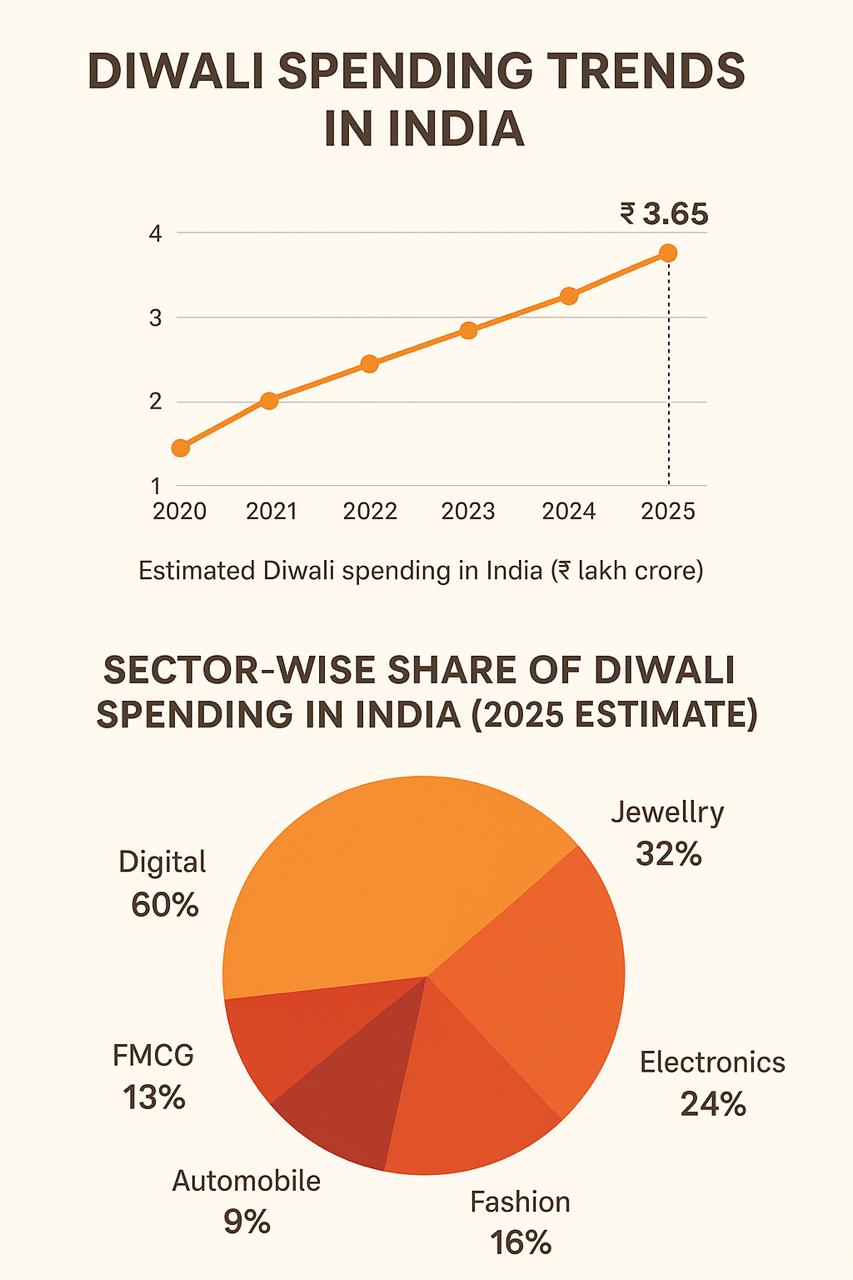
In 2024, India’s festive spending during Diwali week was estimated at INR 3.2 lakh crore, reflecting a 17% rise over 2023, driven by rising disposable incomes, pent-up post-pandemic demand, and digital retail penetration. Retail chains, e-commerce platforms, and even microenterprises depend on this period to recover annual profits. For small traders, Diwali is often the difference between a good year and a bad one. The festival also synchronizes the Indian economy’s emotional rhythm—consumer sentiment peaks as the festival approaches, heightened by work bonuses, gifts, and an almost cultural belief that new purchases bring prosperity.

Two days before Diwali, Indians celebrate Dhanteras, considered the most auspicious day to buy gold, silver, or anything of value. Historically, this practice was rooted in agrarian prosperity cycles during which, farmers who had completed the harvest season invested their earnings in tangible assets like metals. Today, the sentiment remains, but the scale has exploded. The symbolism has migrated from the vault to the marketplace, aligning tradition with modern consumption.

Diwali’s economic landscape has been radically redrawn by digital commerce. In 2024, online festive sales crossed INR 90,000 crore, driven by e-commerce platforms like Amazon, Flipkart, and Meesho. Tier-II and Tier-III cities accounted for more than 60% of new shoppers, an indication that India’s digital inclusion is now deeply linked with its festive economy.

Algorithms have replaced astrologers in predicting purchasing patterns. AI-driven recommendations, influencer marketing, and digital payment ecosystems like UPI have made the act of buying faster and impulsive. While urban consumers enjoy massive discounts, small offline retailers struggle to match online prices. Many traditional businesses like sweet shops, garment stores, and gift outlets are now adapting with hybrid models, selling on WhatsApp or through community platforms. The local bazaar is not dying; it is simply going online.

Behind the glitter of malls and advertisements lies a quieter but equally powerful story of the informal and rural economy that powers Diwali. Across India, millions of artisans, potters, weavers, and small manufacturers depend on the season for a significant portion of their income. From handmade diyas in Bihar to terracotta idols from Bankura, paper lanterns in Maharashtra, and bamboo crafts from Northeastern states, Diwali sustains local creative economies that embody both tradition and entrepreneurship. In recent years, several NGOs and social enterprises have helped rural producers connect directly with urban buyers through digital platforms. For instance, self-help groups (SHGs) supported by government programs like NRLM (National Rural Livelihoods Mission) and private CSR initiatives now sell festive handicrafts on e-commerce sites and social media. The “Make in Village” movement during Diwali is becoming a quiet counter-narrative to imported mass-produced goods. Every diya sold is not just a source of light but a livelihood.

Gifting is central to Diwali’s economic ecosystem. From corporate gift hampers to sweets exchanged among families, the ritual symbolizes goodwill, reciprocity, and status. In 2024, India’s corporate gifting industry was valued at ₹12,000 crore, with strong growth projected for 2025. Beyond sweets and dry fruits, companies now gift experiences like wellness vouchers, eco-friendly hampers, and handmade products to reflect social consciousness and sustainability. The gifting economy also reveals deeper social psychology. Gifts during Diwali are not just commodities; they are currencies of relationship. In economic terms, they create “social capital”, the trust and goodwill that sustain business and personal networks alike.

In last decade or so, Diwali’s environmental impact has come under scrutiny. Delhi is the best (or worst) example of this intense air pollution from firecrackers making the environment unbreathable, plastic waste from packaging, and excessive electricity consumption have led to rising calls for a Green Diwali. The market is responding with conscious choices. In 2025, the sale of eco-friendly crackers and biodegradable decorations is expected to grow by 30%. Solar-powered lighting, organic sweets, and recycled packaging are becoming mainstream. Conscious consumers, especially younger urban Indians, are now demanding sustainable alternatives that align celebration with responsibility. The shift from conspicuous consumption to conscious consumption marks a new chapter in the economics of Diwali, one where prosperity is measured not just by spending, but by sustainability.

However, Diwali’s prosperity is not evenly distributed. Inflation affects the purchasing power of lower-income families who often face higher food and fuel prices during the season despite the recent GST reforms, which has significantly brought down the prices of most of the consumer goods. While the urban affluent splurge on gadgets and gold, many households cut back on essentials.

This divergence reflects the broader K-shaped recovery post-pandemic of the Indian economy, where upper segments surge ahead while those on the lower segments struggle. The festive glow, though radiant, hides shadows of inequality. For small retailers, rising input costs and competition from online giants have squeezed margins. For daily wage earners, the festival may mean temporary income spikes but little long-term security. Diwali illuminates both the promise and paradox of India’s growth story.

At its core, Diwali celebrates renewal of hope, homes, and human spirit. Economically too, it acts as a reset button for the nation’s consumer sentiment. The act of cleaning homes, buying new things, and lighting lamps mirrors the cyclical nature of economic optimism. For policymakers and economists, the festive season is a real-time barometer of demand. For families, it’s a reminder that prosperity is not just about wealth, but about togetherness and gratitude. In many ways, Diwali teaches an enduring lesson in economics that growth is sustainable only when it is inclusive, joyful, and mindful.

The economics of Diwali is not just about expenditure, but it is also about the exchange of energy, emotion, and enterprise. It reflects India’s evolving story of modernization rooted in tradition, digital transformation anchored in ritual, and capitalism softened by culture. The future of India’s festive economy will shine brightest when it balances profit with purpose, growth with gratitude, and consumption with conscience.

Who are urban marginalized people

Photo Credit: https://humana-india.org/

In last 2-3 years, I have been part of several discussions to define and build a consensus on understanding of urban marginalised and vulnerable population (UMVP) in the context of India, and how this population group has been evolving and growing in numbers. India’s rapid urbanization over the past few decades has transformed its cities into economic powerhouses contributing 60% of India’s GDP. While in 2023 around 37% of India’s population lived in urban areas, it is estimated that by 2036, half of India’s population will live in cities. However, this growth has also led to the marginalization of a significant portion of the population. Cities Alliance estimated that 25% of the population living in urban areas are below the poverty line. By this estimate, a shocking 125+ million people are marginalised and vulnerable living in the urban areas. The urban marginalized and vulnerable groups comprising of slum dwellers, informal workers, migrant labourers, women, children, and the homeless face numerous challenges like access to basic citizens’ rights, services, and opportunities. As India continues its urban transition, addressing the vulnerabilities of these populations is critical to achieving inclusive development.

The UMVPs live in precarious conditions, often lacking access to basic services like clean water, housing, sanitation, healthcare, and education. Their vulnerabilities are shaped by socio-economic, cultural, political, and structural factors that leave them excluded from mainstream urban life. They often lack the necessary documentation to access government schemes and services, such as ration cards, Aadhaar cards, or voter identification. This exclusion prevents them from benefiting from welfare programs like the Public Distribution System (PDS), healthcare subsidies, or housing schemes. The UMVPs can broadly be classified in five sub-groups,

  1. Slum Dwellers: According to the 2011 Census, about 65 million people in India live in urban slums. Slums across India have poor housing, lack of sanitation, overcrowding, and a high risk of diseases, especially communicable. People living in the slums often have insecure tenure, making them vulnerable to eviction and displacement due to urban development projects. Displacement not only disrupts their livelihoods but also pushes them further into poverty. Poor living conditions contribute to health problems, including respiratory diseases (especially TB) and waterborne infections.
  • Homeless Population: India’s urban homeless population is particularly vulnerable, facing extreme marginalization. With no permanent shelter, the homeless are exposed to harsh weather conditions, violence, and health risks. They have limited access to government welfare schemes and often fall outside the purview of census data, making it difficult to design targeted interventions. HLRN estimates that there could be more than 3 million homeless individuals. Extreme poverty, unemployment, displacement due to natural disasters, mental illness, substance abuse, runaways, are often the causes of homelessness, and their numbers are continuously increasing in urban India.
  • Informal Workers: The informal sector accounts for nearly 80% of India’s urban workforce. This includes daily wage labourers, street vendors, domestic workers, and construction workers, among others. Informal workers lack job security, social protection, and access to formal financial systems, leaving them vulnerable to economic shocks. The COVID-19 pandemic exposed the extreme vulnerability of informal workers, who faced sudden job losses and had low-to-no access to financial aid. Informal workers often are slum dwellers, or live in low income housing colonies, or are even homeless.
  • Migrant Laborers: Migration to cities in search of employment and better life is common in India. However, migrant labourers, often from rural areas both intra- and inter-state, face significant challenges in urban settings. They often find employment in low-paying jobs with little to no benefits, live in temporary or inadequate housing, and struggle to access public services due to a lack of local identification documents. Temporary migratory population is also a sub-set of this group, who come to cities for seasonal work, migrate from one place to another, also migrate within the cities in search of work. Construction workers and artisanal nomadic groups can be good examples of migratory population.
  • Women and Children: Women and children within urban marginalized communities living in slums or informal settlements often work in low-paid informal jobs while managing household responsibilities. They are more likely to experience gender-based violence, discrimination and exploitation, limited access to healthcare, and lack of educational/skilling opportunities. Children in these settings suffer from malnutrition, poor schooling, and limited opportunities for social mobility. They often attend poorly equipped government schools or are forced to drop out to contribute to household income.

India’s urban marginalized and vulnerable populations represent a significant and often overlooked segment of society. Ensuring their inclusion in the country’s urban development is essential for sustainable and equitable growth, while bestowing opportunity and dignity for all citizens as their Right.

Importance of family counseling in entrepreneur selection

A person requires to possess both ‘can do’ attitude and aptitude for business to start on an entrepreneurial journey. But is that enough? Often an entrepreneur’s success is celebrated as an individual, but seldom the support system in the form of family and friends are discussed due to which the entrepreneur has achieved success. This is irrespective of the nature and size of business, geography, gender and backgrounds of the entrepreneur, and investment that goes in the venture.

While there’s no age to starting a business, the development programs I am working with focuses on women and girls in the age group of 18-50 years from poor and low-income households in the rural areas, with a desire to be self-employed and in future create employment for the youth in their respective villages. Selection processes of such aspiring entrepreneurial women vary depending on the model and approach of the programs. For the conventional businesses existing vocational skills and basic business acumen is analyzed, for others apart from these qualities, level of confidence, ability to invest their time, efforts, and money, general awareness, and other aptitude tests are conducted to measure the eligibility. What remains common across, and I believe is one of the most crucial factors for them to succeed from the word go is the support of their families, which remains the backbone of their ventures during and after the programmatic support. Therefore, post shortlisting of a potential entrepreneurial candidate, family counselling becomes the ultimate decider for her to join the program. And no, it has nothing to do with patriarchy. It’s same for any gender, and I think anywhere in the world. I have been a serial entrepreneur in my past, and have experienced in firsthand that without family support, I could have only done so much.

Family background including the size, type, and economic status can influence entrepreneurs’ and, therefore, entrepreneurship development. Even if the entrepreneurial spirit doesn’t necessarily run in the family, their support plays a vital role in an entrepreneur’s journey. Through their belief, encouragement, constant motivation, and involvement, families provide a nurturing environment for entrepreneurial growth.

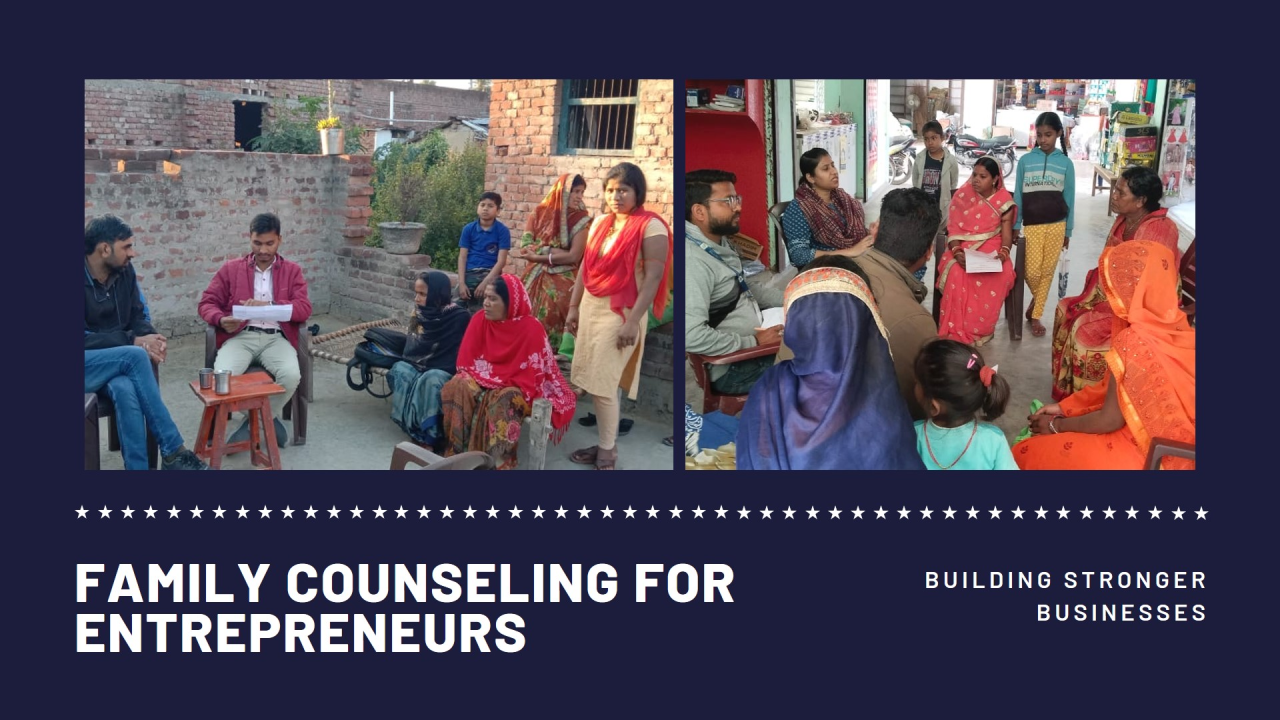
In the process of meeting the family at their house in the village and discussing about their current livelihood and income sources, level of education in the household, aspirations and future plans, nature of relationship with the potential entrepreneurial candidate, sharing about the program, and earning their commitment of being the wind  beneath the wings of their daughters, daughters-in-law, wife, and in turn building trust is the main agenda of the family counselling. This support is the most important step and measure for induction of an aspiring candidate in our entrepreneurship program. Garnering this support is half the battle won for the aspiring entrepreneur.

The hard work has to be of the entrepreneur, but families give financial assistance and provides the seed capital for the start-up, provides emotional assistance keeping the morale high during those challenging and difficult times that every entrepreneur undergoes, promote the venture in their long curated networks both within and outside their villages through word-of-mouth, volunteer their time at the business to attend to customers and promotion, and more importantly celebrate even the small moments of joy together.

Apart from money and market, family support is the third pillar of the tripod, which drives entrepreneurial success.

If you want to know more about designing rural women entrepreneurship projects and/or learn about family-counselling for rural entrepreneurship, feel free to connect.

(First published on LinkedIn on 6th March 2024)

Kabul Disco

kabul-discoKabul Disco

by Nicolas Wild | 148 Pages | Genre: Graphic Novel | Publisher: HarperCollins India | Year: 2009 | My Rating: 8/10

“What do I draw?” he asks.

“Make it symbolic by representing the ethnic balance: 45% are Pushtuns, 36% are Tajiks, 12% are Uzbeks, 14% are Hazaras, And then there are a few Nuristanis, of course. Draw some wearing shalwar kamiz with turbans, patoos or pakols. Then others wearing three piece suits. Out of the 300 members, 25% are women.”

“Of course,” he says. Only: “I just wanted to know, what do Pushtuns, Tajiks, Uzbeks, Hazaras, Nuristanisshalwar kamiz, patoos, pakols and women look like?”

– Nicolas Wild, Kabul Disco

Nicolas Wild has written a marvelous satire on the big global business that is Afghanistan and its reconstruction post American bombing of the Country to get rid of Taliban and Osama. This novel thus is an entertaining account of the French graphic artist’s life in the Afghanistan working with a development agency, of international NGOs, coalition forces, nascent democracy and the not-so-diminished Taliban. At times hilariously ridiculous, and at others poignant in its observation of the prevalent times, the book brings to life the contrasting mindsets of the two cultures. Wild captures the pretentious, privileged, vaguely Eurotrash existence of the professional expat do-gooder with a suitably wicked eye. He has hilariously portrayed the protected lifestyles, the local “utility men”, the SUVs, the suspiciously connected American and, of course, the expat party scene. Skillfully he has kept the political references limited to comments on the Bush administration, and sexual tension is kept to a minimum.

This ironical and hilarious graphic novel is my Read of the Week.

Competitive Practices of NPOs

Perhaps the dominant force shaping the non-profit sector at the present time is the widespread commercialization or “marketization” of social and economic life. While commercialization is nothing new to the non-profit sector, in recent years the sector has not only reacted to the market but also embraced it on a scale not previously seen, integrating market impulses into non-profit operations in often creative ways, though with consequences that are not completely clear.

Sources of Market Pressures. the pressures propelling non-profit organizations towards greater engagement with the prevailing market system are multiple. They include declining government financial support, slow growth in private giving, increased service demands from widely disparate population groups, growing competition from for-profit and non-profit organizations, increased accountability demands, and the increasing presence of potential corporate partners.

Growth of Fee Income. In response to this combination of push and pull factors, many more non-profit organizations seem to be reaching out to the market, and on a much broader front. Perhaps the most obvious evidence of this is the growth of non-profit reliance on fees for service charges. But non-profits are also deriving money from the sales of ancillary goods and services, such as merchandise in gift shops and facility rentals.

Social Purpose Enterprises. Non-profits are also integrating the market more directly into the pursuit of their social missions through the formation of “social purpose enterprises,” or “social ventures.” These hybrid organizations use market means to pursue non-profit objectives. Here the market is not simply a source of revenue but a preferred vehicle through which to achieve a social purpose.

Corporate Partnerships. Non-profits are being drawn further into the commercial orbit by alliances with the corporate world. Businesses have found that teaming up with non-profits adds respectability and trust to their images while cultivating new markets, new sources of employees, and new pools of research and expertise. In exchange, corporations donate money, form employee volunteer programs, sponsor events, loan out executives, and provide equipment, space and contacts.

Incorporation of the Market Culture. As they have come to operate in an increasingly competitive, market-oriented environment, non-profits have also increasingly absorbed the culture and manner of the market into their internal structures and operations. Non-profits are no longer bashful about aggressively advertising their services or competing for charitable contributions. Indeed, they have become increasingly “entrepreneurial,” worrying about their “market niche” and engaging in “strategic planning.” Agencies are increasingly adopting performance measurement techniques, adopting smaller, corporate-style boards, and building more elaborate organizational structures.

A New Enterprising Social Sector. Emerging from these various developments is a new picture of the “social sector,” a picture of a self-propelled set of organizations loosened from their original moorings in charity or as a passive agent of government and much more closely connected to the market system, while still somehow tied, however tenuously, to the pursuit of public benefit. Unquestionably, the non-profit sector has gained many advantages from this closer association with the market. Marketization has offered the non-profit sector access not only to an enlarged resource base but also to the energy and creativity that the market system has long represented. Armed with earned income, non-profits may become more fully independent than either government support or private charity has made possible. Engagement with the market also opens possibilities for leveraging enormous private resources and talents for social purposes, and for erasing widespread images of non-profit ineffectiveness, establishing instead the image of a set of organizations that has learned how to bring the most efficient means to the service of the most valued ends.

But if the potential advantages of the non-profit sector’s embrace of the market are considerable, so too are the risks. Market pressures can undermine non-profits’ commitments to their core values, to doing what is right as opposed to what is popular or commercially viable. They can also threaten the sector’s public support if efforts are not made to keep the public engaged and informed.

The solution to these problems may not lie either in restricting the commercial involvement of the non-profit sector or in relying blindly on the restriction on distribution of profits to ensure appropriate non-profit performance. Rather, more direct mechanisms of control may be desirable—performance measurements and mechanisms that empower key stakeholders, such as donors or the users of non-profit services. Under any circumstances, while it is essential to keep the challenges posed by the market clearly in view, it would be foolhardy to let the opportunities it presents to the non-profit sector go unexplored.