The missing business case for ending Tuberculosis
August 24, 2026 Leave a comment
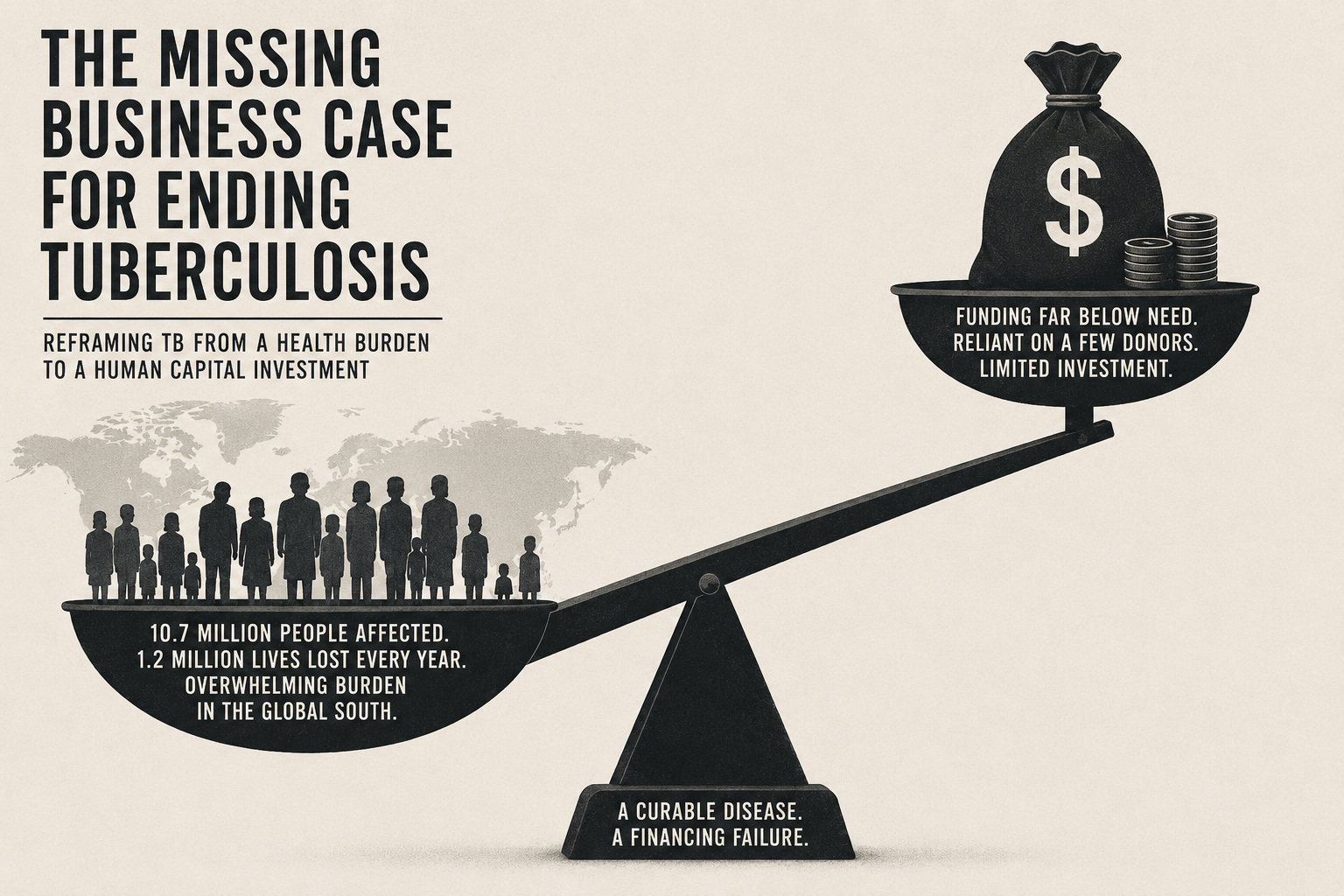
Tuberculosis (TB) presents one of the most enduring paradoxes in global health. It is preventable, diagnosable, and curable, yet it remains among the world’s deadliest infectious diseases. Every year, millions of people fall ill, and more than a million lose their lives to a disease that medicine has known how to treat for decades. The burden is concentrated overwhelmingly in the Global South, particularly in countries such as India, Indonesia, Pakistan, Nigeria, Bangladesh, and the Philippines. Yet despite this enormous human and economic cost, TB continues to attract only a fraction of the funding mobilised for many other global health challenges. The question is not whether TB is a public health emergency, but rather why a disease with such a high burden struggles to attract sustained investment.
The answer lies less in epidemiology and more in economics. Global health financing is often driven by a combination of political attention, public visibility, strategic interests, and commercial incentives. Diseases that threaten wealthier populations, generate public fear, or offer lucrative opportunities for innovation tend to attract substantial resources. Tuberculosis does none of these particularly well. It is largely a disease of poverty, affecting populations with limited political influence and weak purchasing power. As a result, the market signals that typically drive investment remain weak, even when the social need is overwhelming.
This disconnect is evident in the global financing landscape. Governments meeting at the United Nations High-Level Meeting on Tuberculosis in 2023 committed to mobilising US$22 billion annually for TB prevention, diagnosis, treatment, and care by 2027, alongside US$5 billion annually for research and development. Yet current financing remains far below these ambitions. Many high-burden countries continue to face significant resource shortages, and funding gaps persist across national TB programmes. Research funding is even more constrained. Global investment in tuberculosis research remains only a fraction of what experts estimate is necessary to develop better diagnostics, shorter treatment regimens, and more effective vaccines. The world has repeatedly declared its intention to end TB, but its financial commitments suggest otherwise.
A major reason for this shortfall is the narrow donor base supporting the global TB response. Unlike some other health sectors that benefit from a broad coalition of governments, foundations, corporations, and private investors, TB relies heavily on a small number of actors. The Global Fund to Fight AIDS, Tuberculosis, and Malaria (GFTAM) remains the largest external financier of TB programmes worldwide. A handful of bilateral donors and philanthropic organisations account for much of the remaining support. Outside this relatively small circle, engagement is limited. Family foundations, corporate social responsibility programmes, impact investors, and development finance institutions have yet to embrace tuberculosis as a priority issue at scale.
This concentration of funding creates vulnerability. Any reduction in donor commitments, shifts in geopolitical priorities, or fiscal pressures in donor countries can quickly undermine progress. Recent debates around development assistance budgets and declining aid commitments have highlighted the fragility of the current model. The reality is that the global TB response rests on a financial foundation that is both narrow and uncertain.
The deeper challenge, however, is that tuberculosis has never been successfully positioned as an investment opportunity. Unlike cancer therapies, medical technologies, or chronic disease management solutions, TB offers limited prospects for commercial returns. The populations most affected are often served by publicly funded health systems or donor-supported programmes. Pharmaceutical companies face uncertain revenue streams, while investors struggle to identify scalable business models capable of generating attractive financial returns. In a world increasingly shaped by market logic, tuberculosis suffers from a lack of investability.
Yet this perception obscures a much larger economic reality. Tuberculosis may be one of the highest-return investments available in international development. The disease primarily affects people during their most productive years, reducing labour force participation, household earnings, and economic mobility. Children leave school to care for sick relatives. Communities lose workers, caregivers, and local leaders. The economic impact extends far beyond health systems, affecting productivity, human capital formation, and long-term development outcomes. Every case prevented and every patient cured generates benefits that ripple across households, communities, and economies.
The problem is that these returns are largely social rather than financial. The benefits accrue to governments, employers, families, and society as a whole rather than to any single investor. Economists describe this as a classic market failure. The social return on investment is extraordinarily high, but the private return remains relatively low. As a consequence, the market underinvests in solutions despite their obvious public value.
This is precisely why tuberculosis requires a different financing narrative. For decades, the disease has been framed primarily as a public health challenge. While this framing is accurate, it is insufficient. Tuberculosis should also be understood as a development challenge, a labour market challenge, and a human capital challenge. Countries across Asia and Africa are investing heavily in education, skills, entrepreneurship, and economic growth to capitalise on their demographic dividends. Yet the continued prevalence of tuberculosis silently erodes these investments by reducing productivity and weakening workforce participation.
Reframing TB as an economic issue rather than solely a health issue could unlock new sources of capital. Development finance institutions could view TB investments as essential components of economic resilience. Corporate CSR programs could recognise tuberculosis as a workforce and community development issue. Family offices and philanthropists interested in inclusive growth could support interventions that strengthen human capital among vulnerable populations. Impact investors could explore opportunities in diagnostics, digital adherence technologies, and community-based healthcare delivery. Innovative financing mechanisms, including blended finance and outcome-based funding, could help bridge the gap between social value and financial participation.
Such approaches would not replace traditional public health financing, nor should they. Governments must remain the primary funders of national TB responses. However, relying solely on governments, multilateral agencies, and a handful of foundations is unlikely to generate the scale of resources required to end the epidemic. The financing ecosystem must expand, and that expansion will only occur if the narrative changes.
Perhaps the most troubling aspect of tuberculosis is that its persistence is no longer primarily a scientific problem. The tools to diagnose and cure the disease already exist, and innovations are emerging. What remains missing is sufficient investment and political commitment to deploy these solutions at scale. In an age that celebrates technological breakthroughs and billion-dollar innovation ecosystems, the continued burden of a curable disease reflects not a failure of medicine but a failure of financing.The global community has largely treated tuberculosis as a charitable cause. It is time to recognise it as an investment in human productivity, economic resilience, and social stability. Until funders, policymakers, and investors view tuberculosis through this broader lens, the gap between disease burden and financial commitment will persist. The missing business case for ending tuberculosis is not a lack of evidence that the returns are absent.
(Disclaimer: The opinions expressed are those of the author and do not purport to reflect the views or opinions of any organisation, foundation, CSR, non-profit or others.)
Cover image is generated using AI
First Published on LinkedIn: 26 June 2026