Top 10 must-read Books for Social Impact Professionals

Social impact professionals face challenges that require both strategic thinking and deep empathy. Whether working in non-profits, CSR, philanthropy, development agencies, or social enterprises, professionals in these fields need to balance passion for change with evidence-based approaches to development. Books remain one of the most powerful ways to gain insight, inspiration, and tools for creating sustainable social impact.

I have put together a list of ten must-read books that every social impact professional should consider adding to their shelf, as they are on mine. These books are on leadership, systems thinking, innovation, fundraising, evaluation, and purpose. They provide both the vision and the practical tools needed to make a lasting difference.

1. “How to Change the World: Social Entrepreneurs and the Power of New Ideas” by David Bornstein

David Bornstein profiles pioneering social entrepreneurs who are solving some of the world’s toughest problems with creativity and determination. From rural health initiatives to innovative education programs; from rural poverty in India to discrimination against gypsies in Central Europe; from industrial pollution in the United States to child prostitution in Thailand, the book shows how individuals and organizations can catalyse systemic change. For social impact professionals, it provides concrete case studies and a roadmap for thinking beyond short-term solutions. It offers inspiration and practical lessons in scaling impact, showing how bold ideas combined with persistence can transform communities.

2. “The Blue Sweater: Bridging the Gap Between Rich and Poor in an Interconnected World” by Jacqueline Novogratz

Jacqueline Novogratz, founder of Acumen, blends personal narrative with the evolution of impact investing. Her journey from traditional philanthropy to patient capital investing shows how financial innovation can tackle poverty while respecting dignity. It challenges professionals to rethink charity and aid, emphasizing sustainable solutions that empower rather than create dependency.

3. “Creating a World Without Poverty: Social Business and the Future of Capitalism” by Muhammad Yunus

Nobel laureate Muhammad Yunus introduces the concept of “social business”, a business model designed not for profit maximization but for solving social problems. Drawing on his work with Grameen Bank and microfinance, Yunus presents a radical yet practical vision of blending entrepreneurship with social change. It inspires a new way of seeing markets and entrepreneurship as allies in social development, especially for professionals exploring hybrid models of impact.

4. “The Lean Startup” by Eric Ries

At first glance, this book seems more suited to tech entrepreneurs than social impact leaders. Yet, its core idea of test, learn, iterate has transformed the way many social innovations are designed and scaled. Social enterprises and NGOs increasingly use lean principles to reduce waste, validate solutions with communities, and adapt quickly. Because social impact efforts often operate under resource constraints, adopting lean experimentation can make interventions more effective and sustainable.

5. “Measuring What Matters: Tools for Aligning Capital and Impact” by Rodney Schwartz & Geoff Mulgan (or substitute with John Doerr’s “Measure What Matters” depending on focus)

Impact measurement remains one of the most pressing challenges for the field. This book provides frameworks and practical tools for defining, measuring, and aligning impact with mission. It explores case studies of organizations that have successfully embedded impact metrics in their operations. It equips professionals with methods to track progress, communicate value to funders, and ensure accountability without losing sight of mission.

6. “Switch: How to Change Things When Change Is Hard” by Chip Heath and Dan Heath

Social impact work is essentially about behaviour change, whether convincing communities to adopt healthier practices, companies to embrace sustainability, or policymakers to reform systems. “Switch” explains why people resist change and offers strategies to inspire collective action. It’s a practical guide to leading change management in complex social contexts, with evidence-based techniques that can be applied across sectors.

7. “Development as Freedom” by Amartya Sen

Economist and Nobel laureate Amartya Sen reframes development not simply as economic growth but as the expansion of human freedoms. He argues that true development empowers individuals with choices, agency, and opportunities. For anyone engaged in social impact, this book provides a philosophical foundation. It reminds professionals that the goal is not just programs or numbers, but human dignity and freedom.

8. “The Infinite Game” by Simon Sinek

Social impact work is not about short-term wins but about long-term transformation. In “The Infinite Game,” Sinek contrasts finite games (with fixed rules and winners) with infinite ones (driven by purpose and adaptability). Social impact is clearly an infinite game, requiring resilience and continuous rethinking. It equips leaders with the mindset needed to sustain impact, avoid burnout, and build organizations that thrive beyond immediate results.

9. “Winners Take All: The Elite Charade of Changing the World” by Anand Giridharadas

This provocative book critiques the global elite’s role in shaping the social impact landscape. Giridharadas argues that many wealthy philanthropists and corporations pursue impact while preserving the very systems that cause inequality. Even if one disagrees with all its conclusions, it challenges professionals to reflect critically on power, privilege, and accountability in the sector.

10. “The Systems Work of Social Change: How to Harness Connection, Context, and Power to Cultivate Deep and Enduring Change” by Cynthia Rayner and Francois Bonnici

Addressing complex issues like poverty or climate change requires a systems lens. This book offers practical insights into how organizations can shift from isolated interventions to systemic approaches that address root causes. It helps professionals understand complexity, collaborate across sectors, and design interventions that endure over time.

The work of social impact professionals is as inspiring as it is demanding. It calls for creativity, humility, persistence, and continuous learning. The ten books highlighted above represent a spectrum of ideas, from the visionary and philosophical to the highly practical. Together, they offer a toolkit for navigating the challenges of creating social good in a complex, globalized world.Reading these books won’t just sharpen your technical skills, they will also deepen your sense of purpose, expand imagination, and foster resilience. For professionals committed to solving humanity’s most pressing problems, these works serve as companions, guides, and sometimes challengers, reminding us that lasting change is possible when ideas, innovation, and values align.

Data is Divine

In God we trust. All others must bring data.” This quote, made by W. Edwards Deming holds true (and may even supersede God for some as Divine).

I have been in love with data right from my school years and the mysteries of the world it holds. I have tried to develop data driven models on human relationships, the movement of animals, finding patterns in the ways of the world, and later designing programs of social impact for challenging poverty, and policy development. In the end, we all are data, from the moment we are an idea until long after we pass away.

“Data is divine” highlights the growing understanding of data’s vital significance in modern society, in much the same way that religious or spiritual values have directed civilizations throughout history. In today’s digital age, data powers innovation, decision-making, and advancement in all fields, including governance, research, business, healthcare, and lifestyle.

1. Data as a source of truth: Data is frequently regarded as an impartial depiction of reality, providing information on trends and occurrences that may be imperceptible to anecdotal experience or intuition. In this way, data has a unique position as the basis for making well-informed decisions and uncovering hidden facts.

2. The power of data in innovation: Data is driving advancements in domains like healthcare, finance, and climate science and is revolutionizing industries as it powers AI/ML and sophisticated analytics. This emphasizes how data has the “divine” ability to spark significant change. The use of data for enhancing human welfare, from preventing pandemics through data-driven epidemiology to lowering inequality by studying societal trends has been in use. When applied sensibly and morally, it can aid in resolving some of the most pressing issues facing society.

3. Data as omnipresent: From the apps we use daily to the systems that manage our cities, data is present everywhere in the modern world. Its pervasiveness is comparable to a certain “divine” quality in that it affects almost every facet of contemporary life, whether we are conscious of it or not.

4. Data and ethics: Data carries a great deal of responsibility along with its power. Similar to supernatural knowledge, there are significant ethical ramifications to the way we collect, use, and safeguard data. Data misuse can result in inequality, manipulation, and privacy violations. As a result, it is crucial to handle data with dignity, openness, and ethics.

“Data is divine” also implies that we must treat it with deference and accountability while simultaneously appreciating its immense importance in shaping our future. We need to balance the power of data with ethical considerations as our world grows more and more data driven. The following are some crucial strategies to preserve this equilibrium,

1. Data privacy and informed consent: People ought to be in charge of how their information is gathered, kept, and utilized. It is not appropriate to force them to divulge information. Companies must be open and honest about their data practices so that users know what information is being gathered and why. Clear and informed consent should not be buried in complicated terms and conditions. Data literacy is essential among general population so that they are aware of the consequences of disclosing personal information, and the dangers of data misuse.

2. Data minimization: Only gather information that is absolutely required for the current job. This reduces the possibility of abuse and shields people from needless exposure. I’ve seen in recent years how social development initiatives gather and store vast amounts of data, with donors coercing their nonprofit partners to obtain it, yet this doesn’t address any societal issues. It is crucial to have a conscious grasp of what is needed.

3. Data bias and fairness: AI/ML systems may reinforce or increase biases found in the training data. Therefore, diversifying datasets, employing inclusive development techniques, and reviewing algorithms for bias are all necessary to ensure fairness.

4. Equitable data access: One way to lessen inequality is to make sure that data access and its advantages are shared equitably among all communities. This entails preventing the reinforcement of systemic disadvantages while ensuring that marginalized groups have access to data-driven insights.

5. Data governance and accountability: To ensure that data is utilized properly, organizations and governments must establish robust data governance policies and ethical frameworks. To stay up with the latest developments in technology, these policies must be revised regularly. It is imperative to establish unambiguous lines of accountability for the handling and utilization of data. Data practices can be kept moral and in line with social standards with the support of independent oversight organizations or ethics boards.

6. Regulation and legal safeguards: Strong data protection laws that impose restrictions on how businesses and organizations can gather, keep, and handle personal data must be enforced by governments. Laws that address issues like accountability for algorithmic judgments, eliminating discrimination, and safeguarding human rights in AI-driven systems are crucial for the ethical application of automation and artificial intelligence. Because technology is changing so quickly, regulatory models must be adaptable and flexible to support innovation and enable quick responses to emerging ethical dilemmas.

7. Data for social good: Data can and should also be used positive social impact including lowering inequality and poverty, combating climate change, and improving public health. Governments, corporations, and civil society organizations working together can help guarantee that data is used morally and for the good of society. These collaborations may result in common frameworks for the ethical use of data.

A multifaceted strategy including legislation, transparency, public education, and proactive governance is needed to strike a balance between the power of data and ethical issues. Prioritizing the defence of individual rights, maintaining equity, and advancing the common good while fostering innovation should be the main goals of ethical data use. Through cultivating a culture of accountability and responsibility, we can leverage data’s promise (and divinity) without sacrificing moral principles.

Disclaimer: The opinions expressed are those of the author and do not purport to reflect the views or opinions of any organization, foundation, CSR, non-profit or others

Cover Photo: This is an AI generated image.

Importance of family counseling in entrepreneur selection

A person requires to possess both ‘can do’ attitude and aptitude for business to start on an entrepreneurial journey. But is that enough? Often an entrepreneur’s success is celebrated as an individual, but seldom the support system in the form of family and friends are discussed due to which the entrepreneur has achieved success. This is irrespective of the nature and size of business, geography, gender and backgrounds of the entrepreneur, and investment that goes in the venture.

While there’s no age to starting a business, the development programs I am working with focuses on women and girls in the age group of 18-50 years from poor and low-income households in the rural areas, with a desire to be self-employed and in future create employment for the youth in their respective villages. Selection processes of such aspiring entrepreneurial women vary depending on the model and approach of the programs. For the conventional businesses existing vocational skills and basic business acumen is analyzed, for others apart from these qualities, level of confidence, ability to invest their time, efforts, and money, general awareness, and other aptitude tests are conducted to measure the eligibility. What remains common across, and I believe is one of the most crucial factors for them to succeed from the word go is the support of their families, which remains the backbone of their ventures during and after the programmatic support. Therefore, post shortlisting of a potential entrepreneurial candidate, family counselling becomes the ultimate decider for her to join the program. And no, it has nothing to do with patriarchy. It’s same for any gender, and I think anywhere in the world. I have been a serial entrepreneur in my past, and have experienced in firsthand that without family support, I could have only done so much.

Family background including the size, type, and economic status can influence entrepreneurs’ and, therefore, entrepreneurship development. Even if the entrepreneurial spirit doesn’t necessarily run in the family, their support plays a vital role in an entrepreneur’s journey. Through their belief, encouragement, constant motivation, and involvement, families provide a nurturing environment for entrepreneurial growth.

In the process of meeting the family at their house in the village and discussing about their current livelihood and income sources, level of education in the household, aspirations and future plans, nature of relationship with the potential entrepreneurial candidate, sharing about the program, and earning their commitment of being the wind  beneath the wings of their daughters, daughters-in-law, wife, and in turn building trust is the main agenda of the family counselling. This support is the most important step and measure for induction of an aspiring candidate in our entrepreneurship program. Garnering this support is half the battle won for the aspiring entrepreneur.

The hard work has to be of the entrepreneur, but families give financial assistance and provides the seed capital for the start-up, provides emotional assistance keeping the morale high during those challenging and difficult times that every entrepreneur undergoes, promote the venture in their long curated networks both within and outside their villages through word-of-mouth, volunteer their time at the business to attend to customers and promotion, and more importantly celebrate even the small moments of joy together.

Apart from money and market, family support is the third pillar of the tripod, which drives entrepreneurial success.

If you want to know more about designing rural women entrepreneurship projects and/or learn about family-counselling for rural entrepreneurship, feel free to connect.

(First published on LinkedIn on 6th March 2024)

Navigating the Road to Sustainability for Nonprofits in India

Source: Idea taken from Foraker group model

Sustainability has become a buzzword across industries, and for nonprofits in India, it’s more than just a trend—it’s a necessity! Sustainability in the nonprofit sector is a critical issue that encompasses not only environmental stewardship but also financial stability, organizational resilience, and long-term impact. Nonprofits, by their nature, are dedicated to addressing social, economic, and environmental challenges, often with limited resources and high expectations. With India’s rapid economic shifts and evolving social landscape, understanding and overcoming these hurdles is essential for nonprofits striving to make a lasting difference.

Key Challenges Facing Nonprofits in India

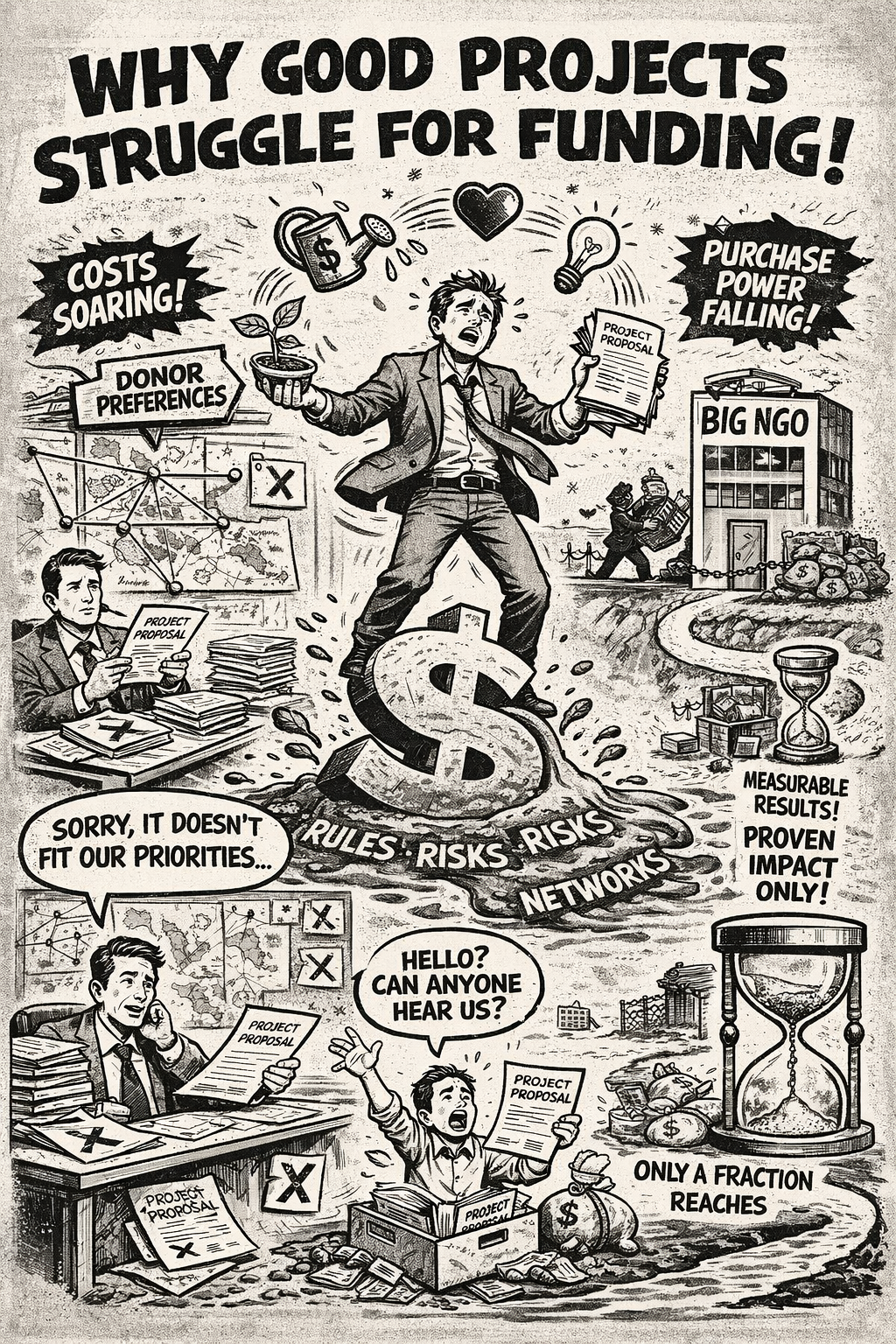
1. Funding Instability:  One of the most significant challenges facing nonprofits is financial instability. Nonprofits rely heavily on donor contributions, government grants, and CSR grants, which can be unpredictable and subject to economic fluctuations. Furthermore, many donors prefer to fund specific projects rather than general operations, leaving nonprofits vulnerable to financial shortfalls. The global economy, changing donor priorities, and a lack of diversified income streams often impact an organization’s ability to plan and execute long-term projects. This gets further compounded by competition among nonprofits for limited resources.

Nonprofits must constantly innovate and demonstrate their impact to attract and retain donors. This requires significant investment in fundraising and partnership strategies, donor relations, and marketing, which are resource-intensive and divert attention from core mission activities, often resulting in chicken-egg situations.

2. Administrative and Operational Inefficiencies:  Many nonprofits in India struggle with limited administrative resources and inefficient operational practices. Limited resources lead to outdated technologies, inefficient processes, and a lack of professional expertise. Inefficiencies in management, compliance, accounting, and reporting undermine the effectiveness of programs and reduce transparency, negatively impacting stakeholders and donors’ trust. This is more challenging for smaller organizations with limited administrative capacity.

3. Regulatory and Compliance Maze: Managing the complex regulatory landscape in India is challenging for nonprofits. Compliance with legal requirements, such as the Foreign Contribution Regulation Act (FCRA) and the Goods and Services Tax (GST), requires careful attention to detail and significant administrative effort. Changes in regulations and stringent reporting requirements add to the administrative burden. Staying compliant while adapting to new regulations can strain organizational resources and divert attention from mission-critical activities.

4. Capacity Building and Skill Gaps: The nonprofit sector often faces challenges related to human resources. There is a growing need for skilled professionals who can handle strategic planning, fundraising, and program management, leading to organizational sustainability. The sector often faces challenges in attracting and retaining skilled professionals due to budget constraints and lower salaries compared to the private sector.

Capacity building requires investing in learning and development for employees. However, many organizations lack the resources to provide comprehensive training programs or to hire experienced professionals. This often limits their ability to effectively manage programs, drive strategic initiatives, and ensure organizational growth.

5. Measuring Impact: Measuring and presenting evidence-backed impact is essential for donor confidence and organizational effectiveness. Nonprofits need to develop robust monitoring and evaluation frameworks to assess the outcomes and effectiveness of their programs. However, many organizations struggle with setting up these systems due to limited resources and expertise.

 Strategies for Enhancing Sustainability

1. Diversifying Funding Sources: To address funding instability, nonprofits need to explore multiple revenue streams. This includes engaging in social entrepreneurship and blended finance opportunities, establishing partnerships with businesses, leveraging online crowdfunding platforms, and digital fundraising. Creating a diversified funding base helps in reducing dependency on a single source and enhances financial stability.

2. Leveraging and Embracing Technology: Technology offers significant opportunities for enhancing operational efficiency and reach. Digital tools can streamline administrative processes, improve data management, and facilitate better communication with stakeholders through online platforms and social media. Adopting technology also opens avenues for online fundraising and virtual program delivery such as webinars, workshops, and training.

3. Building Stronger Partnerships: Collaboration with other nonprofits, governmental agencies, and private sector organizations can amplify the impact of initiatives and improve sustainability. Strategic partnerships can provide access to additional resources, expertise, and networks. Strategic alliances can also lead to cost savings through shared services and joint initiatives. By working together, organizations can leverage each other’s strengths, reduce duplication of efforts, and achieve greater impact.

4. Investing in Human Capital: Prioritizing the development of human resources is crucial for organizational growth and sustainability. Nonprofits should invest in training and capacity-building programs for their staff and volunteers through training programs, workshops, and professional development opportunities. Creating a culture of continuous learning and career advancement opportunities can enhance program delivery, improve management practices, organizational resilience, and employee retention. Leadership development is particularly important for long-term sustainability. Cultivating strong leaders within the organization can drive strategic planning, innovation, and effective decision-making.

5. Enhancing Transparency and Accountability: Building trust with stakeholders through transparency and accountability is essential for long-term success. Nonprofits should adopt the best practices in financial management, regularly publish impact reports, and engage in open communication with donors and stakeholders. Transparency not only attracts more funding but also strengthens community support. Implementing robust internal controls and conducting regular audits can help maintain financial integrity and accountability. Additionally, engaging stakeholders in decision-making processes and soliciting feedback can enhance organizational credibility and responsiveness.

6. Adopting Sustainable Practices: Integrating sustainability into program design and organizational operations can drive long-term impact. Nonprofits should consider the environmental impact of their activities and seek to minimize their footprint. This might involve adopting green practices, such as reducing waste, conserving energy, and promoting eco-friendly initiatives. Sustainable practices also include ensuring the long-term viability of programs. This involves designing initiatives that can be sustained over time, building local capacity, and fostering community ownership. By promoting sustainability within programs, nonprofits can create a transformative impact.

The road to nonprofit sustainability is full of challenges, but with innovation, partnership, and a commitment to continuous improvement, nonprofits can navigate these challenges and continue to make a meaningful impact on society.  As the sector is continuously evolving, embracing sustainability will be key to ensuring that nonprofits can adapt to changing circumstances continue to remain steadfast in their mission, and drive positive social change for years to come.

Disclaimer: The opinions expressed are those of the author and do not purport to reflect the views or opinions of any organization, foundation, CSR, non-profit or others

Impact Funding in the time of COVID-19

Photo source: The New Humanitarian

The global pandemic COVID-19 has triggered the most severe economic recession in nearly a century and is causing enormous damage to people’s health, jobs, and well-being. It has changed the social sector landscape and will continue to impact the sector for the next few years. In the short term, since March 2020, change in the funding trends is already being witnessed by non-profits, especially of the CSR in India, with majority of them contributing to the PM Cares, CM Relief Funds and contributions towards local relief work like food and PPE distribution. The unexpected crisis created due to migrant labour returning to their home states, we are witnessing some of the bigger CSRs channeling their funds towards ‘Rehabilitation during and post COVID-19’ phase with a focus on re-skilling, sustainable livelihoods and job creation, BCC, and food & nutrition security.

Until the next 12-18 months, there will be opportunities for partnerships under the ‘rehabilitation lens’ across geographies, but more focused on states like Bihar, Uttar Pradesh, Madhya Pradesh, Chhattisgarh, Odisha, Assam, and Jharkhand. Apart from relief & rehabilitation, Health (preventive health, strengthening local health systems at block and village levels, and co-morbidity diseases like TB, HIV/AIDS, Diabetes, etc.) and Education (especially working with a sudden increase in out-of-school-children due to in-migration, and skilling School teachers in rural and sub-urban India in virtual classrooms, course development and delivery, and digital communication) are other areas, where donor funds are potentially going to be invested. In other areas, especially environment and climate change (unless CSRs & foundation’s core focus is environment), it is bound to be severe funding cuts (40%-60% from pre-COVID times) over short to mid-term.

Non-profits need to continue building strong partnership with their existing CSR Partners, to continue getting support to even those projects that are not COVID aligned, and build new partnerships using COVID aligned models. It is expected that Government funding will increase and so will partnership opportunities in most of the areas like livelihoods, education and health using innovative implementation mechanisms and digital communication. The World Bank has announced large assistance programs for India, which will be implemented through state governments and may bring non-profits with the opportunities of large partnerships between now and 2025. The current changed funding trend will more or less continue in 2021. However bigger CSR and foundations will see a potential downside of 30-50% in their funding allocations.

As restrictions are being eased world-wide, the path to global economic recovery remains highly uncertain with 6-7.5% negative growth in 2020, it is expected to climb back to around 2.8-3% in 2021 and move slowly towards recovery. In the long run, 2022-25, when both national and international economies are strongly on the recovery path, it is expected that several international aid agencies, which had stopped direct funding in Indian development sector, once again will open a window for 3-5 years of funding, and number of funding opportunities for India and other developing countries will increase. Historically, post mega disaster comes the golden period of funding for impact sector. It is a phase, and it too shall pass. Together, we will continue to drive change and together we will prevail.

Disclaimer: The opinions expressed are those of the author and do not purport to reflect the views or opinions of any organization, foundation, CSR, non-profit or others.