Unbroken

Genre: War/Action | Year: 2014 | Duration: 138 mins | Director: Angelina Jolie | Medium: DVD | Trailer: HERE | Language: English | My rating: 5/5

Favorite Dialogue: “A moment of pain is worth a lifetime of glory.”

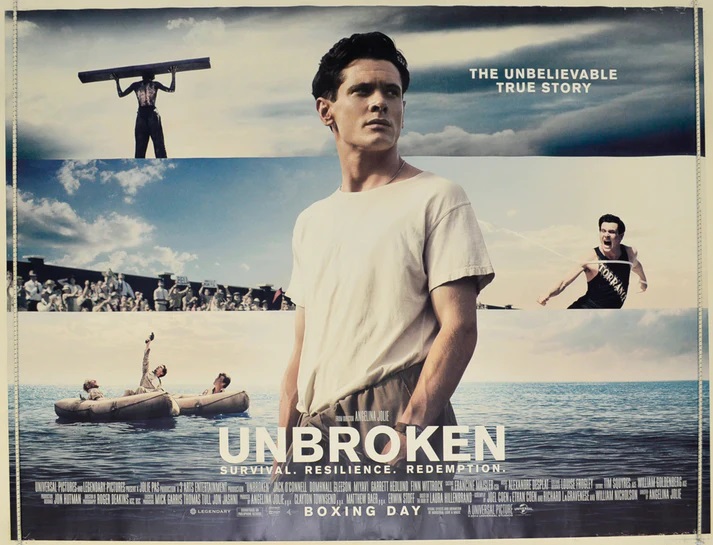
Unbroken is based on an inspiring true story of Louis Zamperini, a World War II bombardier, and an Olympic athlete whose remarkable life story is chronicled in Laura Hillenbrand’s bestselling book, Unbroken: A World War II Story of Survival, Resilience, and Redemption (2010). The film is a powerful tale of human spirit and forgiveness.

The story follows Zamperini (Jack O’Connell), who survives a plane crash in the Pacific Ocean, captured by the Japanese navy and endure years of brutal treatment in prison camps. The film spans Louis’s early life, childhood and his troubled youth, athletic achievements, and his experiences during the war, first as a Bombardier and then as a POW. 

Jack O’Connell delivers a compelling performance, capturing both the vulnerability and strength of Zamperini as he faces unimaginable hardships. The supporting cast, including Domhnall Gleeson as fellow soldier Phil, and Takamasa Ishihara as the sadistic camp commander “The Bird,” contribute significantly to the film’s emotional weight.

Angelina Jolie’s direction is visually stunning, emphasizing the stark contrast between the beauty of nature and the brutality of war. The cinematography portrays the vastness of the ocean and the starkness of the prison camps, effectively immersing the audience in Zamperini’s harrowing journey, combined with Alexandre Desplat’s evocative score.

“Unbroken” excels in showcasing the inspiring and intensity of Zamperini’s ordeal, making it a powerful portrayal of the strength of the human spirit. However, the film differs from the original book in balance. While the book is more focused on his post-war journey of forgiveness and healing, the film focuses more on his suffering.

Overall, Unbroken is a visually compelling and emotionally charged film that pays homage to Louis Zamperini’s extraordinary life, and is certainly a must watch. For me, the DVD of this film is a collectible too.

Jungle Nama: A Story of the Sundarban

Jungle Nama: A Story of the Sundarban

by Amitav Ghosh | 88 Pages | Genre:  Literary Fiction | Publisher: Fourth Estate | Year: 2021 | My Rating: 8.5/10

“All you need do, is be content with what you’ve got, to be always craving more, is a demon’s lot.”
― Amitav Ghosh, Jungle Nama

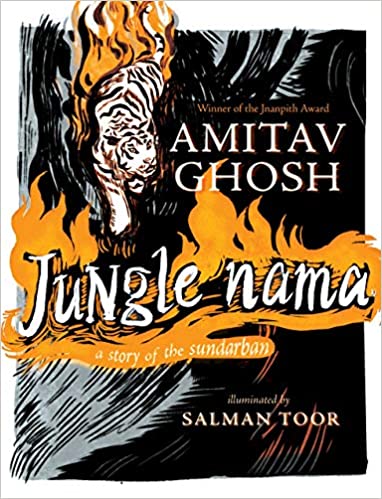
“Jungle Nama” by Amitav Ghosh is a captivating verse adaptation of a Bengali folktale from the Sundarbans, the world’s largest mangrove forest shared between India and Bangladesh. Written in a lyrical, rhythmic style, and illustrated by Salman Toor, the book tells the story of “Bon Bibi,” a benovelent goddess of the Sundarbans who safeguards the jungle and its people, and her conflict with Dokkhin Rai, a powerful demon-like figure who seeks to exploit the forest’s riches.

Ghosh’s decision to render this ancient tale in verse brings a unique musicality to the story, echoing the cadence of oral storytelling introducing music to current speech that has kept the folktale alive for generations. His prose is imbued with both reverence for the source material and a contemporary sensibility that makes the story accessible to a modern audience. Accompanying the text are hauntingly beautiful illustrations by artist Salman Toor, whose work enhances the mystical and otherworldly atmosphere of the Sundarbans and its lore.

Beyond its enchanting style, Jungle Nama explores timeless themes of balance between nature and humanity, the perils of human greed, and the importance of respecting natural boundaries. Ghosh subtly draws parallels to modern issues like climate change and environmental degradation, suggesting that the ancient wisdom in the Bon Bibi story holds valuable lessons for today’s world. Through Bon Bibi’s character, he raises questions about stewardship, sustainability, and the price of human ambition.

The book is more than a poetic retelling; it’s an immersive experience that connects readers to both nature and folklore. Ghosh’s evocative language and Toor’s illustrations work in harmony to capture the spirit of the Sundarbans and its lore, making this book a visually and intellectually rich addition to Ghosh’s body of work. The poem-like style of the book follows twelve syllables in each line, and each couplet has twenty-four syllables. After each line there is a natural pause or a caesura, replicating the cadence of the original legend.

This book by one of my all-time favourite authors is a mesmerizing read for anyone interested in myth, poetry, linguistic hybridity, and environment, offering a rare glimpse into a world where nature and spirituality are deeply intertwined.

The Man Who Cried

Genre: Romance | Year: 2000 | Duration: 100 mins | Director: Sally Potter | Medium: DVD | Trailer: HERE | Language: English, French, Yiddish | My rating: 3.5*/5*

Favorite Dialogue: “Lola: One should never look back. One should never regret. Never.”

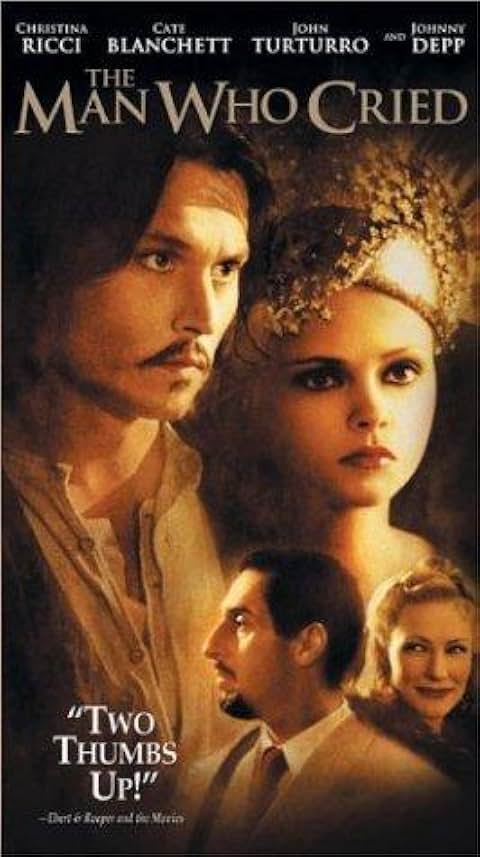
This romantic movie by Sally Potter has no chemistry between its co-stars, Johnny Depp and Christina Ricci, even though I quite liked their individual performances as Fegele, a Russian Jew with elfin features separated from her father as a child in 1927 and later re-named as Suzie when she escapes to England, and Cesar, a Romani gypsy with brooding countenance . And therefore there was no heat and the romance seemed sterile. 

Fegele’s father leaves for the promise of wealth and better future to the land of opportunity, America, intending to bring his daughter over later. However, after he left, a band of raiders attacks Fegele’s settlement, and she is bundled off in the middle of the night by her grandmother with few gold coins to take the ship to America. She ends up living in a foster home in England. After ten years she leaves England and joins a musical troupe in Paris, with the goal of making enough money so she can go to America to locate her father. She keeps her identity as a Jew a secret – only her roommate, Lola (Cate Blanchett), her roommate’s famous opera-singing lover, Dante (John Turturro), and her landlady know the truth. With World War II looming, Suzie and Lola escapes Paris, and after some drama Suzie reaches America and finds her ailing father in Hollywood.

This beautifully recorded and scored film of love, loss and human character is worth a watch.

Code Dependent: Living in the Shadow of AI

Code Dependent: Living in the Shadow of AI

by Madhumita Murgia | 320 Pages | Genre: Non-Fiction | Publisher: Pan Macmillan | Year: 2024 | My Rating: 5/10

My life—and yours—is being converted into such a data package that is then sold on. Ultimately, we are the products.”
― Madhumita Murgia, Code Dependent

Code Dependent is a collection of case studies about people who are affected by technology, without the rigour and analysis that I was expecting. But then it is not an academic or research-oriented book, but more in the popular non-fiction genre. Several of the case studies in the book reflected on the dark side of technology and social media manipulation of individuals and communities, and their rights, privacy, freedom and future.

The book is an account of how the algorithms used by tech in our daily lives through the user-friendly apps like Google Maps, Uber, Instagram, Facebook and others are changing us and the way we see the world. Our data and us as data is continuously being used for targeted advertisements to make businesses grow fatter.

Murgia defines AI as “a complex statistical software applied to finding patterns in large sets of real-world data.” I believe that AI is much more than Statistical Pattern Recognition (SPR), and this viewpoint of the author is quite narrow.

I agree with Murgia’s take on emergence of new data colonialism around the worlds, especially in under-developed and poor economies, where sub-contracting create numerous jobs as data workers, but wealth created in not shared equitably. ‘Informed Consent’ seemed misinterpreted in the book, and subjective.

There was less of ‘AI’ and more of ominous ‘shadows’ in the book. While the book talks about algorithmic bias against people, it certain has flavours of human bias against technology from the author. The book read more on data transparency than demystifying the positives and negatives of AI and technology. Pessimistic views due to advancement in technology is more pronounced throughout the book.

The book is still a fascinating read, with glimpses of ‘how AI is altering the very experience of being human’.

Frequency

Genre: Sci Fi | Year: 2000 | Duration: 118 mins | Director: Gregory Hoblit | Medium: DVD | Trailer: HERE | Language: English | My rating: 3.5*/5*

Favorite Dialogue: “John Sullivan [Jim Caviezel]: Ya’know the past is a funny thing, we all got skeletons in closet and ya never when one is gonna pop up and bite ya in the ass”

Frequency is about time travel and alternate paradoxes, baseball, father (Dennis Quaid as Frank Sullivan) and son (Jim Caviezel as John Sullivan), aurora borealis, and New York city. John, who’s a homicide detective in NYPD uses a Ham radio to connect and communicate with his deceased father 30 years in the past through the miracle of extraordinary solar activity, and alters the course of events and saves his father from death as a fire fighter for FDNY. 

Even though the film has competent acting and direction, the script seems poor. Moreover there are several factual errors in the movie. One of my favorite errors is that, when Shepard and his partner are looking for Frank on the docks, the camera pans to the left and we see a flash of the World Trade Center just before the cameraman catches his error. It was built between 1970 and 1977, not 1969! As past events change, so do John’s old clippings and framed photos, updating themselves every time somebody who died doesn’t.

This science fiction about alternate realities and the cosmic relationship between cause and effect is an interesting watch.