The bark side of friendship

You know how people say imitation is the sincerest form of flattery? I used to believe that until my friend named his dog after me. I’m still not sure whether to feel honoured or insulted.

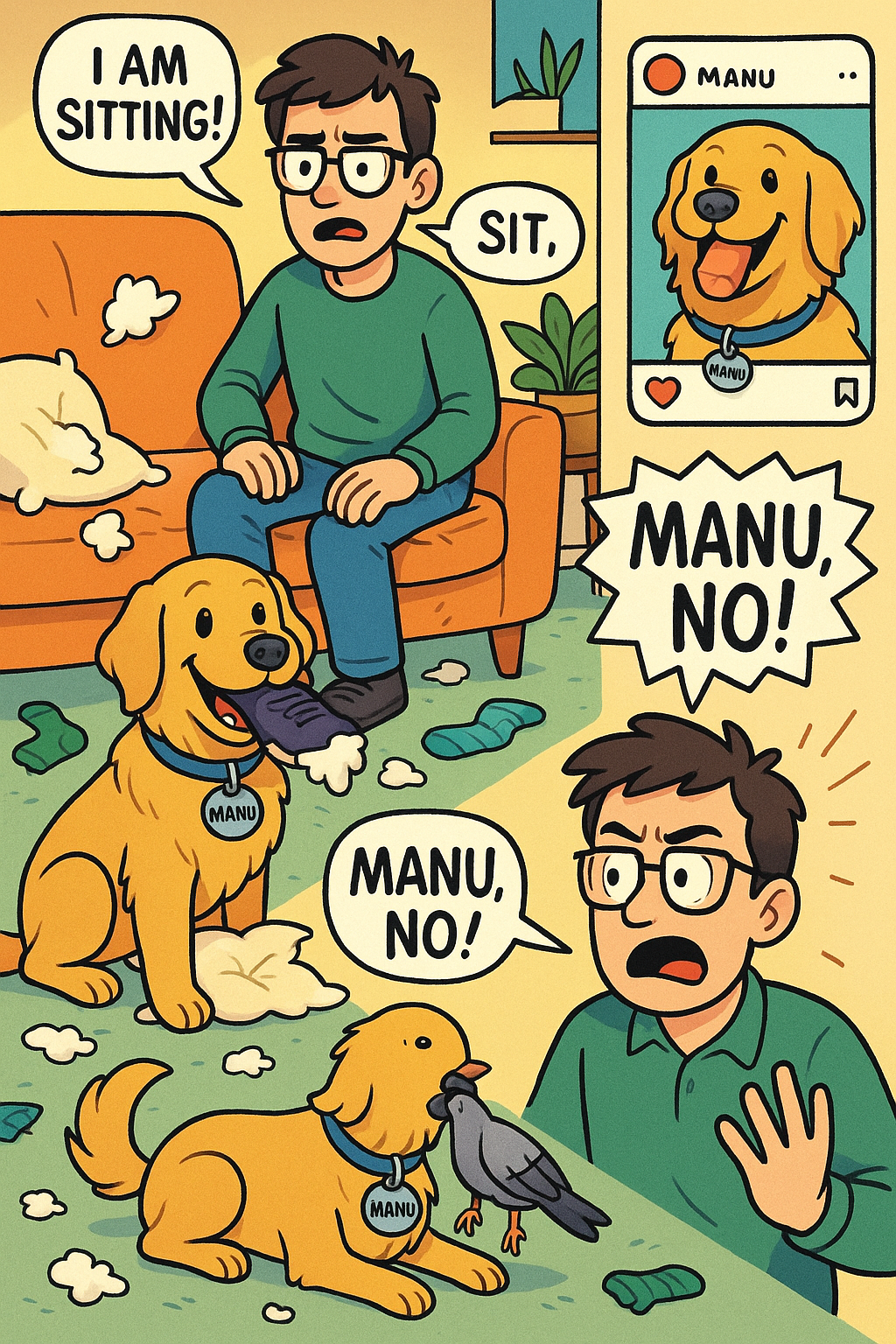
This isn’t just any dog. This is a fluffy, drooling tornado that eats sofa cushions and socks for breakfast. It once proudly presented a dead pigeon as a “gift”. And now, thanks to my dear lifelong friend, this creature shares my name.

Meet Manu.

Or rather, meet Dog-Manu.

I, the human Manu, now live in a world where people often mistake me for a top dog with boundary issues. It started innocently enough. One day, my friend called me and said, “Hey, I got a dog!” Sweet. Dogs are great. Then he added, “And I named him Manu!”

“After me?” I asked, thinking I might have misheard.  

“Yes! Because you’re loyal, funny, and always hungry. It just felt right.”

Right. Because who doesn’t want to be compared to a creature that thinks toilet water is a delicacy?

Even though my friend tried to placate me by saying that dog-manu has been named after his favourite football team, Manchester United (Man-U), it was just too fake for me to digest. 

To make things worse, every time I visit his house, it turns into a comedy of mistaken identity.

“Sit, Manu!”  

“I am sitting.”  

“No, not you. The one licking his nether regions.”

Oh. Good to know I’m the one who isn’t licking anything. Progress.

The other day, our mutual friend called me and exclaimed, “I saw a video of Manu on Instagram with a cube in his mouth!”  

I panicked. “What? When was this? Was I sleepwalking?”  

“No! The dog. Your namesake.”  

Of course. Because nothing screams “legacy” like being remembered as a four-legged menace with a vendetta against all household items.

I’ve also been getting some strange compliments.  

“Wow, Manu, you have such soft ears!”  

“Thanks, since childhood?”  

“Oh no, I meant the dog.”

Sure. Because I definitely needed another blow to my self-esteem.

There are some benefits, though. For example, now I know what it feels like to be loved unconditionally, vicariously, through a golden retriever. People light up when they hear my name, until they realize I don’t respond to belly rubs with tail wags.

But maybe the best part? Every time Dog-Manu gets in trouble for chewing a shoe or peeing on a rug, my friend yells, “MANU, NO!” and then looks at me apologetically, as if he just scolded me personally, which in a way, he has.

So if you’re wondering what it’s like to have your friend name a dog after you, I must say that it’s confusing, mildly humiliating, and an ultimate compliment in a weird way! 

After all, in dog years, I’ll be legendary for at least 87 more.

And let’s be honest, if someone had to be named after a stubborn, loyal, treat-obsessed creature who occasionally pees on rugs during thunderstorms, it might as well be me.

Long live Manu—the dog. And also me, I guess.

How Social Media Reels are Redefining Relationships

Social media has evolved over the last decade and more so during and post COVID-19 from a casual means of communication to a complex social ecosystem where relationships are not only maintained but also publicly measured, performed, and often misunderstood. The act of tagging someone in a post or sending a reel now frequently carries more weight than the content itself and appears to be a new language of intimacy, loyalty, and belonging.

Human relationships were always forged and maintained through physical presence, shared experiences, and mutual conversation. While those elements still hold value, social media platforms like Instagram, WhatsApp, and Facebook have changed social interaction. Friendship seems to have become ‘performative’ and is now getting increasingly defined by our digital gestures, who we tag, send content to, and frequently react to on social media. The exchange of DMs, reels, memes, and story replies may seem petty, but they have become the new currency of connection. In this new digital age, being remembered in someone’s “share” list is a modern affirmation of your place in their emotional world where time is divided and attention is commodified. It’s no longer the maturity of the friendship built over years defining the strength of the connection, this new phenomenon has been affecting and afflicting across all age groups from teens to people in their 70s!

What used to be simple rules for friendship, like coffee, conversations, and sharing silly jokes over text, has now changed. Friendship is now measured in direct messages, tags, and who receives the meme first. It’s no longer just about being included; it’s about being the first and only one included. Because nothing says “you matter to me” like a cat video at 3 AM. Social media platforms promote visibility and engagement. As a result, users develop interaction patterns that reflect this trend. Relationships are increasingly maintained through small interactions: likes, reactions, emojis, replies, and short content exchanges. These replace deeper communication, creating the illusion of closeness without needing much time or vulnerability.

Algorithmic affection is growing. If you engage often with someone’s content, they will show up more in your feed, and vice versa. This strengthens some relationships while quietly undermining others. Sometimes, a drop in communication doesn’t stem from emotional distance but rather because an algorithm has quietly removed someone from your digital view. Social media has turned even the smallest actions into emotional signals that are often unintentional. Reels are like modern-day carrier pigeons of affection, flying through algorithmic skies and delivering 60 seconds of inside jokes, shared interests, or passive-aggressive messages.

A subtle but clear hierarchy has formed in social groups based on digital content. Who sees the funny video first? Who is tagged in the inside joke? Who gets included in close friends’ stories? These digital hierarchies provide new social cues about belonging, preference, and even exclusion. This change creates anxiety and social tension, particularly for those who often read omissions or changes in online behaviour as signs of personal problems. We’ve all experienced this. You’re casually scrolling through the group chat, dodging memes and unwanted life updates, when you notice that your friend has been sending reels, but not to you. Instead, they are sending them to someone else in your friend circle. Betrayal has never looked so clear.

With constant connectivity and “always on” friendships comes an unintended consequence: relational burnout. There was a time when friendships were tested by forgotten birthdays. Now, deep emotional hurt comes from not being tagged in a reel or story about something entirely unrelated. The pressure to respond quickly, stay updated, and keep up with every friend’s online persona can drain the joy of connection. Friendship, once based on depth, now often depends on speed and consistency, two measures that reflect platforms more than people. This urgency leads to miscommunication. A late reply, a missed tag, or a seen-but-not-responded reel can be seen as disinterest or rejection, even if the reason is trivial. As a result, friendships suffer not from real conflict but from imagined slights born from the overly sensitive nature of digital interaction.

Soon, new measures of connection and relationships will emerge, and platforms will introduce new tools to assess your FQ (Friendship Quotient). Measure these three indicators, and you’ll have your FQ. Like quarterly or annual performance reviews at school, these FQ levels will shape the future of friendship.

Quality of friendship = (number of reels received × frequency of tags) / number of mutual story reacts. 

Closeness coefficient = number of times you get the reel before it appears on your public feed/total reels posted. 

Emotional intimacy level = number of times and frequency they send you the reel with “this reminded me of you” instead of a lifeless emoji.

Despite the challenges, social media offers new ways to show care and share thoughts. A well-timed meme or relevant reel can bring laughter, validation, and a shared moment of joy across distances. In an increasingly busy and scattered world, these exchanges can be lifelines.

But, like all technologies, mindful use is essential. As we adjust to this new relational landscape, we should consider, 

– Are we truly connecting, or just maintaining a facade of connection?

– Are we sharing to include others, or to show how close we are? 

– Are we interpreting digital silence too severely, or using it too carelessly?

In the end, while the medium has changed, the need for empathy, intention, and presence remains the same. Whether through reels, texts, or face-to-face conversations, what we all want is simple: to be seen, to be valued, and to know we matter.

Nick’s Italian Kitchen, McLeodganj

Google photo memory showed me a blast-from-past photo from Mcleodganj, and I thought I must write about my favourite breakfast place (and even dinner) from one of my most favourite places in this world. Over last 16-17 years, I have been to McLeodganj several times, and there’s never been a day while being there that I have not spent some quality time relishing food and enjoying the vibe at Nick’s Kitchen.

If you find yourself wandering the streets of McLeodganj, searching for a meal that feels like a warm hug after a trek, Nick’s Kitchen is where you want to be. With its blend of authentic Italian cuisine, a diverse vegetarian menu, and a serene ambiance that captures the essence of McLeodganj’s laid-back, multicultural vibe, being there is not just about the food, it’s a cultural experience! It isn’t just a place to eat – it’s a place to be.

Nick’s Kitchen is located at the Kunga Guest House on the Bhagsunag road. The restaurant features both indoor and outdoor seating, with its expansive rooftop terrace being a standout feature. The first time I went there more than a decade ago, it had few plastic tables and chairs outside, especially in early morning for coffee and breakfast under the sun. Now the terrace is partially covered with multiple seating arrangement, provides breathtaking views of the Dhauladhar valley and surrounding mountains. 

The simple interiors exude a cozy, homey charm with wooden furniture, book-lined shelves, and a relaxed atmosphere. The restaurant’s ability to blend Italian aesthetics with McLeodganj’s monastic, multicultural vibe creates a unique ambiance, which is calm, peaceful, and segmented. Whether you’re a backpacker exchanging stories or a family enjoying a meal together, Nick’s offers a setting that feels inclusive and inviting.

The vibe is relaxed and homely, with a quiet buzz of travellers reading, journaling, or just soaking in the peaceful ambiance. It’s the kind of place where time slows down and conversations linger.

Nick’s Kitchen has a delightful mix of Indian, Tibetan, and Continental dishes, but it’s their delicious comfort food that steals the show. The lasagna is rich, cheesy, and perfectly baked. Their momos (because you musthave momos in McLeodganj) are soft, flavourful, and come with a spicy chutney that wakes up your senses. Don’t leave without trying the banoffee pie, cheesecake or the chocolate walnut cake – they’re nothing short of soul food.

Service is laid-back and friendly, which fits perfectly with the ambiance. You’re not here for fast food; you’re here to unwind, to watch the clouds roll by, get mesmerised by the killer views of snow-capped peaks of Dhauladhar range and to connect either with fellow travellers or simply with yourself. Whether you’re a backpacker, a soul-searcher, a couple, or just someone craving good food with epic views and chill vibe, this little haven in the hills is a must-visit.