Economics of Diwali

As we celebrate the sparkle of Diwali festivities with lights, the Indian economy, too, is glowing with festive energy. Diwali is not only a cultural and spiritual event but also an economic phenomenon that mobilizes consumption, trade, and emotion on a scale unmatched by any other festival in India. It is a festival where faith, finance, and family come together to illuminate not just homes but entire markets.

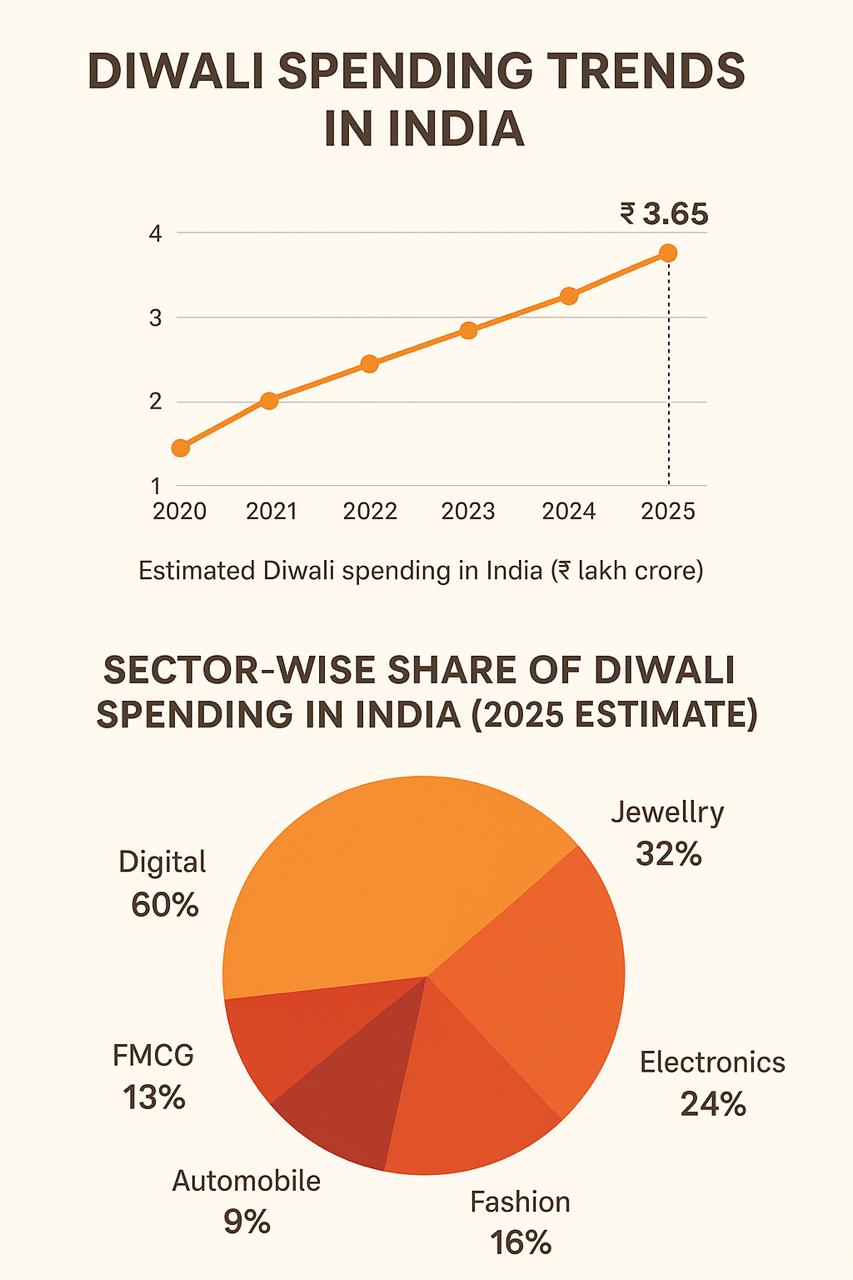
Diwali blends culture and commerce. Traditionally marking the return of Lord Ram to Ayodhya after 14 years of vanavasa (exile), the festival has evolved into India’s largest consumption cycle. According to industry estimates, Diwali season alone accounts for 30–40% of annual sales in sectors like jewellery, automobiles, electronics, apparel, and consumer goods.

In 2024, India’s festive spending during Diwali week was estimated at INR 3.2 lakh crore, reflecting a 17% rise over 2023, driven by rising disposable incomes, pent-up post-pandemic demand, and digital retail penetration. Retail chains, e-commerce platforms, and even microenterprises depend on this period to recover annual profits. For small traders, Diwali is often the difference between a good year and a bad one. The festival also synchronizes the Indian economy’s emotional rhythm—consumer sentiment peaks as the festival approaches, heightened by work bonuses, gifts, and an almost cultural belief that new purchases bring prosperity.
Two days before Diwali, Indians celebrate Dhanteras, considered the most auspicious day to buy gold, silver, or anything of value. Historically, this practice was rooted in agrarian prosperity cycles during which, farmers who had completed the harvest season invested their earnings in tangible assets like metals. Today, the sentiment remains, but the scale has exploded. The symbolism has migrated from the vault to the marketplace, aligning tradition with modern consumption.

Diwali’s economic landscape has been radically redrawn by digital commerce. In 2024, online festive sales crossed INR 90,000 crore, driven by e-commerce platforms like Amazon, Flipkart, and Meesho. Tier-II and Tier-III cities accounted for more than 60% of new shoppers, an indication that India’s digital inclusion is now deeply linked with its festive economy.

Algorithms have replaced astrologers in predicting purchasing patterns. AI-driven recommendations, influencer marketing, and digital payment ecosystems like UPI have made the act of buying faster and impulsive. While urban consumers enjoy massive discounts, small offline retailers struggle to match online prices. Many traditional businesses like sweet shops, garment stores, and gift outlets are now adapting with hybrid models, selling on WhatsApp or through community platforms. The local bazaar is not dying; it is simply going online.

Behind the glitter of malls and advertisements lies a quieter but equally powerful story of the informal and rural economy that powers Diwali. Across India, millions of artisans, potters, weavers, and small manufacturers depend on the season for a significant portion of their income. From handmade diyas in Bihar to terracotta idols from Bankura, paper lanterns in Maharashtra, and bamboo crafts from Northeastern states, Diwali sustains local creative economies that embody both tradition and entrepreneurship. In recent years, several NGOs and social enterprises have helped rural producers connect directly with urban buyers through digital platforms. For instance, self-help groups (SHGs) supported by government programs like NRLM (National Rural Livelihoods Mission) and private CSR initiatives now sell festive handicrafts on e-commerce sites and social media. The “Make in Village” movement during Diwali is becoming a quiet counter-narrative to imported mass-produced goods. Every diya sold is not just a source of light but a livelihood.

Gifting is central to Diwali’s economic ecosystem. From corporate gift hampers to sweets exchanged among families, the ritual symbolizes goodwill, reciprocity, and status. In 2024, India’s corporate gifting industry was valued at ₹12,000 crore, with strong growth projected for 2025. Beyond sweets and dry fruits, companies now gift experiences like wellness vouchers, eco-friendly hampers, and handmade products to reflect social consciousness and sustainability. The gifting economy also reveals deeper social psychology. Gifts during Diwali are not just commodities; they are currencies of relationship. In economic terms, they create “social capital”, the trust and goodwill that sustain business and personal networks alike.

In last decade or so, Diwali’s environmental impact has come under scrutiny. Delhi is the best (or worst) example of this intense air pollution from firecrackers making the environment unbreathable, plastic waste from packaging, and excessive electricity consumption have led to rising calls for a Green Diwali. The market is responding with conscious choices. In 2025, the sale of eco-friendly crackers and biodegradable decorations is expected to grow by 30%. Solar-powered lighting, organic sweets, and recycled packaging are becoming mainstream. Conscious consumers, especially younger urban Indians, are now demanding sustainable alternatives that align celebration with responsibility. The shift from conspicuous consumption to conscious consumption marks a new chapter in the economics of Diwali, one where prosperity is measured not just by spending, but by sustainability.

However, Diwali’s prosperity is not evenly distributed. Inflation affects the purchasing power of lower-income families who often face higher food and fuel prices during the season despite the recent GST reforms, which has significantly brought down the prices of most of the consumer goods. While the urban affluent splurge on gadgets and gold, many households cut back on essentials.

This divergence reflects the broader K-shaped recovery post-pandemic of the Indian economy, where upper segments surge ahead while those on the lower segments struggle. The festive glow, though radiant, hides shadows of inequality. For small retailers, rising input costs and competition from online giants have squeezed margins. For daily wage earners, the festival may mean temporary income spikes but little long-term security. Diwali illuminates both the promise and paradox of India’s growth story.

At its core, Diwali celebrates renewal of hope, homes, and human spirit. Economically too, it acts as a reset button for the nation’s consumer sentiment. The act of cleaning homes, buying new things, and lighting lamps mirrors the cyclical nature of economic optimism. For policymakers and economists, the festive season is a real-time barometer of demand. For families, it’s a reminder that prosperity is not just about wealth, but about togetherness and gratitude. In many ways, Diwali teaches an enduring lesson in economics that growth is sustainable only when it is inclusive, joyful, and mindful.

The economics of Diwali is not just about expenditure, but it is also about the exchange of energy, emotion, and enterprise. It reflects India’s evolving story of modernization rooted in tradition, digital transformation anchored in ritual, and capitalism softened by culture. The future of India’s festive economy will shine brightest when it balances profit with purpose, growth with gratitude, and consumption with conscience.

Algorithmic Self

In today’s digital landscape, our identities are increasingly shaped by algorithms. These complex sets of rules and calculations determine the content we see on social media, the advertisements we encounter, and even the news we consume. This phenomenon, often referred to as the ‘algorithmic self,’ highlights the interplay between technology and personal identity. Algorithmic mechanisms on digital media are powered by social drivers, creating a feedback loop complicating the role of algorithms and existing social structures. 

At the core of the algorithmic self is the idea that our online behaviours and interactions feed into algorithms that, in turn, influence our future actions. Are we becoming the people our feeds want us to be? Scroll long enough on social media platforms like Insta, Tube, or FB and you’ll notice that the content feels uncannily tailored to you. Your feed seems to know what you crave before you do, an oddly perfect mix of travel destinations, recipes, memes, news, workouts, and political takes. This can lead to a more personalised online experience, but it also raises questions about the extent to which our choices are truly our own. What began as a convenience has evolved into something far more consequential. We are not merely using algorithms anymore; we are slowly becoming the selves they design for us.

Algorithms are built to predict and keep us engaged. Every click, pause, like, or scroll is recorded and analysed. In return, the system feeds us more of what we have already consumed. This sounds harmless. After all, who wouldn’t want relevant recommendations? But personalization is never neutral. When a platform rewards the content that hooks us, it amplifies our biases and shrinks our curiosity. Over time, the feedback loop begins to define our worldview, narrowing the range of opinions, art, music, or even relationships we encounter.

The unsettling part is that the algorithm’s goal is not truth, diversity, or personal growth. It is engagement. If desire makes you scroll, it will serve you love. If envy fuels your clicks, it will curate envy-inducing lifestyles. What feels like a reflection of your taste is often a reflection of what keeps you online.

Human behaviour is always shaped by culture, but algorithmic influence is different in speed and precision. Traditional media might set trends, but it never recalibrated itself in real time for every individual. Today, AI systems track micro-reactions—how long your eyes linger on a video frame, how quickly you swipe away, and adjust instantly.

This raises a disturbing question. When you decide to buy a product, support a social cause, or adopt a new hobby, how much of that decision is you, and how much is a carefully engineered nudge? We still feel autonomous because the algorithm rarely forces choices. Instead, it quietly limits what enters the realm of possibility. You can’t choose what you don’t see. Is this the erosion of free will?

Living in an algorithmic world also reshapes identity. Our “digital selves” are rewarded for consistency. The more we like certain posts, the more similar content we receive, and the more we feel pressure to maintain that version of ourselves, whether it’s the fitness enthusiast, the foodie, the activist, or the minimalist. The feed trains us to be predictable because unpredictability breaks the machine’s efficiency.

The rise of the algorithmic self also brings about ethical considerations. There are concerns about privacy, as the data collected to fuel these algorithms often includes personal and sensitive information. Additionally, there is the issue of transparency. Many algorithms operate as ‘black boxes,’ with their inner workings hidden from users. This lack of transparency can make it difficult to understand how decisions are being made and to hold platforms accountable for their actions.

Many people feel a subtle dissonance, their offline preferences drift, but their online persona stays fixed. We perform for the algorithm, optimizing captions, hashtags, even our emotions, to remain visible. Our feeds don’t just reflect who we are, they encourage us to stay who we were yesterday.

But then how do we break the loop?  The answer is not to reject technology altogether. Algorithms are not inherently evil; they can help us discover music, connect with communities, find a job we want, or learn skills we might never find on our own. The challenge is to reclaim agency within the system.

Practical acts of resistance can be quite simple, like, disrupting the feed by clicking on unfamiliar topics or following people outside your cultural bubble; time-box social media use or schedule ‘algorithm-free’ days; read newsletters or listen podcasts where engagement isn’t the primary metric. There could be several other ways to disrupt and reintroduce randomness. However, the most important step, is awareness. Algorithms will always evolve faster than regulations or ethical guidelines. The only lasting defence is a conscious user, someone who understands that every scroll is a form of training data.

The algorithmic self represents a significant shift in how we navigate our identities in the digital age. The question is not whether technology shapes us. It always has. As we continue to integrate technology into our daily lives, it is essential to remain mindful of the ways in which algorithms shape our identities and to advocate for greater transparency and ethical considerations in their design and implementation. The real question is whether we allow a handful of opaque systems to quietly define what we desire, believe, and become. If we don’t actively resist, our algorithmic selves may thrive while our authentic selves quietly disappear into the feed.

How sustainable is Sustainability?

Few words have travelled as far and wide in recent decades as “sustainability”, and has certainly surpassed another overused (in recent past) term ‘social capital’ in usage! It has become synonymous with progress in corporate boardrooms, multilateral summits, government policies, NGO goals, and grassroots movements alike. From ESG scorecards to climate pledges, from net-zero roadmaps to community-led conservation, the language of sustainability has become universal. Every government strategy, corporate report, and grassroots initiative seems anchored in the promise of a more sustainable future. Yet beneath this consensus lies a paradoxical and uncomfortable question: ‘is the sustainability agenda itself sustainable?’

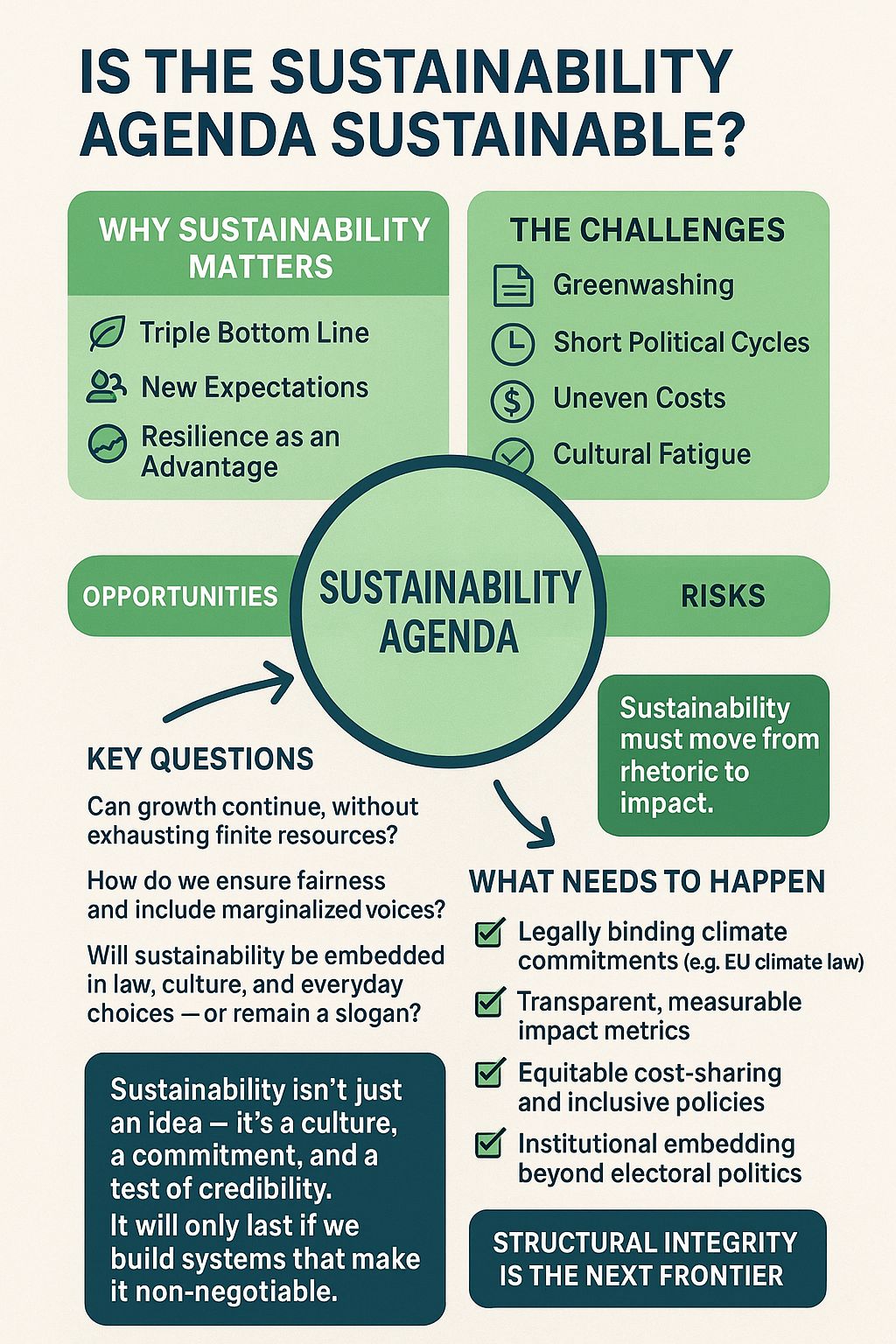
The modern sustainability agenda rests on a powerful proposition that economic growth, social equity, and environmental stewardship can be reconciled. This “triple bottom line” has mobilized unprecedented investment in renewable energy, green finance, and inclusive business models. It has inspired younger generations to demand more from institutions. And it has reframed long-term resilience as a competitive advantage, not a trade-off. But the very breadth of the agenda also makes it fragile. Sustainability risks becoming a catch-all phrase, diluted by overuse and co-opted for public relations more than systemic change. “Greenwashing” scandals, short political cycles, and the uneven costs of climate transitions all threaten to erode public trust. Without credibility and consistency, the agenda risks collapsing under its own ambition.

Sustainability requires commitments that extend far beyond the horizon of electoral politics. Yet in many countries, climate targets or ESG mandates are vulnerable to reversal when governments change. Contrast this with the European Union’s legally binding climate law, a structural safeguard that makes sustainability less of a political preference and more of a shared contract. Unless sustainability is institutionally embedded, it remains hostage to short sightedness.

Green growth advocates argue that economies can decouple prosperity from resource use. The rapid expansion of renewable energy, circular economy models, and impact investing provide evidence of possibility. Yet sceptics highlight that global consumption continues to outpace planetary boundaries. The sustainability agenda will endure only if it reconciles with the fundamental question of growth Vs limits. Can infinite growth coexist with finite resources?

No agenda, however well-intentioned, survives if it is perceived as unjust. For sustainability to be sustainable, it must embody fairness that includes redistributing costs, creating inclusive opportunities, and acknowledging diverse voices, particularly from the Global South. Social justice and legitimacy must go hand in hand.

Ultimately, sustainability is not just a strategy, it is a cultural shift. The more it embeds in consumer choices, organizational values, and educational systems, the harder it becomes to reverse. Yet cultural fatigue is real. When “sustainability” is reduced to a buzzword on every product label, development projects, and corporate brochure, it risks losing meaning. The agenda must therefore move from rhetoric to demonstrable impact, measured transparently and communicated honestly.

The sustainability agenda is both fragile and resilient. Fragile because it depends on long-term alignment across politics, markets, and societies, an alignment often in short supply. Resilient because it has transcended niche environmentalism to become a mainstream expectation that governments and corporations cannot ignore.

Its endurance will depend not on visionary statements but on institutional embedding, equitable policies, and a relentless focus on credibility. At its best, sustainability can serve as the organising principle of a new social contract, aligning business, government, and citizens toward long-term collective wellbeing. Sustainability will only be sustainable if it delivers, not someday, but today.

The next frontier is not about asking companies, governments, or communities to “do more” on sustainability. It is about demanding structural integrity – mechanisms, institutions, and accountability frameworks that ensure sustainability survives political shifts, economic pressures, and cultural fatigue.