Art of Gifting Books

A few of my friends, family members, and a couple of my colleagues gift me books, often on my birthdays, and sometimes in between. I inherited a love for reading from my parents, especially my mother and my grandfather, both of whom have been voracious readers. I received my first book as a birthday gift from my father when I was in school. It was ‘The History of Western Philosophy’ by Bertrand Russel. 

Few gifts in life feel as personal, thoughtful, and lasting as a book. When someone hands you a neatly wrapped rectangle hiding a world within its covers, the gesture means more than just the promise of pages. It carries thought, intimacy, and a recognition of who you are. A book is not merely a gift; it shows understanding. For a book lover like me, it has always represented one of the highest forms of affection, a conversation without words, a silent connection of minds and feelings.

Books reflect both the giver and the receiver. A book requires careful thought, unlike routine gifts like perfume, gadgets, clothes, or vouchers. This act of choosing is intimate, showing familiarity not just with the recipient’s reading habits but also with their inner lives, beliefs, and hidden thoughts. When a friend gives you a book, they often imply, “This reminded me of you.” That unspoken message carries emotional weight. It suggests that they have seen you through the lens of a character, a philosophy, or a poem. It’s like the giver is handing you a mirror showing part of yourself, which possibly one you hadn’t noticed before.

For avid readers, this connection is unmatched as a new book means a new journey and a new companionship. Receiving it as a gift indicates that someone cared enough to guide you toward that path. I have always viewed books as a form of emotional currency. They are not consumed quickly or superficially; they unfold over days or weeks, creating a lasting connection between the giver and receiver. Each time you open a gifted book, you also revisit the memory of the person who gave it to you.

A note inside the cover, like “Hope you love this as much as I did” or “Read and Reflect,” becomes an emotional bookmark for years. Even after the friendship has changed, the note remains, tangible and unforgettable. The book turns into a keepsake of that moment, of that relationship. In this way, books gather layers of meaning beyond their content; they absorb personal histories.

Unlike many modern gifts that can age or fade, books age gracefully. A book received in your twenties might reveal new insights in your forties. A book of poetry shared during a tough year can later offer comfort. In this way, books outlast their occasions; they evolve with the reader. I have re-read several books in my ever-growing collection over the last 20 to 30 years, and each time, I have gleaned a deeper understanding and gained more from the same pages.

Receiving books from family carries a sense of heritage, adding another layer of intimacy and history. Parents who give books to their children often share not just stories but also values and perspectives. When a parent gifts their favourite childhood novel or a worn copy of a classic, it reflects continuity. It communicates, “This shaped me, and I hope it shapes you too.”

Books create a kind of generational dialogue in many homes. A shelf represents a lineage of thought, with dog-eared pages and underlined passages marking the intellectual footprints of those before us. When you receive a book from a family member, you are essentially invited into their memory, to share their inner world for a while. I often have long conversations with my mother about a book, discussing its theme, author, and philosophy. For a book lover, inherited or gifted books become sacred objects. They may have notes in fading ink, dates marking birthdays or milestones, or the faint scent of another home. They are pieces of family history, connected not just by blood but also by shared words and ideas.

Books exchanged among colleagues hold a subtler but equally significant meaning. In professional settings often focused on efficiency and formality, a book gift feels almost revolutionary, reminding us of our shared humanity. When a colleague gives you a book, it usually reflects admiration or intellectual connection. It might be a management classic that inspired them, a work of fiction that echoes your discussions, or a slim volume of essays that reminds them of your curiosity. This gesture crosses the impersonal barriers of the workplace. It conveys, “I see more in you than just your title. I recognise a mind worth connecting with.”

At a time of emails and digital interactions, such gestures feel refreshingly real. A physical book on your desk serves as a reminder of shared curiosity and trust, sometimes sparking discussions that go beyond work. For a book lover, receiving books is like receiving invitations to journeys, friendships, and moments of reflection. The smell of new pages, the design of a cover, and the promise of a new story all bring joy that few other gifts can match. When people give books to an avid reader, they validate and celebrate a part of their identity. It’s as if they are saying, “I respect your passion enough to contribute to it.” 

Book lovers often remember who gave them which book. Their collections become social maps, each title linked to a person, a moment, or a story. That book from a college friend, that poetry collection from a sister, that biography from a mentor—they all combine to create an autobiography of relationships. Every gifted book is also an act of trust. It assumes that the receiver will take the time, reflect, and engage. By giving a book, one offers not instant pleasure but delayed joy. This trust that the recipient will fully experience those pages is deeply personal. Unlike digital or temporary gifts, books require solitude and contemplation. Receiving one gently reminds us of the value of slowing down in a fast-paced world. Perhaps this is why books promote patience, reflection, and empathy.

Moreover, books can be challenging gifts as they can push the reader’s perspectives, encourage new ideas, or even provoke discomfort. A well-chosen book can disrupt complacency while still showing care. This balance between affection and intellectual challenge makes gifting books a refined art. Over time, a personal library becomes a mosaic of gifts and acquisitions, but the gifted ones stand out. They are the volumes we seldom lend or part with. They carry signatures, notes, or memories that root them in our emotional landscape. There’s something almost sacred about rereading a book that once came wrapped in the hands of someone dear to us. The words on the page remain constant, but their meaning shifts as our memories of the giver change. At times, after the giver is gone, the book transforms into a presence, a voice that still echoes in the silence of our shelves.

Therefore, books are not just gifts; they also extend the presence of people. They traverse time, holding fragments of affection, thought, and memory. A gifted book is both a message and a monument as it says, “I thought of you,” and continues to do so long after. For a book lover, each gifted book is a quiet act of love—sometimes romantic, sometimes platonic, sometimes familial, but always genuine. It is a gift that does not fade and grows richer with each reading. In giving and receiving books, we engage in a timeless exchange, not of objects but of selves. Ultimately, every gifted book conveys one simple yet profound message: I see you, and for any reader, there is no greater gift than that.

The bark side of friendship

You know how people say imitation is the sincerest form of flattery? I used to believe that until my friend named his dog after me. I’m still not sure whether to feel honoured or insulted.

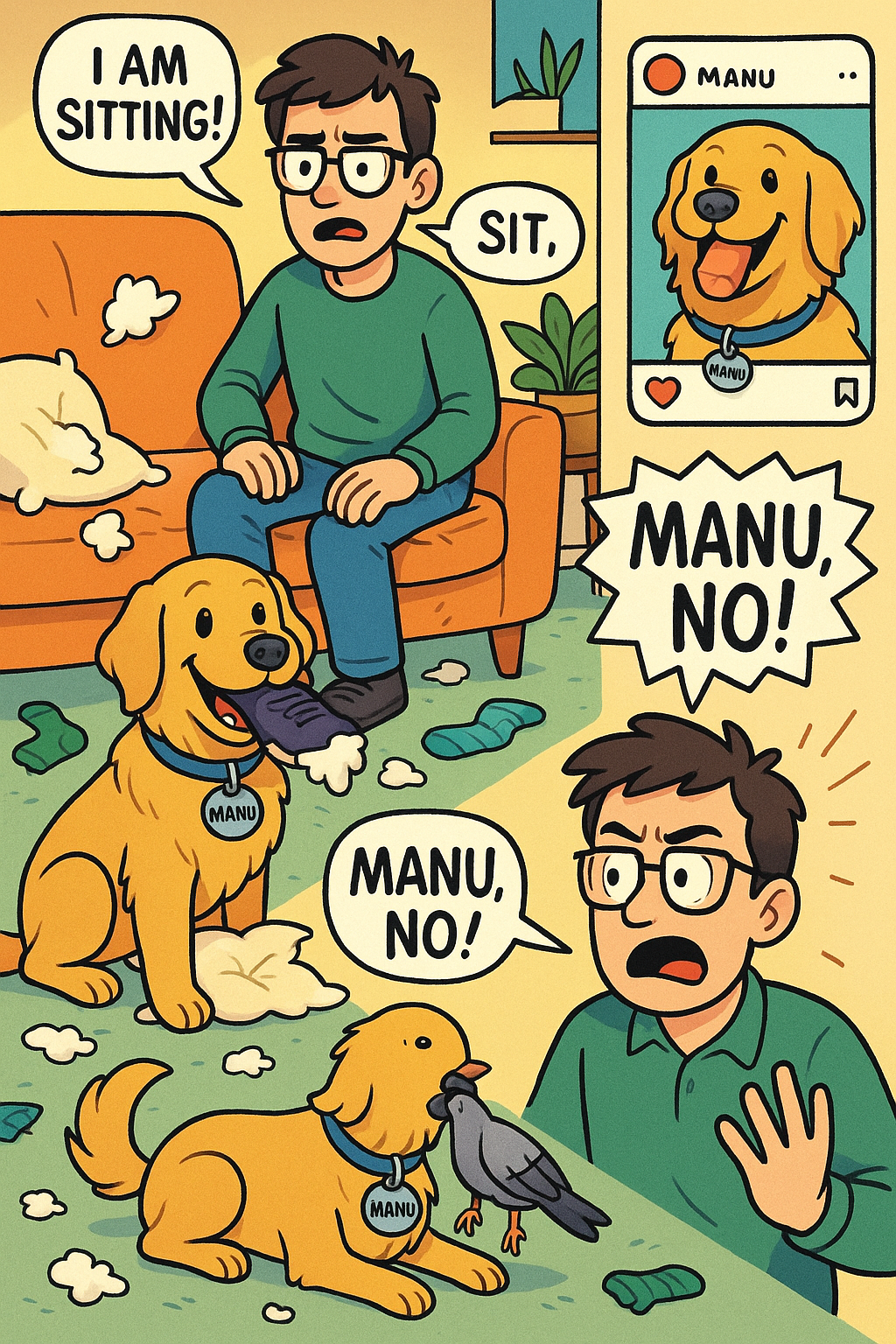
This isn’t just any dog. This is a fluffy, drooling tornado that eats sofa cushions and socks for breakfast. It once proudly presented a dead pigeon as a “gift”. And now, thanks to my dear lifelong friend, this creature shares my name.

Meet Manu.

Or rather, meet Dog-Manu.

I, the human Manu, now live in a world where people often mistake me for a top dog with boundary issues. It started innocently enough. One day, my friend called me and said, “Hey, I got a dog!” Sweet. Dogs are great. Then he added, “And I named him Manu!”

“After me?” I asked, thinking I might have misheard.  

“Yes! Because you’re loyal, funny, and always hungry. It just felt right.”

Right. Because who doesn’t want to be compared to a creature that thinks toilet water is a delicacy?

Even though my friend tried to placate me by saying that dog-manu has been named after his favourite football team, Manchester United (Man-U), it was just too fake for me to digest. 

To make things worse, every time I visit his house, it turns into a comedy of mistaken identity.

“Sit, Manu!”  

“I am sitting.”  

“No, not you. The one licking his nether regions.”

Oh. Good to know I’m the one who isn’t licking anything. Progress.

The other day, our mutual friend called me and exclaimed, “I saw a video of Manu on Instagram with a cube in his mouth!”  

I panicked. “What? When was this? Was I sleepwalking?”  

“No! The dog. Your namesake.”  

Of course. Because nothing screams “legacy” like being remembered as a four-legged menace with a vendetta against all household items.

I’ve also been getting some strange compliments.  

“Wow, Manu, you have such soft ears!”  

“Thanks, since childhood?”  

“Oh no, I meant the dog.”

Sure. Because I definitely needed another blow to my self-esteem.

There are some benefits, though. For example, now I know what it feels like to be loved unconditionally, vicariously, through a golden retriever. People light up when they hear my name, until they realize I don’t respond to belly rubs with tail wags.

But maybe the best part? Every time Dog-Manu gets in trouble for chewing a shoe or peeing on a rug, my friend yells, “MANU, NO!” and then looks at me apologetically, as if he just scolded me personally, which in a way, he has.

So if you’re wondering what it’s like to have your friend name a dog after you, I must say that it’s confusing, mildly humiliating, and an ultimate compliment in a weird way! 

After all, in dog years, I’ll be legendary for at least 87 more.

And let’s be honest, if someone had to be named after a stubborn, loyal, treat-obsessed creature who occasionally pees on rugs during thunderstorms, it might as well be me.

Long live Manu—the dog. And also me, I guess.