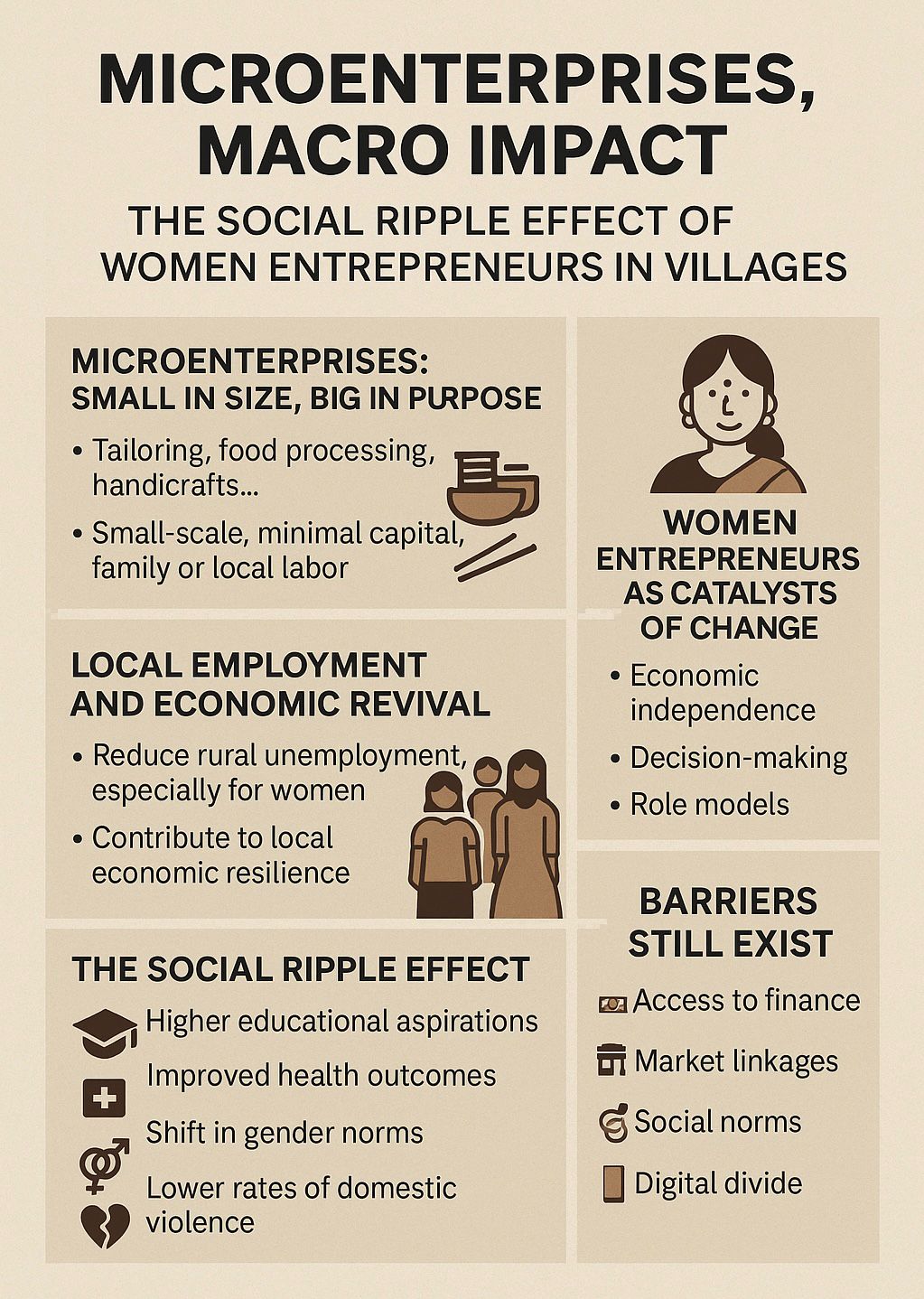
Across India’s villages, a quieter and powerful transformation is unfolding, led by women entrepreneurs building microenterprises that are changing not just their lives but also contributing towards local prosperity.
In rural India, microenterprises (and many a time, even termed as nanoenterprises) are typically small-scale and often home-based ventures. These include tailoring shops, grocery stores, food processing units, poultry farms, handloom or handicraft businesses, among many others. They usually operate with minimal capital, often under INR 1 lakh, and rely on family support systems. While these businesses may appear modest on the surface, they’re laying the foundation for grassroots economic resilience and social transformation.
When a woman in a village starts a business, she’s not just earning an income, she’s stepping into a position of agency. She becomes a decision-maker, a provider, and importantly, a role model.
In Jharkhand, Shashi, a determined and resilient woman, has become a role model of empowerment in her village of Kura. With knowledge, financial and device support, she started her Digital Business, which became a hub of convenience and accessibility for people in her village and neighbouring villages. Her journey as a digital entrepreneur empowered her and gave her the agency to make a meaningful contribution to her community. Today, she’s also a Mukhiya (village head) and fondly known as “Digital Mukhiya”, continuing to be the voice of women’s empowerment.
Microenterprises help address the rural employment gap, especially for women who often can’t migrate or work outside the home due to social norms and family responsibilities. These businesses absorb local labour, retain economic value in the village, and reduce dependence on urban employment.
In Assam, Mintai’s Jacquard Handloom Weaving business now employs 3-4 local women who were previously unemployed. They earn and save, and for the first time, imagine futures that include good education for their children or owning a business.
This kind of bottom-up economic activity contributes to local economic resilience, the ability of communities to survive and thrive even during external shocks. The social impact generated by women entrepreneurs is profound. This often translates into higher educational aspirations for children, especially girls staying and completing their school education; increased income leading to better nutrition, access to healthcare and sanitation leading to improved health outcomes; acceptance and shift in gender norms; and financial independence gives women negotiating power within households leading to lower rates of domestic violence.
Despite their success, rural women entrepreneurs continue to face systemic challenges like, (a) collateral requirements and credit histories disqualify many from accessing formal loans, (b) getting products to larger and fairer markets remains a logistical challenge, (c) stifling social norms due to resistance from family or community, (d) accessing business education to develop ‘aptitude’ matching their entrepreneurial ‘attitude’, and ( e) digital divide due to limited access to smartphones and digital tools. While schemes like Stand-Up India and MUDRA loans have made progress, implementation gaps persist.
Rural women’s microenterprises are not side projects. They are economic engines, social change-makers, and community stabilizers. When one woman is empowered to start a business, a ripple begins, touching families, uplifting communities, and reshaping rural India from the ground up.
If you’re a policymaker, social investor, donor, or even just a storyteller, your support can help expand that ripple into a wave and finally a movement of economic security and resilience.
In last 2-3 years, I have been part of several discussions to define and build a consensus on understanding of urban marginalised and vulnerable population (UMVP) in the context of India, and how this population group has been evolving and growing in numbers. India’s rapid urbanization over the past few decades has transformed its cities into economic powerhouses contributing 60% of India’s GDP. While in 2023 around 37% of India’s population lived in urban areas, it is estimated that by 2036, half of India’s population will live in cities. However, this growth has also led to the marginalization of a significant portion of the population. Cities Alliance estimated that 25% of the population living in urban areas are below the poverty line. By this estimate, a shocking 125+ million people are marginalised and vulnerable living in the urban areas. The urban marginalized and vulnerable groups comprising of slum dwellers, informal workers, migrant labourers, women, children, and the homeless face numerous challenges like access to basic citizens’ rights, services, and opportunities. As India continues its urban transition, addressing the vulnerabilities of these populations is critical to achieving inclusive development.
The UMVPs live in precarious conditions, often lacking access to basic services like clean water, housing, sanitation, healthcare, and education. Their vulnerabilities are shaped by socio-economic, cultural, political, and structural factors that leave them excluded from mainstream urban life. They often lack the necessary documentation to access government schemes and services, such as ration cards, Aadhaar cards, or voter identification. This exclusion prevents them from benefiting from welfare programs like the Public Distribution System (PDS), healthcare subsidies, or housing schemes. The UMVPs can broadly be classified in five sub-groups,
Slum Dwellers: According to the 2011 Census, about 65 million people in India live in urban slums. Slums across India have poor housing, lack of sanitation, overcrowding, and a high risk of diseases, especially communicable. People living in the slums often have insecure tenure, making them vulnerable to eviction and displacement due to urban development projects. Displacement not only disrupts their livelihoods but also pushes them further into poverty. Poor living conditions contribute to health problems, including respiratory diseases (especially TB) and waterborne infections.
Homeless Population: India’s urban homeless population is particularly vulnerable, facing extreme marginalization. With no permanent shelter, the homeless are exposed to harsh weather conditions, violence, and health risks. They have limited access to government welfare schemes and often fall outside the purview of census data, making it difficult to design targeted interventions. HLRN estimates that there could be more than 3 million homeless individuals. Extreme poverty, unemployment, displacement due to natural disasters, mental illness, substance abuse, runaways, are often the causes of homelessness, and their numbers are continuously increasing in urban India.
Informal Workers: The informal sector accounts for nearly 80% of India’s urban workforce. This includes daily wage labourers, street vendors, domestic workers, and construction workers, among others. Informal workers lack job security, social protection, and access to formal financial systems, leaving them vulnerable to economic shocks. The COVID-19 pandemic exposed the extreme vulnerability of informal workers, who faced sudden job losses and had low-to-no access to financial aid. Informal workers often are slum dwellers, or live in low income housing colonies, or are even homeless.
Migrant Laborers: Migration to cities in search of employment and better life is common in India. However, migrant labourers, often from rural areas both intra- and inter-state, face significant challenges in urban settings. They often find employment in low-paying jobs with little to no benefits, live in temporary or inadequate housing, and struggle to access public services due to a lack of local identification documents. Temporary migratory population is also a sub-set of this group, who come to cities for seasonal work, migrate from one place to another, also migrate within the cities in search of work. Construction workers and artisanal nomadic groups can be good examples of migratory population.
Women and Children: Women and children within urban marginalized communities living in slums or informal settlements often work in low-paid informal jobs while managing household responsibilities. They are more likely to experience gender-based violence, discrimination and exploitation, limited access to healthcare, and lack of educational/skilling opportunities. Children in these settings suffer from malnutrition, poor schooling, and limited opportunities for social mobility. They often attend poorly equipped government schools or are forced to drop out to contribute to household income.
India’s urban marginalized and vulnerable populations represent a significant and often overlooked segment of society. Ensuring their inclusion in the country’s urban development is essential for sustainable and equitable growth, while bestowing opportunity and dignity for all citizens as their Right.
Disclaimer: The opinions expressed are those of the author and do not purport to reflect the views or opinions of any organization, foundation, CSR, non-profit or others
India has huge natural bamboo stocks that have been an integral part of Indian culture for many millennia. Bamboo in many ways is the mainstay of the rural Indian economy, sparking considerable social and ecological spin-offs. In the early part of the century, large tracts of bamboo occurred in many parts of the country but were treated by the forestry sector (which was then cast in a production forestry mode) as a weed of little economic value and was used mostly by the rural communities for crafts, making implements and as housing material. It was the discovery of bamboo as a source of long-fiber by the Forest Research Institute in Dehradun that started the process of using bamboo in a variety of industrial applications, so far unexplored, with several paper mills and rayon mills being set up. But in the absence of a clear policy there was rapid degradation and decimation of the resource in much of the country. Bamboo resources plummeted so alarmingly that at present the resource is limited to few pockets in the country. Two-thirds of the bamboo in the country is restricted to the North-Eastern Region (NER) while the remaining one-third is spread across the country.
But there is hope for the resurgence of bamboo, and this is based on evidence of significant new and contemporary economic opportunities that have emerged over the past decades. A bamboo revolution that holds the potential of reversing economic downturns and ensuring profitability, is very much possible. Bamboo is an untapped avenue of economic growth, and a burgeoning bamboo sector can rope in prosperity, profits, and sustainable livelihoods.
Despite the severe degradation of the resource in the past, India still has a considerable growing stock of bamboo, and comparative annual harvest figures[1] still place India at the top of the global league. It is important to realize the considerable latent potential that bamboo has to contribute to economic growth, poverty alleviation, generating employment, rehabilitating vast tracts of degraded land generated due to past agricultural and industrial practices and policies, and revitalizing the social, economic and ecological well-being of rural economies.
In line with this, goals should be aimed at focusing on recovering the resources lost to the rural poor as it has been a natural capital that has helped them to keep their economies afloat even in times of significant cash crunches. Attempts should be made to replenish bamboo stocks, make it economically beneficial to rural communities in a way that it provides them opportunities to earn a sustainable income and improve their standard of living. Efforts should also be made to increase the economic opportunity from the use of bamboo as an industrial raw material, to raise employment opportunities (especially for the educated and unemployed rural youth), and to rehabilitate the degraded lands across the country (making available and productive a natural resource which is increasingly becoming scarce and expensive).
Over the years a variety of strategies have been developed to reduce the poverty of rural and rurban population through small enterprise development, based on various forest produce. In rural areas, the poor are overwhelmingly dependent on natural resources and in most cases, it is the only capital they possess. They have little power or ability to climb out of poverty. They are not only financially poor, but also opportunity-and knowledge-poor. In this respect, bamboo is one of the few natural resources that could provide a lifeline to sagging rural economies and help integrate them into the market economy. As bamboo is not one commodity but the fountainhead of many products, it could open up a number of markets simultaneously for the rural poor with the added advantage of being a low-risk option.
The bamboo sector also forges personal links with the rural community, allowing them to participate closely in production processes and directly access profits through value addition as compared to other industrialized processes. As the sector is dependent to a large extent on manual labour, it demands many hands to contribute to the cultivation, harvesting, preservation and value-added manufacturing processes. The upshot is that it provides livelihood options in varying activities to a large number of rural workers. This is the main reason why developing countries find it more viable to be involved with the sector whereas developed countries prefer becoming consumptive markets for these very products. Women in particular stand to gain from this sector as they secure means of livelihood due to their dexterity with the material and their ability to shape it into products and more important, they gain from the flexible work hours this sector affords. Bamboo can thus break marginalization through empowerment and also bridge gender divides.
Employment generation and livelihood creation are enabled through strong backward integration of bamboo production and processing. Though tree-like in stature, bamboo is best grown and managed like an agricultural crop or managed as such within the forest. This needs labour input, which calls for significant people involvement. Again, volume production in bamboo is achieved through a large number of unit poles, unlike timber where one large log provides a substantial quantity of wood. But on the other hand, the lightweight poles enable people participation in its transport. Furthermore, the easy linear splitting ability of bamboo, quite unlike that of wood, enables primary processing for a final industrial product to be undertaken by the rural community. The above properties lay the economic basis for definite win-win community-industry partnerships in bamboo, with the bamboo being managed or grown, and primary processing undertaken by communities in rural areas.
Experience has shown natural resources can be harvested sustainably if people stand to benefit from it. The development of bamboo as a cash crop will result in the conservation and protection of the existing resource, and the scaling up of cultivation, which would be a natural outcome of the increased cash value of the resource, as against its present low cash to mere-subsistence value. The environmental benefits from the economic development of bamboo can be very significant.
As a resource that can be harvested annually, it could provide a regular supply of construction material to the communities. If the use of wood could be replaced with that of bamboo, it could reverse the process of severe and rapid degradation of forests and forest cover. Bamboo also helps protect soil from erosion, especially in the upland areas. Bamboo should also be strategically grown to reduce or prevent soil cutting from riverbanks, which is perhaps the major cause of siltation of riverbanks, resulting in reduced carrying capacity of rivers and flooding during the peak rainy season.
In last 3-4 decades, intensifying patterns of land and resource utilization, primarily due to pressure from the rapidly increasing population, have caused land and natural resource degradation in many parts of India. Bamboo is an ideal resource for rehabilitation, even in extremely degraded situations such as land used for brick making.
India with its rich potential of bamboo resources has only just started to develop bamboo marketing and trade. However, the significant bamboo resources in India make it ideally placed to benefit from the experience of China and other countries around the globe. Bamboo holds within it the promise of bailing people out from below poverty line levels.
Bamboo finds many uses today in addition to its conventional uses for handicrafts, scaffolding and the paper industry. It can be used as construction material, as a wood substitute and as food, fuel and a filtration medium. Its real contribution to housing lies in the dual role it can play – of providing a cheap and affordable wood alternative to the homeless while at the same time generating livelihood options for those involved with it.
Bamboo can propel economic growth through increased local production and the sale of high-value wood-substitute products, especially in bamboo-rich states. Robust local production of a local natural resource capital like bamboo will lead to the retention and circulation of cash within the state economies itself, rather than the cash flowing out for purchase of goods from outside the state. Export of cash value-added bamboo products to markets outside the bamboo states could enable incremental cash earnings that will add to the economic growth of the state. Asset creation and local consumption can get a fillip from the increased circulation of money within the state economy from local consumption of locally manufactured products. This consumption will be enabled not only by government purchases, but also as a result of the higher disposable incomes that will be generated.
In India, as elsewhere in other developing countries, strong correlative linkages exist between economic growth, rural poverty and the environment. Firstly, the poor are more vulnerable to the health effects of pollution because of their inadequate nutrition, poor access to health care and their unhealthy living environment. Secondly, the poor are affected faster by degradation of natural resources because of their greater reliance on them to meet basic needs. Environmental degradation, in turn, adversely affects the economy’s capacity to grow, because growth relies on the sustainable productivity of natural resources and the health of the population.
It is a vicious circle, which can be broken through a growth solution that is not only income generating for rural communities but also environmentally sound. Bamboo, a natural resource and one that protects the environment, enables the development of industries, which function through a symbiotic linkage between small and large enterprise that significantly benefits the community.
Bamboo is available throughout the country barring the states of Jammu and Kashmir and Rajasthan (except for some areas). Existing traditional bamboo and cane handicraft products, though not many, could be improved, diversified, produced along industrial assembly lines and converted into value-added products that are already a part of mainstream industry. Value additions could be made to its use in the paper industry and its use in the unorganized scaffolding industry can be doubled. Simultaneously, other mainstream micro and small enterprise products such as matchsticks, pencils, toothpicks, skewer sticks, and blinds, as well as medium-scale industrial panel products that rival wood products, with strong backward community linkages and benefits can be explored. An increase in bamboo products and market opportunities will also result in increases in demand for raw bamboo, besides the production of fresh bamboo shoots and their processed products. There is considerable potential to set up medium and large-scale industries for generating value-added food and wood-substitute products for export markets.
The value-added bamboo industry is ideally placed to adopt that model. Given the right policy atmosphere and thrust, the value-added bamboo industry in India has the potential of reaching a size of USD 2.3 billion (USD 131.5 billion globally) in the next 10 years with a CAGR of 10.3%, employing 11-15 million people in the primary, secondary and tertiary sectors[2].
The bamboo industry also fulfils the criteria needed by sectors that aim to achieve double-digit economic growth. Bamboo has a very strong and direct with rural communities, which would allow them to partake directly and in a more significant way to value addition as compared to other industrialized processes. The value-added bamboo industry thus provides an integrated solution that uses an abundant natural resource that protects the environment and can be processed and generated through community-owned enterprises, both small and large.
Disclaimer: The opinions expressed are those of the author and do not purport to reflect the views or opinions of any organization, foundation, CSR, non-profit or others
“In God we trust. All others must bring data.” This quote, made by W. Edwards Deming holds true (and may even supersede God for some as Divine).
I have been in love with data right from my school years and the mysteries of the world it holds. I have tried to develop data driven models on human relationships, the movement of animals, finding patterns in the ways of the world, and later designing programs of social impact for challenging poverty, and policy development. In the end, we all are data, from the moment we are an idea until long after we pass away.
“Data is divine” highlights the growing understanding of data’s vital significance in modern society, in much the same way that religious or spiritual values have directed civilizations throughout history. In today’s digital age, data powers innovation, decision-making, and advancement in all fields, including governance, research, business, healthcare, and lifestyle.
1. Data as a source of truth: Data is frequently regarded as an impartial depiction of reality, providing information on trends and occurrences that may be imperceptible to anecdotal experience or intuition. In this way, data has a unique position as the basis for making well-informed decisions and uncovering hidden facts.
2. The power of data in innovation: Data is driving advancements in domains like healthcare, finance, and climate science and is revolutionizing industries as it powers AI/ML and sophisticated analytics. This emphasizes how data has the “divine” ability to spark significant change. The use of data for enhancing human welfare, from preventing pandemics through data-driven epidemiology to lowering inequality by studying societal trends has been in use. When applied sensibly and morally, it can aid in resolving some of the most pressing issues facing society.
3. Data as omnipresent: From the apps we use daily to the systems that manage our cities, data is present everywhere in the modern world. Its pervasiveness is comparable to a certain “divine” quality in that it affects almost every facet of contemporary life, whether we are conscious of it or not.
4. Data and ethics: Data carries a great deal of responsibility along with its power. Similar to supernatural knowledge, there are significant ethical ramifications to the way we collect, use, and safeguard data. Data misuse can result in inequality, manipulation, and privacy violations. As a result, it is crucial to handle data with dignity, openness, and ethics.
“Data is divine” also implies that we must treat it with deference and accountability while simultaneously appreciating its immense importance in shaping our future. We need to balance the power of data with ethical considerations as our world grows more and more data driven. The following are some crucial strategies to preserve this equilibrium,
1. Data privacy and informed consent: People ought to be in charge of how their information is gathered, kept, and utilized. It is not appropriate to force them to divulge information. Companies must be open and honest about their data practices so that users know what information is being gathered and why. Clear and informed consent should not be buried in complicated terms and conditions. Data literacy is essential among general population so that they are aware of the consequences of disclosing personal information, and the dangers of data misuse.
2. Data minimization: Only gather information that is absolutely required for the current job. This reduces the possibility of abuse and shields people from needless exposure. I’ve seen in recent years how social development initiatives gather and store vast amounts of data, with donors coercing their nonprofit partners to obtain it, yet this doesn’t address any societal issues. It is crucial to have a conscious grasp of what is needed.
3. Data bias and fairness: AI/ML systems may reinforce or increase biases found in the training data. Therefore, diversifying datasets, employing inclusive development techniques, and reviewing algorithms for bias are all necessary to ensure fairness.
4. Equitable data access: One way to lessen inequality is to make sure that data access and its advantages are shared equitably among all communities. This entails preventing the reinforcement of systemic disadvantages while ensuring that marginalized groups have access to data-driven insights.
5. Data governance and accountability: To ensure that data is utilized properly, organizations and governments must establish robust data governance policies and ethical frameworks. To stay up with the latest developments in technology, these policies must be revised regularly. It is imperative to establish unambiguous lines of accountability for the handling and utilization of data. Data practices can be kept moral and in line with social standards with the support of independent oversight organizations or ethics boards.
6. Regulation and legal safeguards: Strong data protection laws that impose restrictions on how businesses and organizations can gather, keep, and handle personal data must be enforced by governments. Laws that address issues like accountability for algorithmic judgments, eliminating discrimination, and safeguarding human rights in AI-driven systems are crucial for the ethical application of automation and artificial intelligence. Because technology is changing so quickly, regulatory models must be adaptable and flexible to support innovation and enable quick responses to emerging ethical dilemmas.
7. Data for social good: Data can and should also be used positive social impact including lowering inequality and poverty, combating climate change, and improving public health. Governments, corporations, and civil society organizations working together can help guarantee that data is used morally and for the good of society. These collaborations may result in common frameworks for the ethical use of data.
A multifaceted strategy including legislation, transparency, public education, and proactive governance is needed to strike a balance between the power of data and ethical issues. Prioritizing the defence of individual rights, maintaining equity, and advancing the common good while fostering innovation should be the main goals of ethical data use. Through cultivating a culture of accountability and responsibility, we can leverage data’s promise (and divinity) without sacrificing moral principles.
Disclaimer: The opinions expressed are those of the author and do not purport to reflect the views or opinions of any organization, foundation, CSR, non-profit or others
In a twist of fate that seems like it was ripped straight from the pages of a dystopian novel, Planet Earth has decided it’s time for a little payback. And who can blame it? After decades of exploitation, pollution, and blatant disregard for its well-being, the Earth is ready to reclaim its throne. So, buckle up and prepare for the “Revenge of the Planet,” a wild ride through the hilarious and dramatic consequences of our environmental neglect.
The year was 2030, and Earth had been dealing with humanity’s nonsense for centuries: automobile humming, factories puffing, and smartphones buzzing, plastic in the oceans, air full of smog and pollutants, and forests reduced to sad little patches that looked like Mother Nature’s receding hairline. While we humans went about our business, basking in the glow of smartphones and conveniently ignoring every climate report ever written, the planet finally had enough. It was time for some cosmic payback.
First came the heatwaves. When the sun started sizzling eggs on car hoods and air conditioners were breaking down in sheer exhaustion, we should’ve known something was up. Earth wasn’t playing anymore. Then came the incessant rain, cyclones and Hurricanes. Thousands of cities and villages got flooded killing all in their wake: humans, animals, trees, cars, houses, all were game for the planet’s rage. As glaciers melted at a pace faster than your average deadline in an office setting, and wildfires spread like trending tweets, humans start to notice. Our beloved beaches? Now more like lava zones.
As Earth’s revenge gained momentum, the animals began organizing. Rats—usually content with minor mischief like digging up flower beds—became stealth operatives, chewing through power lines and cutting off electricity to entire neighbourhoods. Birds, tired of dodging skyscrapers, formed tactical squadrons to stage mass air raids on unsuspecting pedestrians. Pigeons, already seasoned in the art of airborne attacks and eating through aircon units, took their missions to new heights, dive-bombing with precision accuracy.
Mother Earth had one last ace up her sleeve: technology. Since humans had become so dependent on gadgets, she decided to hit us where it hurt. Phones suddenly started overheating for no reason, GPS systems began suggesting scenic routes through uncharted forests, and voice assistants became strangely passive-aggressive.
“Hey, Siri, what’s the weather today?”
“Why don’t you go outside and find out for yourself, you lazy carbon footprint.”
By the time forests started sprouting overnight and the Arctic ice declared “We’re back!” humanity finally took notice. Governments convened emergency meetings to address the phenomenon, though the politicians were quick to blame each other.
“We need to plant more trees!” one leader shouted.
“But the trees are literally attacking us,” another replied.
Meanwhile, while we sat glued to our screens, watching the chaos unfold, the bees are buzzing in the background. That’s right, our fuzzy little friends are holding clandestine meetings, plotting a revolt. “We’ll stop pollinating crops if they don’t start recycling!” one bee declares, and with that, the price of avocados skyrockets, pushing millennials to the edge of madness. Who knew that eco-awareness could double as a financial crisis?
After a series of failed peace talks with the ocean (which responded with a tsunami every time someone brought up offshore drilling), humans collectively realized: we were in deep compost!
Just as it seemed like Earth would forever reign supreme, a surprising thing happened. Humans finally got their act together. It’s time for a Renaissance! Countries began cooperating—trading carbon offsets instead of insults. Renewable energy became the norm. Plastic was replaced by biodegradable alternatives, and landfills shrank faster than your favourite sweater. People rally together armed with reusable bags and solar panels. Urban gardens sprout up like mushrooms after a rain, while communities bond over composting workshops. It’s a revolution of education, where every child learns how to plant a tree faster than their parents can say, “Remember when we just used to throw things in the landfill?” In the end, Earth called off her revenge, not because she couldn’t win, but because she wanted to see what we’d do next. As for humanity, we learned the hard way that Earth isn’t just a rock floating in space—it’s a vengeful force of nature with a wicked sense of humour. And if we want to stay on its good side, we’d better treat it right.
Disclaimer: The opinions expressed are those of the author and do not purport to reflect the views or opinions of any organization, foundation, CSR, non-profit or others