Microenterprises, Macro Impact: The transformative social impact by rural women entrepreneurs

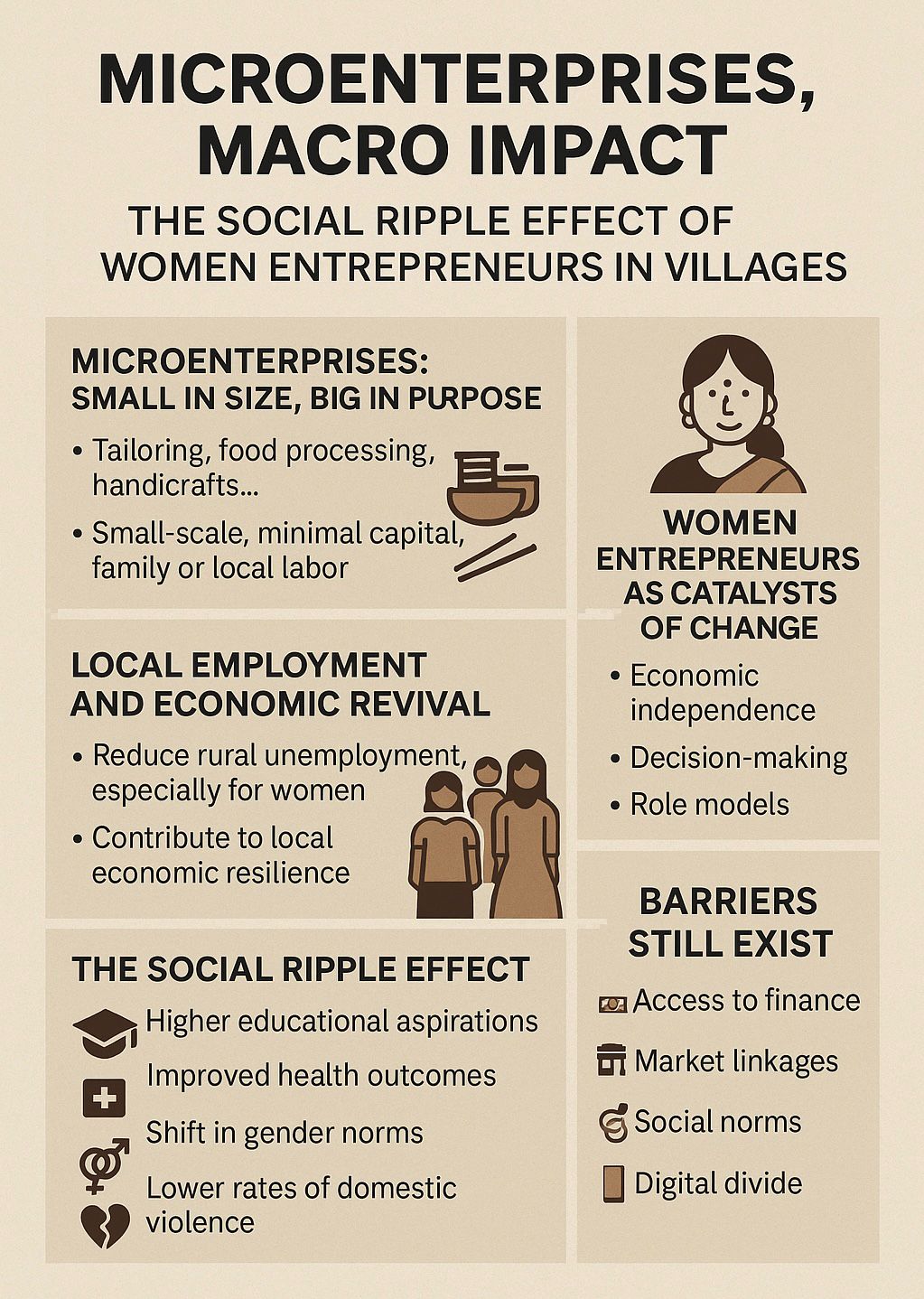
Across India’s villages, a quieter and powerful transformation is unfolding, led by women entrepreneurs building microenterprises that are changing not just their lives but also contributing towards local prosperity.

In rural India, microenterprises (and many a time, even termed as nanoenterprises) are typically small-scale and often home-based ventures. These include tailoring shops, grocery stores, food processing units, poultry farms, handloom or handicraft businesses, among many others. They usually operate with minimal capital, often under INR 1 lakh, and rely on family support systems. While these businesses may appear modest on the surface, they’re laying the foundation for grassroots economic resilience and social transformation.

When a woman in a village starts a business, she’s not just earning an income, she’s stepping into a position of agency. She becomes a decision-maker, a provider, and importantly, a role model.

In Jharkhand, Shashi, a determined and resilient woman, has become a role model of empowerment in her village of Kura. With knowledge, financial and device support, she started her Digital Business, which became a hub of convenience and accessibility for people in her village and neighbouring villages. Her journey as a digital entrepreneur empowered her and gave her the agency to make a meaningful contribution to her community. Today, she’s also a Mukhiya (village head) and fondly known as “Digital Mukhiya”, continuing to be the voice of women’s empowerment.

Microenterprises help address the rural employment gap, especially for women who often can’t migrate or work outside the home due to social norms and family responsibilities. These businesses absorb local labour, retain economic value in the village, and reduce dependence on urban employment.

In Assam, Mintai’s Jacquard Handloom Weaving business now employs 3-4 local women who were previously unemployed. They earn and save, and for the first time, imagine futures that include good education for their children or owning a business.

This kind of bottom-up economic activity contributes to local economic resilience, the ability of communities to survive and thrive even during external shocks. The social impact generated by women entrepreneurs is profound. This often translates into higher educational aspirations for children, especially girls staying and completing their school education; increased income leading to better nutrition, access to healthcare and sanitation leading to improved health outcomes; acceptance and shift in gender norms; and financial independence gives women negotiating power within households leading to lower rates of domestic violence.

Despite their success, rural women entrepreneurs continue to face systemic challenges like, (a) collateral requirements and credit histories disqualify many from accessing formal loans, (b) getting products to larger and fairer markets remains a logistical challenge, (c) stifling social norms due to resistance from family or community, (d) accessing business education to develop ‘aptitude’ matching their entrepreneurial ‘attitude’, and ( e) digital divide due to limited access to smartphones and digital tools. While schemes like Stand-Up India and MUDRA loans have made progress, implementation gaps persist.

Rural women’s microenterprises are not side projects. They are economic engines, social change-makers, and community stabilizers. When one woman is empowered to start a business, a ripple begins, touching families, uplifting communities, and reshaping rural India from the ground up.

If you’re a policymaker, social investor, donor, or even just a storyteller, your support can help expand that ripple into a wave and finally a movement of economic security and resilience.

(All views are personal)

(Cover image generated using AI)

#Stand-upIndia #LetsDoMore

Who are urban marginalized people

Photo Credit: https://humana-india.org/

In last 2-3 years, I have been part of several discussions to define and build a consensus on understanding of urban marginalised and vulnerable population (UMVP) in the context of India, and how this population group has been evolving and growing in numbers. India’s rapid urbanization over the past few decades has transformed its cities into economic powerhouses contributing 60% of India’s GDP. While in 2023 around 37% of India’s population lived in urban areas, it is estimated that by 2036, half of India’s population will live in cities. However, this growth has also led to the marginalization of a significant portion of the population. Cities Alliance estimated that 25% of the population living in urban areas are below the poverty line. By this estimate, a shocking 125+ million people are marginalised and vulnerable living in the urban areas. The urban marginalized and vulnerable groups comprising of slum dwellers, informal workers, migrant labourers, women, children, and the homeless face numerous challenges like access to basic citizens’ rights, services, and opportunities. As India continues its urban transition, addressing the vulnerabilities of these populations is critical to achieving inclusive development.

The UMVPs live in precarious conditions, often lacking access to basic services like clean water, housing, sanitation, healthcare, and education. Their vulnerabilities are shaped by socio-economic, cultural, political, and structural factors that leave them excluded from mainstream urban life. They often lack the necessary documentation to access government schemes and services, such as ration cards, Aadhaar cards, or voter identification. This exclusion prevents them from benefiting from welfare programs like the Public Distribution System (PDS), healthcare subsidies, or housing schemes. The UMVPs can broadly be classified in five sub-groups,

  1. Slum Dwellers: According to the 2011 Census, about 65 million people in India live in urban slums. Slums across India have poor housing, lack of sanitation, overcrowding, and a high risk of diseases, especially communicable. People living in the slums often have insecure tenure, making them vulnerable to eviction and displacement due to urban development projects. Displacement not only disrupts their livelihoods but also pushes them further into poverty. Poor living conditions contribute to health problems, including respiratory diseases (especially TB) and waterborne infections.
  • Homeless Population: India’s urban homeless population is particularly vulnerable, facing extreme marginalization. With no permanent shelter, the homeless are exposed to harsh weather conditions, violence, and health risks. They have limited access to government welfare schemes and often fall outside the purview of census data, making it difficult to design targeted interventions. HLRN estimates that there could be more than 3 million homeless individuals. Extreme poverty, unemployment, displacement due to natural disasters, mental illness, substance abuse, runaways, are often the causes of homelessness, and their numbers are continuously increasing in urban India.
  • Informal Workers: The informal sector accounts for nearly 80% of India’s urban workforce. This includes daily wage labourers, street vendors, domestic workers, and construction workers, among others. Informal workers lack job security, social protection, and access to formal financial systems, leaving them vulnerable to economic shocks. The COVID-19 pandemic exposed the extreme vulnerability of informal workers, who faced sudden job losses and had low-to-no access to financial aid. Informal workers often are slum dwellers, or live in low income housing colonies, or are even homeless.
  • Migrant Laborers: Migration to cities in search of employment and better life is common in India. However, migrant labourers, often from rural areas both intra- and inter-state, face significant challenges in urban settings. They often find employment in low-paying jobs with little to no benefits, live in temporary or inadequate housing, and struggle to access public services due to a lack of local identification documents. Temporary migratory population is also a sub-set of this group, who come to cities for seasonal work, migrate from one place to another, also migrate within the cities in search of work. Construction workers and artisanal nomadic groups can be good examples of migratory population.
  • Women and Children: Women and children within urban marginalized communities living in slums or informal settlements often work in low-paid informal jobs while managing household responsibilities. They are more likely to experience gender-based violence, discrimination and exploitation, limited access to healthcare, and lack of educational/skilling opportunities. Children in these settings suffer from malnutrition, poor schooling, and limited opportunities for social mobility. They often attend poorly equipped government schools or are forced to drop out to contribute to household income.

India’s urban marginalized and vulnerable populations represent a significant and often overlooked segment of society. Ensuring their inclusion in the country’s urban development is essential for sustainable and equitable growth, while bestowing opportunity and dignity for all citizens as their Right.

Importance of family counseling in entrepreneur selection

A person requires to possess both ‘can do’ attitude and aptitude for business to start on an entrepreneurial journey. But is that enough? Often an entrepreneur’s success is celebrated as an individual, but seldom the support system in the form of family and friends are discussed due to which the entrepreneur has achieved success. This is irrespective of the nature and size of business, geography, gender and backgrounds of the entrepreneur, and investment that goes in the venture.

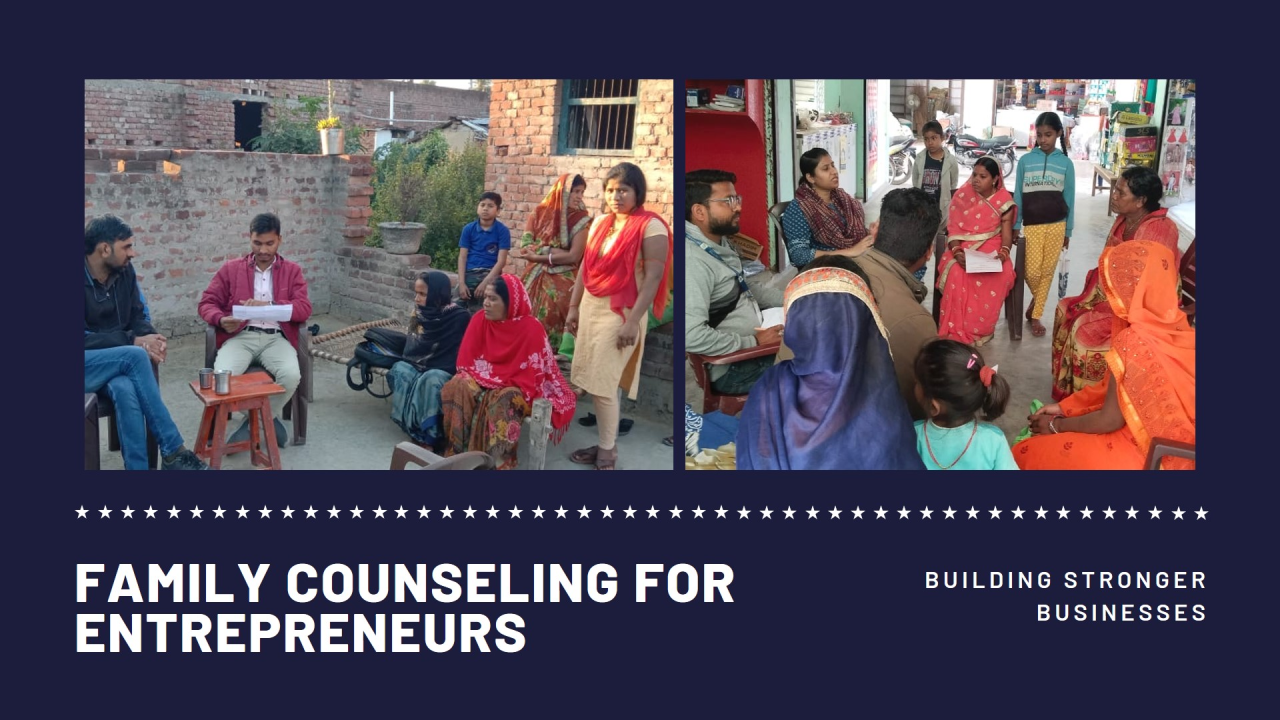
While there’s no age to starting a business, the development programs I am working with focuses on women and girls in the age group of 18-50 years from poor and low-income households in the rural areas, with a desire to be self-employed and in future create employment for the youth in their respective villages. Selection processes of such aspiring entrepreneurial women vary depending on the model and approach of the programs. For the conventional businesses existing vocational skills and basic business acumen is analyzed, for others apart from these qualities, level of confidence, ability to invest their time, efforts, and money, general awareness, and other aptitude tests are conducted to measure the eligibility. What remains common across, and I believe is one of the most crucial factors for them to succeed from the word go is the support of their families, which remains the backbone of their ventures during and after the programmatic support. Therefore, post shortlisting of a potential entrepreneurial candidate, family counselling becomes the ultimate decider for her to join the program. And no, it has nothing to do with patriarchy. It’s same for any gender, and I think anywhere in the world. I have been a serial entrepreneur in my past, and have experienced in firsthand that without family support, I could have only done so much.

Family background including the size, type, and economic status can influence entrepreneurs’ and, therefore, entrepreneurship development. Even if the entrepreneurial spirit doesn’t necessarily run in the family, their support plays a vital role in an entrepreneur’s journey. Through their belief, encouragement, constant motivation, and involvement, families provide a nurturing environment for entrepreneurial growth.

In the process of meeting the family at their house in the village and discussing about their current livelihood and income sources, level of education in the household, aspirations and future plans, nature of relationship with the potential entrepreneurial candidate, sharing about the program, and earning their commitment of being the wind  beneath the wings of their daughters, daughters-in-law, wife, and in turn building trust is the main agenda of the family counselling. This support is the most important step and measure for induction of an aspiring candidate in our entrepreneurship program. Garnering this support is half the battle won for the aspiring entrepreneur.

The hard work has to be of the entrepreneur, but families give financial assistance and provides the seed capital for the start-up, provides emotional assistance keeping the morale high during those challenging and difficult times that every entrepreneur undergoes, promote the venture in their long curated networks both within and outside their villages through word-of-mouth, volunteer their time at the business to attend to customers and promotion, and more importantly celebrate even the small moments of joy together.

Apart from money and market, family support is the third pillar of the tripod, which drives entrepreneurial success.

If you want to know more about designing rural women entrepreneurship projects and/or learn about family-counselling for rural entrepreneurship, feel free to connect.

(First published on LinkedIn on 6th March 2024)