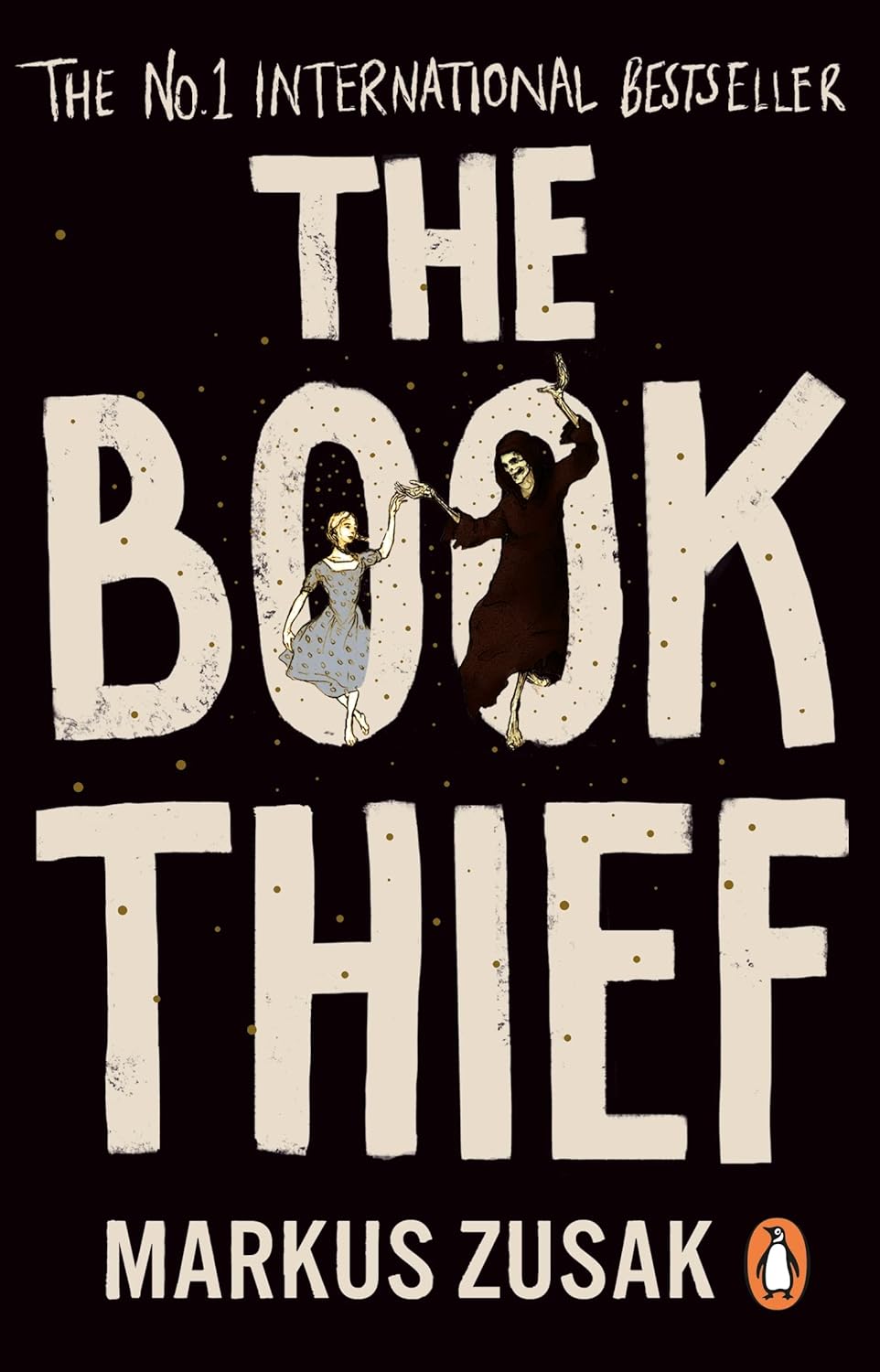
The Book Thief

Author: Markus Zusak | 560 PagesGenre: Historical Fiction | Publisher: First edition published by Alpha 2 Omega Books. My edition published by Penguin Random House (2018) | Year: 2005 | My Rating: 9/10

“The human heart is a line, whereas my own is a circle, and I have the endless ability to be in the right place at the right time. The consequence of this is that I’m always finding humans at their best and worst. I see their ugly and their beauty, and I wonder how the same thing can be both”
― Markus Zusak, The Book Thief

The Book Thief combines brutality and beauty with extraordinary grace, and I found it to be truly unique and spectacular. The novel is set in 1939 Nazi Germany, during World War II, where the story is a haunting exploration of love, loss, language, and the power of storytelling to preserve humanity. Narrated through the unexpected voice of Death, the novel redefines the familiar war narrative, which is both poetic and profoundly human.

The story centres on Liesel Meminger, a young girl sent to live with foster parents Hans and Rosa Hubermann in Molching, near Munich. After her brother dies en route to their new home in 1939, Liesel steals her first book, marking the beginning of her quiet rebellion through reading. Liesel’s foster father, Hans, patiently teaches her to read during late-night sessions in their basement. Liesel’s foster mother, Rosa, is gruff yet deeply protective. For Liesel, books become both a refuge and a means of resisting the Nazi regime’s manipulation of language.

When the Hubermanns shelter Max Vandenburg, a Jewish man fleeing Nazi persecution, Liesel’s world broadens. Her friendship with Max, rooted in fear and hope, highlights the power of imagination to endure hardship. Max’s stories, especially “The Word Shaker,” reinforce the novel’s central theme that ‘words can both harm and heal.’

The author’s decision to use Death as the narrator is both bold and effective. Death is portrayed as weary, compassionate, and reflective, observing humanity’s capacity for both cruelty and kindness. His tone shifts between irony and melancholy, providing both distance and intimacy. Death’s closing line, “I am haunted by humans,” underlines the novel’s meditation on human fragility and resilience.

Zusak removes sentimentality from tragedy through his narration by Death. I knew early in my reading that the story would end in loss, and Death tells plainly who will die, but this foreknowledge deepened rather than diminished my emotional investment. Zusak’s central theme of the power of language could not be more resonant. The Nazi regime weaponized words to manipulate a nation and justify genocide. In contrast, Liesel and Max reclaim language as a force for healing and remembrance. Books become tools of freedom, teaching Liesel not only literacy but empathy and defiance. There is also a profound theme of ordinary heroism. The Hubermanns, Liesel, and her friend Rudy Steiner resist in small, quiet ways, sharing bread with starving prisoners, hiding a Jew in their basement, refusing to let fear extinguish decency. These are acts of rebellion born not of ideology but of humanity.

The novel also explores how even in a time of death, there are moments of laughter, friendship, and love. It portrays war as a lived experience through the eyes of a child who learns too soon about loss but clings to hope through storytelling. Zusak’s prose is poetic, fragmented, and rhythmic, a departure from conventional realism. He uses vivid imagery and typographical experimentation, breaking the fourth wall and inserting short notes, sketches, and lists. These stylistic quirks mirror Death’s fragmented perception of events and add texture to the reading experience. Like his description of the sky as Death collects souls, “The sky was the colour of Jews.” It is shocking, ambiguous, and heartbreaking, capturing the moral weight of genocide in those six words. It made me pause at the sentence and page for a while, feeling the sentence rather than merely understanding. Liesel is one of contemporary literature’s most memorable protagonists, who is resilient, curious, and brave. Through her eyes, one can experience both the innocence of childhood and the disillusionment of war. Her evolution from an illiterate girl to a book thief who reads to others in bomb shelters symbolizes the redemptive arc of language.

The moral core of the novel, Hans Hubermann, embodies quiet courage. His act of painting over antisemitic graffiti and hiding Max is not grand heroism but the moral defiance of an ordinary man. Rosa, abrasive yet loving, offers a realism often absent in depictions of maternal figures. Rudy Steiner, Liesel’s best friend, brings youthful vitality and heartbreak into the story. His dream of kissing Liesel becomes a symbol of innocence stolen by war. Max, the Jewish fugitive, represents endurance and the power of imagination, writing his own story literally over the pages of “Mein Kampf,” transforming an instrument of hate into one of creation. Each character feels deeply human, flawed, frightened, and compassionate, and their relationships form the emotional spine of the novel.

The Book Thief focuses on ordinary citizens rather than soldiers or political figures. Zusak reminds us that history is lived by common people, those who make small moral choices every day. Since its first publication in 2005, The Book Thief has also been adapted into a film released in 2013. Its endurance over the years lies in its emotional honesty and narrative innovation. It teaches us that even in times of darkness, stories can keep the flame of humanity alive. The Book Thief is not just a story about war or death; it is about the defiance of the human spirit through words and empathy.

This novel reminded me that reading, too, is an act of resistance. It is a book that stays with you, not because of the horrors it depicts, but because of the beauty it finds amidst them. As Death himself observes, “It’s only small stories like this one that can make the bigger ones bearable.”

Top 10 must-read Books for Social Impact Professionals

Social impact professionals face challenges that require both strategic thinking and deep empathy. Whether working in non-profits, CSR, philanthropy, development agencies, or social enterprises, professionals in these fields need to balance passion for change with evidence-based approaches to development. Books remain one of the most powerful ways to gain insight, inspiration, and tools for creating sustainable social impact.

I have put together a list of ten must-read books that every social impact professional should consider adding to their shelf, as they are on mine. These books are on leadership, systems thinking, innovation, fundraising, evaluation, and purpose. They provide both the vision and the practical tools needed to make a lasting difference.

1. “How to Change the World: Social Entrepreneurs and the Power of New Ideas” by David Bornstein

David Bornstein profiles pioneering social entrepreneurs who are solving some of the world’s toughest problems with creativity and determination. From rural health initiatives to innovative education programs; from rural poverty in India to discrimination against gypsies in Central Europe; from industrial pollution in the United States to child prostitution in Thailand, the book shows how individuals and organizations can catalyse systemic change. For social impact professionals, it provides concrete case studies and a roadmap for thinking beyond short-term solutions. It offers inspiration and practical lessons in scaling impact, showing how bold ideas combined with persistence can transform communities.

2. “The Blue Sweater: Bridging the Gap Between Rich and Poor in an Interconnected World” by Jacqueline Novogratz

Jacqueline Novogratz, founder of Acumen, blends personal narrative with the evolution of impact investing. Her journey from traditional philanthropy to patient capital investing shows how financial innovation can tackle poverty while respecting dignity. It challenges professionals to rethink charity and aid, emphasizing sustainable solutions that empower rather than create dependency.

3. “Creating a World Without Poverty: Social Business and the Future of Capitalism” by Muhammad Yunus

Nobel laureate Muhammad Yunus introduces the concept of “social business”, a business model designed not for profit maximization but for solving social problems. Drawing on his work with Grameen Bank and microfinance, Yunus presents a radical yet practical vision of blending entrepreneurship with social change. It inspires a new way of seeing markets and entrepreneurship as allies in social development, especially for professionals exploring hybrid models of impact.

4. “The Lean Startup” by Eric Ries

At first glance, this book seems more suited to tech entrepreneurs than social impact leaders. Yet, its core idea of test, learn, iterate has transformed the way many social innovations are designed and scaled. Social enterprises and NGOs increasingly use lean principles to reduce waste, validate solutions with communities, and adapt quickly. Because social impact efforts often operate under resource constraints, adopting lean experimentation can make interventions more effective and sustainable.

5. “Measuring What Matters: Tools for Aligning Capital and Impact” by Rodney Schwartz & Geoff Mulgan (or substitute with John Doerr’s “Measure What Matters” depending on focus)

Impact measurement remains one of the most pressing challenges for the field. This book provides frameworks and practical tools for defining, measuring, and aligning impact with mission. It explores case studies of organizations that have successfully embedded impact metrics in their operations. It equips professionals with methods to track progress, communicate value to funders, and ensure accountability without losing sight of mission.

6. “Switch: How to Change Things When Change Is Hard” by Chip Heath and Dan Heath

Social impact work is essentially about behaviour change, whether convincing communities to adopt healthier practices, companies to embrace sustainability, or policymakers to reform systems. “Switch” explains why people resist change and offers strategies to inspire collective action. It’s a practical guide to leading change management in complex social contexts, with evidence-based techniques that can be applied across sectors.

7. “Development as Freedom” by Amartya Sen

Economist and Nobel laureate Amartya Sen reframes development not simply as economic growth but as the expansion of human freedoms. He argues that true development empowers individuals with choices, agency, and opportunities. For anyone engaged in social impact, this book provides a philosophical foundation. It reminds professionals that the goal is not just programs or numbers, but human dignity and freedom.

8. “The Infinite Game” by Simon Sinek

Social impact work is not about short-term wins but about long-term transformation. In “The Infinite Game,” Sinek contrasts finite games (with fixed rules and winners) with infinite ones (driven by purpose and adaptability). Social impact is clearly an infinite game, requiring resilience and continuous rethinking. It equips leaders with the mindset needed to sustain impact, avoid burnout, and build organizations that thrive beyond immediate results.

9. “Winners Take All: The Elite Charade of Changing the World” by Anand Giridharadas

This provocative book critiques the global elite’s role in shaping the social impact landscape. Giridharadas argues that many wealthy philanthropists and corporations pursue impact while preserving the very systems that cause inequality. Even if one disagrees with all its conclusions, it challenges professionals to reflect critically on power, privilege, and accountability in the sector.

10. “The Systems Work of Social Change: How to Harness Connection, Context, and Power to Cultivate Deep and Enduring Change” by Cynthia Rayner and Francois Bonnici

Addressing complex issues like poverty or climate change requires a systems lens. This book offers practical insights into how organizations can shift from isolated interventions to systemic approaches that address root causes. It helps professionals understand complexity, collaborate across sectors, and design interventions that endure over time.

The work of social impact professionals is as inspiring as it is demanding. It calls for creativity, humility, persistence, and continuous learning. The ten books highlighted above represent a spectrum of ideas, from the visionary and philosophical to the highly practical. Together, they offer a toolkit for navigating the challenges of creating social good in a complex, globalized world.Reading these books won’t just sharpen your technical skills, they will also deepen your sense of purpose, expand imagination, and foster resilience. For professionals committed to solving humanity’s most pressing problems, these works serve as companions, guides, and sometimes challengers, reminding us that lasting change is possible when ideas, innovation, and values align.

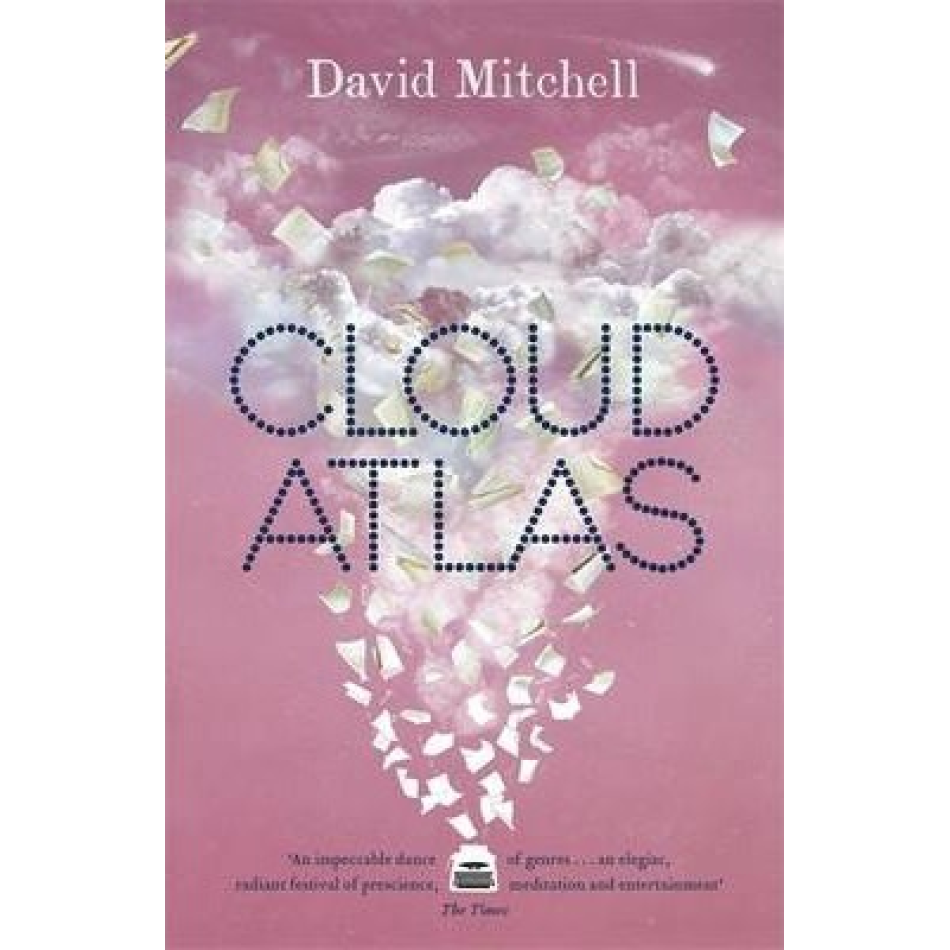
Cloud Atlas

by David Mitchell | 544 PagesGenre: Fiction | Publisher: Hodder & Stoughton | Year: 2004 | My Rating: 9.5/10

“A half-read book is a half-finished love affair.”
― David Mitchell, Cloud Atlas

Some novels entertain, others provoke. David Mitchell’s Cloud Atlas does both and then something rarer still, it bends the time itself! Since its publication in 2004, this novel has become a cult classic, not only for its intricate structure but also for its audacious attempt to string together the vast tapestry of human existence from past, present and future. The book is one of the most original, unusual, and polarising works on this century.

Mitchell presents us with six interconnected stories that span centuries and genres, a 19th-century Pacific voyage, letters from a young composer in Belgium, a taut thriller set in 1970s California, a satirical farce about a vanity publisher, the interrogation of a genetically engineered clone in a near-future Korea, and a tale told in a fractured dialect after civilization’s collapse. At first, these stories seem like discrete novellas. Yet as each thread is interrupted and later resumed, patterns begin to emerge, as symbols, names, and echoes that ripple across time.

Reading Cloud Atlas is like listening to a symphony in six movements. Each section has its own rhythm, its own instrumentation, yet together they build a haunting, resonant chorus about power, exploitation, love, and resilience. The stories have drama, thrill, humour and fantasy, and takes a deep look into the nature of humanity and moral choices. Mitchell’s message is clear but never heavy-handed, history is cyclical, cruelty and greed recur, but so too do acts of kindness, rebellion, and hope.

A movie was released in 2012 based on the adaptation of the book by the same name featuring Tom Hanks and Halle Berry. The main difference between the book and the movie is the structure and depth, with the book offering distinct, in-depth narratives and complexities, while the movie uses a faster, intercutting cinematic style that emphasizes visual connections and emotion over intellectual understanding, though sometimes oversimplifying plot points like Sonmi-451’s ending. 

This brilliantly written book’s shift in style across the stories can be dizzying, and the patience it demands is substantial. But when the final notes fall into place, the reward is profound, a recognition that our lives, however fleeting, echo forward and backward, part of something infinitely larger.

Cloud Atlas is not just a novel, it is a meditation on the human nature, a daring cartography of time.

I am including some of my most favourite quotes from this book, which is totally worth mentioning with this review.

  • “Power, time, gravity, love. The forces that really kick ass are all invisible.”
  • “My life amounts to no more than one drop in a limitless ocean. Yet what is any ocean, but a multitude of drops?.”
  • “Anticipating the end of the world is humanity’s oldest pastime.”
  • “Nothing is as eloquent as nothing.”

Code Dependent: Living in the Shadow of AI

Code Dependent: Living in the Shadow of AI

by Madhumita Murgia | 320 Pages | Genre: Non-Fiction | Publisher: Pan Macmillan | Year: 2024 | My Rating: 5/10

My life—and yours—is being converted into such a data package that is then sold on. Ultimately, we are the products.”
― Madhumita Murgia, Code Dependent

Code Dependent is a collection of case studies about people who are affected by technology, without the rigour and analysis that I was expecting. But then it is not an academic or research-oriented book, but more in the popular non-fiction genre. Several of the case studies in the book reflected on the dark side of technology and social media manipulation of individuals and communities, and their rights, privacy, freedom and future.

The book is an account of how the algorithms used by tech in our daily lives through the user-friendly apps like Google Maps, Uber, Instagram, Facebook and others are changing us and the way we see the world. Our data and us as data is continuously being used for targeted advertisements to make businesses grow fatter.

Murgia defines AI as “a complex statistical software applied to finding patterns in large sets of real-world data.” I believe that AI is much more than Statistical Pattern Recognition (SPR), and this viewpoint of the author is quite narrow.

I agree with Murgia’s take on emergence of new data colonialism around the worlds, especially in under-developed and poor economies, where sub-contracting create numerous jobs as data workers, but wealth created in not shared equitably. ‘Informed Consent’ seemed misinterpreted in the book, and subjective.

There was less of ‘AI’ and more of ominous ‘shadows’ in the book. While the book talks about algorithmic bias against people, it certain has flavours of human bias against technology from the author. The book read more on data transparency than demystifying the positives and negatives of AI and technology. Pessimistic views due to advancement in technology is more pronounced throughout the book.

The book is still a fascinating read, with glimpses of ‘how AI is altering the very experience of being human’.

The Emperor’s New Mind

Author: Roger Penrose | 640 Pages | Genre: Non-Fiction | Publisher: Oxford University Press | Year: 1989 | My Rating: 10/10

I argue that the phenomenon of consciousness cannot be accommodated within the framework of present-day physical theory.”
― Roger Penrose, The Emperor’s New Mind

Sir Roger Penrose’s “The Emperor’s New Mind” is a captivating exploration of the intersection between mathematics, physics, consciousness, and the cognitive mind. Renowned for his contributions to theoretical physics and cosmology, Penrose brings his deep understanding of complex scientific concepts to the realm of cognition and artificial intelligence in this thought-provoking work. He covers a wide range of topics, from classical physics and Gödel’s incompleteness theorem to the puzzles of quantum mechanics and the philosophy of mind. He explains complex scientific ideas with remarkable clarity and delves into the question of what constitutes consciousness and the nature of human thought. He critiques the current state of artificial intelligence and posits that human understanding and awareness transcend mere computation. Through a blend of philosophical inquiry and scientific analysis, he argues against the idea that machines can fully replicate human cognitive processes. The book highlights the unique qualities of human thought, suggesting that there are aspects of consciousness that remain elusive to mechanistic interpretations.

Penrose also explores the implications of his theories for fields such as neuroscience and philosophy, offering insights into the workings of the human brain and the potential limitations of current scientific understanding. He integrates ideas from his previous works, such as the concept of objective reality and the nature of mathematical truths, providing a cohesive framework for his arguments.

The book is also notable for its engagement with the nature of mathematics and reality. Penrose argues that mathematics has an existence independent of the human mind, a stance known as mathematical Platonism. This perspective is central to his critique of artificial intelligence and his belief that the brain’s functioning may be linked to quantum processes. It truly is a profound and insightful exploration of consciousness and the nature of thought, bridging the gap between science and philosophy. It makes one ponder the complexities of the mind and the potential for understanding what makes us human in an age increasingly dominated by artificial intelligence.

This book is a must-read for anyone with a scientific temper, a love for complex and abstract ideas, and a deep interest in the fundamental questions of consciousness, cognitive science, and the philosophy of mind, offering an enriching perspective on the enduring mysteries of human existence.