How sustainable is Sustainability?

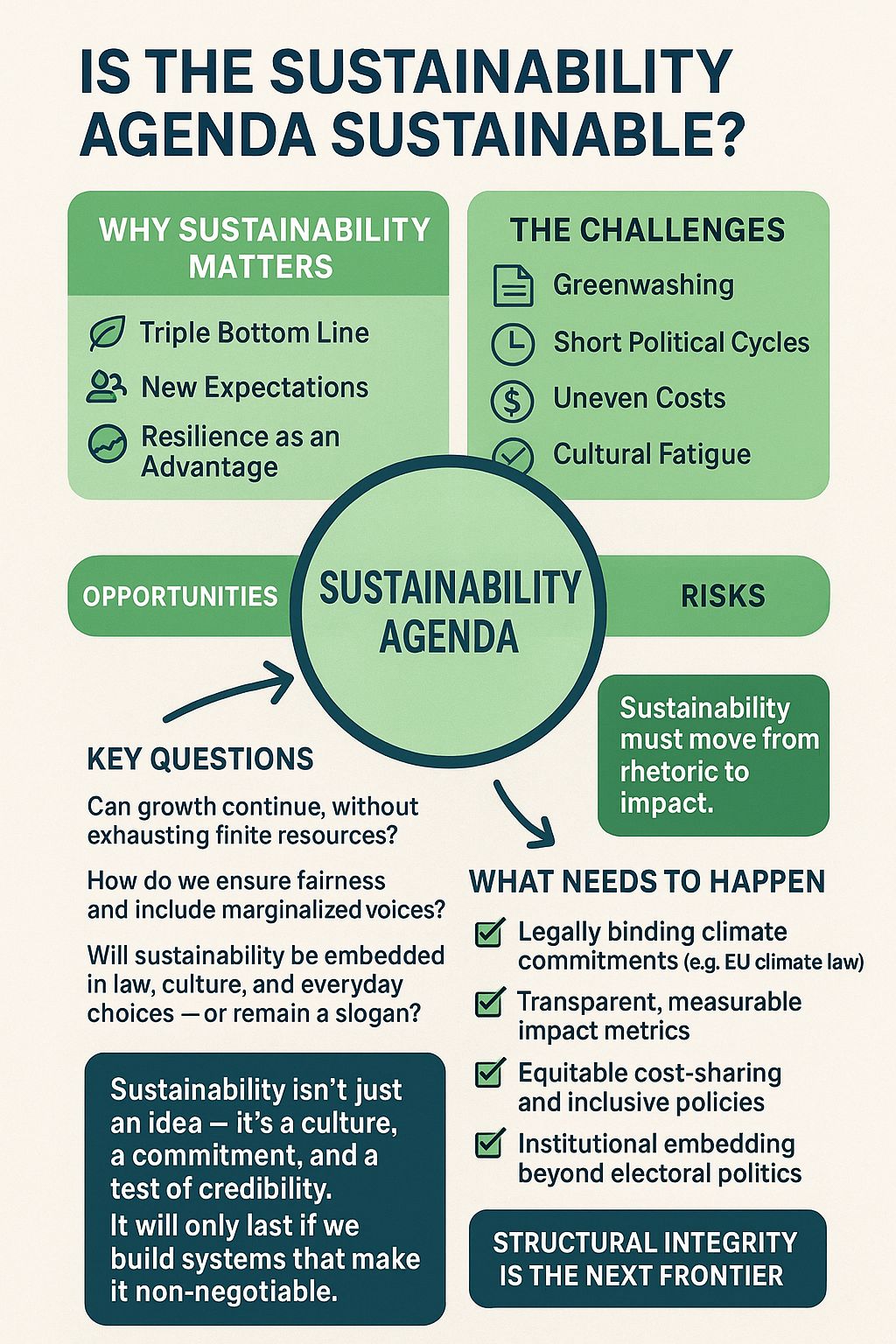
Few words have travelled as far and wide in recent decades as “sustainability”, and has certainly surpassed another overused (in recent past) term ‘social capital’ in usage! It has become synonymous with progress in corporate boardrooms, multilateral summits, government policies, NGO goals, and grassroots movements alike. From ESG scorecards to climate pledges, from net-zero roadmaps to community-led conservation, the language of sustainability has become universal. Every government strategy, corporate report, and grassroots initiative seems anchored in the promise of a more sustainable future. Yet beneath this consensus lies a paradoxical and uncomfortable question: ‘is the sustainability agenda itself sustainable?’

The modern sustainability agenda rests on a powerful proposition that economic growth, social equity, and environmental stewardship can be reconciled. This “triple bottom line” has mobilized unprecedented investment in renewable energy, green finance, and inclusive business models. It has inspired younger generations to demand more from institutions. And it has reframed long-term resilience as a competitive advantage, not a trade-off. But the very breadth of the agenda also makes it fragile. Sustainability risks becoming a catch-all phrase, diluted by overuse and co-opted for public relations more than systemic change. “Greenwashing” scandals, short political cycles, and the uneven costs of climate transitions all threaten to erode public trust. Without credibility and consistency, the agenda risks collapsing under its own ambition.

Sustainability requires commitments that extend far beyond the horizon of electoral politics. Yet in many countries, climate targets or ESG mandates are vulnerable to reversal when governments change. Contrast this with the European Union’s legally binding climate law, a structural safeguard that makes sustainability less of a political preference and more of a shared contract. Unless sustainability is institutionally embedded, it remains hostage to short sightedness.

Green growth advocates argue that economies can decouple prosperity from resource use. The rapid expansion of renewable energy, circular economy models, and impact investing provide evidence of possibility. Yet sceptics highlight that global consumption continues to outpace planetary boundaries. The sustainability agenda will endure only if it reconciles with the fundamental question of growth Vs limits. Can infinite growth coexist with finite resources?

No agenda, however well-intentioned, survives if it is perceived as unjust. For sustainability to be sustainable, it must embody fairness that includes redistributing costs, creating inclusive opportunities, and acknowledging diverse voices, particularly from the Global South. Social justice and legitimacy must go hand in hand.

Ultimately, sustainability is not just a strategy, it is a cultural shift. The more it embeds in consumer choices, organizational values, and educational systems, the harder it becomes to reverse. Yet cultural fatigue is real. When “sustainability” is reduced to a buzzword on every product label, development projects, and corporate brochure, it risks losing meaning. The agenda must therefore move from rhetoric to demonstrable impact, measured transparently and communicated honestly.

The sustainability agenda is both fragile and resilient. Fragile because it depends on long-term alignment across politics, markets, and societies, an alignment often in short supply. Resilient because it has transcended niche environmentalism to become a mainstream expectation that governments and corporations cannot ignore.

Its endurance will depend not on visionary statements but on institutional embedding, equitable policies, and a relentless focus on credibility. At its best, sustainability can serve as the organising principle of a new social contract, aligning business, government, and citizens toward long-term collective wellbeing. Sustainability will only be sustainable if it delivers, not someday, but today.

The next frontier is not about asking companies, governments, or communities to “do more” on sustainability. It is about demanding structural integrity – mechanisms, institutions, and accountability frameworks that ensure sustainability survives political shifts, economic pressures, and cultural fatigue.

Economic impact of Tuberculosis in India

Tuberculosis (TB) exacts a significant economic toll in India, affecting individuals, households, and the nation’s economy as a whole. Despite being preventable and treatable, TB continues to pose formidable challenges, impeding economic development and exacerbating poverty. By delving into the economic dimensions of TB in India, we can better understand its impact and the urgent need for concerted action to address this burden.

The economic burden of TB encompasses direct costs related to healthcare services and indirect costs stemming from productivity losses and premature mortality. According to a report by the World Health Organization (WHO), TB costs India an estimated $24 billion annually in terms of lost productivity and healthcare expenses. This staggering figure underscores the magnitude of TB’s economic impact on the nation.

Direct costs of TB care include expenses incurred for diagnosis, treatment, and management of the disease. These costs can be prohibitive for affected individuals and households, particularly those already grappling with poverty. According to the Global Tuberculosis Report 2021, approximately 39% of TB patients in India face catastrophic health expenditures, pushing many families into poverty.

Indirect costs of TB are equally significant, primarily attributable to productivity losses resulting from illness, disability, and premature death. TB often strikes individuals during their prime working years, disrupting employment and income-generating activities. A study published in The Lancet estimated that TB-related productivity losses in India amounted to $340 million annually, reflecting the substantial economic impact of the disease on workforce productivity.

Moreover, TB-related stigma and discrimination can exacerbate indirect costs by impeding social integration and employment opportunities for affected individuals. Fear of transmission and discrimination in the workplace further compound the economic hardships faced by TB patients and their families.

  • India bears the world’s highest burden of TB, accounting for approximately one-quarter of global TB cases.
  • In 2022, there were an estimated 2.8 million incident TB cases in India, with 342,000 TB-related deaths.
  • TB disproportionately affects economically vulnerable populations, including the homeless, slum dwellers, migrants, and marginalized communities.
  • The economic impact of multidrug-resistant TB (MDR-TB) is particularly severe, with higher treatment costs and lower treatment success rates compared to drug-susceptible TB.
  • According to the India TB Report 2021, the economic burden of TB in terms of lost productivity and healthcare costs is estimated to be $32 billion annually, representing a significant drain on the economy.
  • According to The Economic Times, the total cost of TB treatment from the onset of symptoms to one year post-treatment ranged from $330-$375 per PwTB, despite free diagnosis and treatment provided by the government.

Efforts to mitigate the economic impact of TB require a comprehensive approach that integrates health system strengthening, social protection measures, and poverty alleviation strategies. Investing in accessible, affordable, and high-quality TB care services is essential for reducing the financial burden on affected individuals and households. Additionally, addressing social determinants of health such as poverty, malnutrition, and overcrowded living conditions is critical for preventing TB and breaking the cycle of disease and poverty.

Furthermore, enhancing TB control efforts through innovative financing mechanisms, public-private partnerships, and community-based interventions can help alleviate the economic burden of TB while advancing progress toward elimination goals. Prioritizing TB within broader health and development agendas is essential for mobilizing resources, galvanizing political commitment, and fostering multisectoral collaboration to tackle this pervasive public health challenge.

The economic impact of TB in India is substantial, exerting profound consequences on individuals, households, and the nation’s economy. Addressing this burden requires concerted action and sustained investment in TB prevention, diagnosis, and treatment services. By leveraging evidence-based interventions, strengthening health systems, and addressing social determinants of health, India can mitigate the economic impact of TB while advancing progress towards achieving health equity and sustainable development goals. As India strives towards a TB-free future, addressing the economic dimensions of the disease is paramount for fostering inclusive growth and improving the well-being of its citizens.

(First published on LinkedIn on 28th March 2024)

Social Innovation & Enterprise

All innovation involves the application of new ideas – or the reapplication of old ideas in new ways – to devise better solutions to our needs. Innovation is invariably a cumulative, collaborative activity in which ideas are shared, tested, refined, developed and applied. Social innovation applies this thinking to social issues: education and health, issues of inequality and inclusion, and environment.

Read the full article at: http://www.stratessence.com/blog/social-innovation-enterprise/