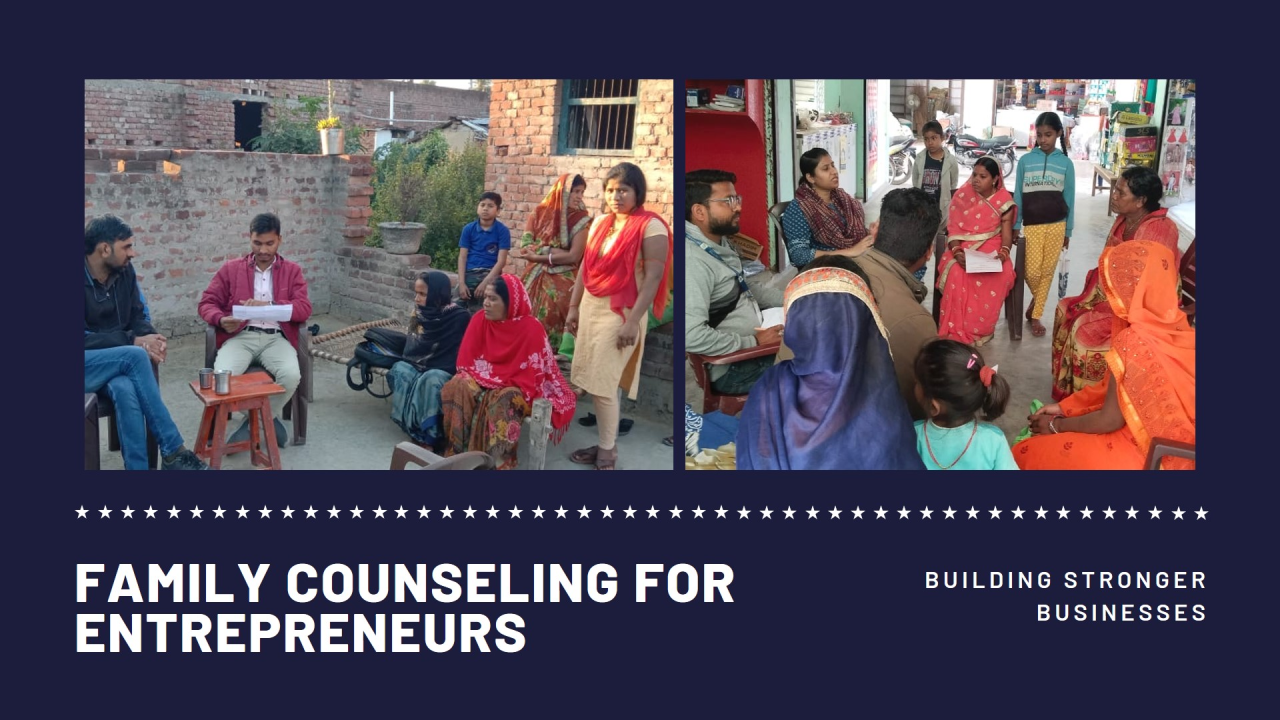
Importance of family counseling in entrepreneur selection

A person requires to possess both ‘can do’ attitude and aptitude for business to start on an entrepreneurial journey. But is that enough? Often an entrepreneur’s success is celebrated as an individual, but seldom the support system in the form of family and friends are discussed due to which the entrepreneur has achieved success. This is irrespective of the nature and size of business, geography, gender and backgrounds of the entrepreneur, and investment that goes in the venture.

While there’s no age to starting a business, the development programs I am working with focuses on women and girls in the age group of 18-50 years from poor and low-income households in the rural areas, with a desire to be self-employed and in future create employment for the youth in their respective villages. Selection processes of such aspiring entrepreneurial women vary depending on the model and approach of the programs. For the conventional businesses existing vocational skills and basic business acumen is analyzed, for others apart from these qualities, level of confidence, ability to invest their time, efforts, and money, general awareness, and other aptitude tests are conducted to measure the eligibility. What remains common across, and I believe is one of the most crucial factors for them to succeed from the word go is the support of their families, which remains the backbone of their ventures during and after the programmatic support. Therefore, post shortlisting of a potential entrepreneurial candidate, family counselling becomes the ultimate decider for her to join the program. And no, it has nothing to do with patriarchy. It’s same for any gender, and I think anywhere in the world. I have been a serial entrepreneur in my past, and have experienced in firsthand that without family support, I could have only done so much.

Family background including the size, type, and economic status can influence entrepreneurs’ and, therefore, entrepreneurship development. Even if the entrepreneurial spirit doesn’t necessarily run in the family, their support plays a vital role in an entrepreneur’s journey. Through their belief, encouragement, constant motivation, and involvement, families provide a nurturing environment for entrepreneurial growth.

In the process of meeting the family at their house in the village and discussing about their current livelihood and income sources, level of education in the household, aspirations and future plans, nature of relationship with the potential entrepreneurial candidate, sharing about the program, and earning their commitment of being the wind  beneath the wings of their daughters, daughters-in-law, wife, and in turn building trust is the main agenda of the family counselling. This support is the most important step and measure for induction of an aspiring candidate in our entrepreneurship program. Garnering this support is half the battle won for the aspiring entrepreneur.

The hard work has to be of the entrepreneur, but families give financial assistance and provides the seed capital for the start-up, provides emotional assistance keeping the morale high during those challenging and difficult times that every entrepreneur undergoes, promote the venture in their long curated networks both within and outside their villages through word-of-mouth, volunteer their time at the business to attend to customers and promotion, and more importantly celebrate even the small moments of joy together.

Apart from money and market, family support is the third pillar of the tripod, which drives entrepreneurial success.

If you want to know more about designing rural women entrepreneurship projects and/or learn about family-counselling for rural entrepreneurship, feel free to connect.

(First published on LinkedIn on 6th March 2024)

The White Tiger

whiteThe White Tiger

by Aravind Adiga | 318 Pages | Genre: Fiction| Publisher: HarperCollins India| Year: 2008 | My Rating: 9/10

“You Chinese are far ahead of us in every respect, except that you don’t have entrepreneurs. And our nation, though it has no drinking water, electricity, sewage system, public transportation, sense of hygiene, discipline, courtesy, or punctuality, does have entrepreneurs. Thousands and thousands of them. Especially in the field of technology. And these entrepreneurs – we entrepreneurs – have set up all these outsourcing companies that virtually run America now.”

– Aravind Adiga, The White Tiger

In his debut novel, which won the Man Booker Prize in 2008, Aravind Adiga has brilliantly portrayed the modern India with its newfound economic prowess through its narrator, Balram Halwai aka Munna with an obsession for China, Chandeliers, and Corruption, rising from being a ‘country mouse’ from a nondescript village of Bihar to a business entrepreneur in technology driven Bangalore. Balram’s narrative is framed as a letter to the visiting Chinese Premier, written over seven nights while sitting at his office in Bangalore. In his letter he talks about the initial years of his life spent in Laxmangarh attending school for few years before moving to work with a tea stall, and later moving to Dhanbad with his brother Kishan, where he learnt how to drive and became a driver for a weak-willed son of a feudal landlord from his village. For him ‘the darkness’ represents the areas around river Ganges deep in the heartland marked by medieval hardship, where brutal landlords hold sway, children are pulled out of school into indentured servitude and elections are routinely bought and sold. Later he moved to Delhi with his employers, which he has described as moving from ‘darkness’ to ‘light’, and one rainy day he slit the throat of his employer with a broken bottle of Johnnie Walker Black, which he justifies as an act of class warfare, took seven hundred thousand rupees in cash and fled to Bangalore. His life in Delhi has taught him the corruption of government and politics, inequality between rich and poor, which he uses to set up his business of transportation for call centers with a motto of ‘driving technology forward’.

This novel as a penetrating piece of social commentary, attuned to the inequalities that persist despite India’s new prosperity is my Read of the Week.

5 key bootstrapping strategies

I have been a bootstrapper from day one since I got bitten by the entrepreneurial bug. I learnt important key lessons from my first Startup that I applied in the next to optimize the chances of its success. Based on my learning, am sharing the following strategies for bootstrapped startups,

  1. Network hard and get connected, but work the ways on your own. Look for business mentors, hire experts, and the rest ‘Do It Yourself’. Remember that all other kinds of help and support costs money that you don’t have. It’s fine that you are a rocket scientist, a specialist, but you can train yourself to do marketing, sales pitch, finance, websites, and other work that will help your Startup grow.
  2. Rent for office space is one of the biggest expenses for any Startup. Till you start making money from your business, try to work from a home office. Rent that garage the Bill Gates way. Work virtually. Spend the rock bottom minimum money to keep your Startup running. Look for innovative ways through which you can cut down your costs, be it setting up fees or the operational costs.
  3. You don’t need to start taking huge CXO salaries the moment your Startup starts making money. Take out survival money and re-invest the rest of profits back in your Startup. Before you get into the bootstrapping mode, plan your survival finances for 12 months, instead of the mythical 6 months break even period. Believe me, in most of the cases you are not going to see any real money coming to your Startup in its first year.
  4. You will have to constantly find ways to market your Startup creatively. Use social media to its fullest. Don’t go for the glittering marketing expenses, which are huge and will eat up your initial money that may not bring results to keep you and your confidence afloat for a long time. Either find interns from graduate schools around who can do marketing for you through twitter, Facebook, e-mail, LinkedIn etc. or just do it yourself.
  5. They key to any bootstrapped Startup is perseverance. If you don’t have patience and want to strike the jackpot from the word go then either you have to be the luckiest person around or you are living in a utopian world. For the real people, steady persistence with focused course of action leads to desirable results and success.

So keep a tight lid on your costs, trust your gut feeling, and march forward with all the passion in your dream. The growth may be slower with bootstrapping, but it’s all yours. All the very best in your endeavors!

Story of a Startup – part 2

Next day, armed with our ‘Green-Pop’ idea & never say die approach and enthusiasm, we met S at a coffee shop (CCD). We discussed the idea at length over several cups of coffee. We discussed the target market, pyramid marketing structure to set up the sales chain, sourcing design and in turn starting a pop-art movement in India, identifying and managing vendors, value addition, financial requirements. We were happy that we are on verge of creating something innovative, and with that we decided to meet the following day with some background research on various modalities. Read the full post HERE

Evaluate Your Startup Idea

For an idea to become a profitable business opportunity, it should be evaluated, both within your current group and experts. I am writing about five major questions to ask while evaluating your business idea, though there can be several more addressing wide array of concerns in order to create a foolproof plan.

Read the full article HERE