The Whiteboard Mind

In the age of digital tools, where every idea has a place in an app and every plan sits behind a login screen, the humble whiteboard continues to command its own quiet power. For many thinkers, creators, and problem-solvers, it remains the most dynamic canvas, a space where thoughts breathe, flow, and transform. For someone like me who designs projects, plans strategies, brainstorms ideas, and lead teams, the whiteboard and marker pen are not just tools. They are extensions of the mind,  translating abstract thought into visible structure. It’s not nostalgia or resistance to technology; instead, it’s about harnessing a form of thinking that is visual, kinetic, and alive.

There’s a deep psychological connection between movement and cognition. When you draw or write by hand, especially on a large surface like a whiteboard, you activate a different mode of thinking. The body participates in the act of thought. The hand sketches a relationship, the eye follows it, the brain reinterprets it, and new connections emerge almost instinctively.

Typing or clicking on the keyboard keeps the mind linear, confined to lists, bullets, and boxes. But drawing on a whiteboard invites a non-linear form of exploration. You can start anywhere, a square, an arrow, a phrase, and the rest begins to grow organically. This freedom to expand, erase, and rearrange is what makes it such a powerful thinking process. Each line is a possibility. Every arrow, a hypothesis. And each erasure, a moment of learning. When thoughts become visible, they also become testable. A whiteboard externalises the inner dialogue of the mind. It takes ideas that could remain foggy abstractions and turns them into something you can point at, challenge, and reshape.

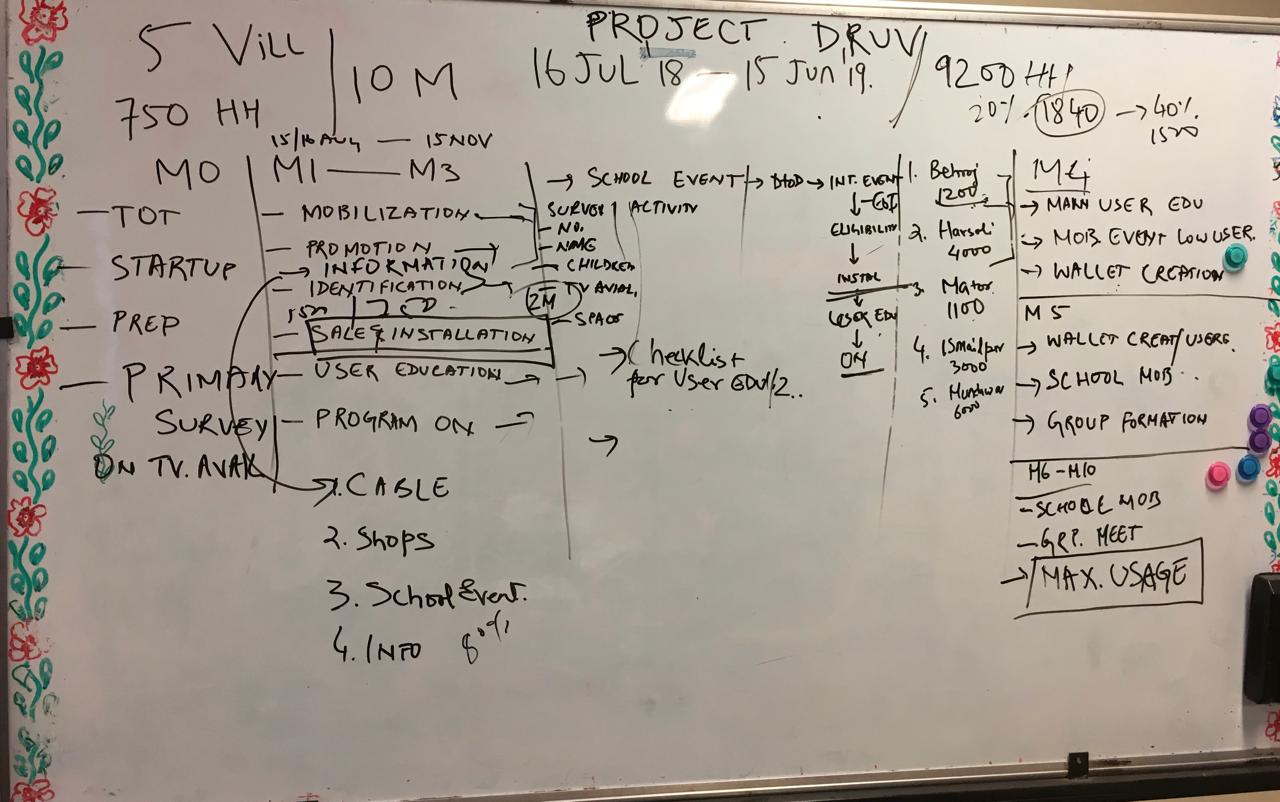
This visibility is particularly powerful in complex problem-solving or project design. When working through implementation challenges or building systems with multiple moving parts, you can literally ‘see’ the interactions. Causal diagrams, mind maps, and process flows make dependencies clear and highlight gaps that words alone might obscure. You can stand back and see the whole ecosystem, how resources connect, where bottlenecks might occur, or which variables influence outcomes. The whiteboard gives you that clear view while still allowing you to dive into details when needed. It’s thinking at both the macro and micro levels, which is simultaneously intuitive and analytical.
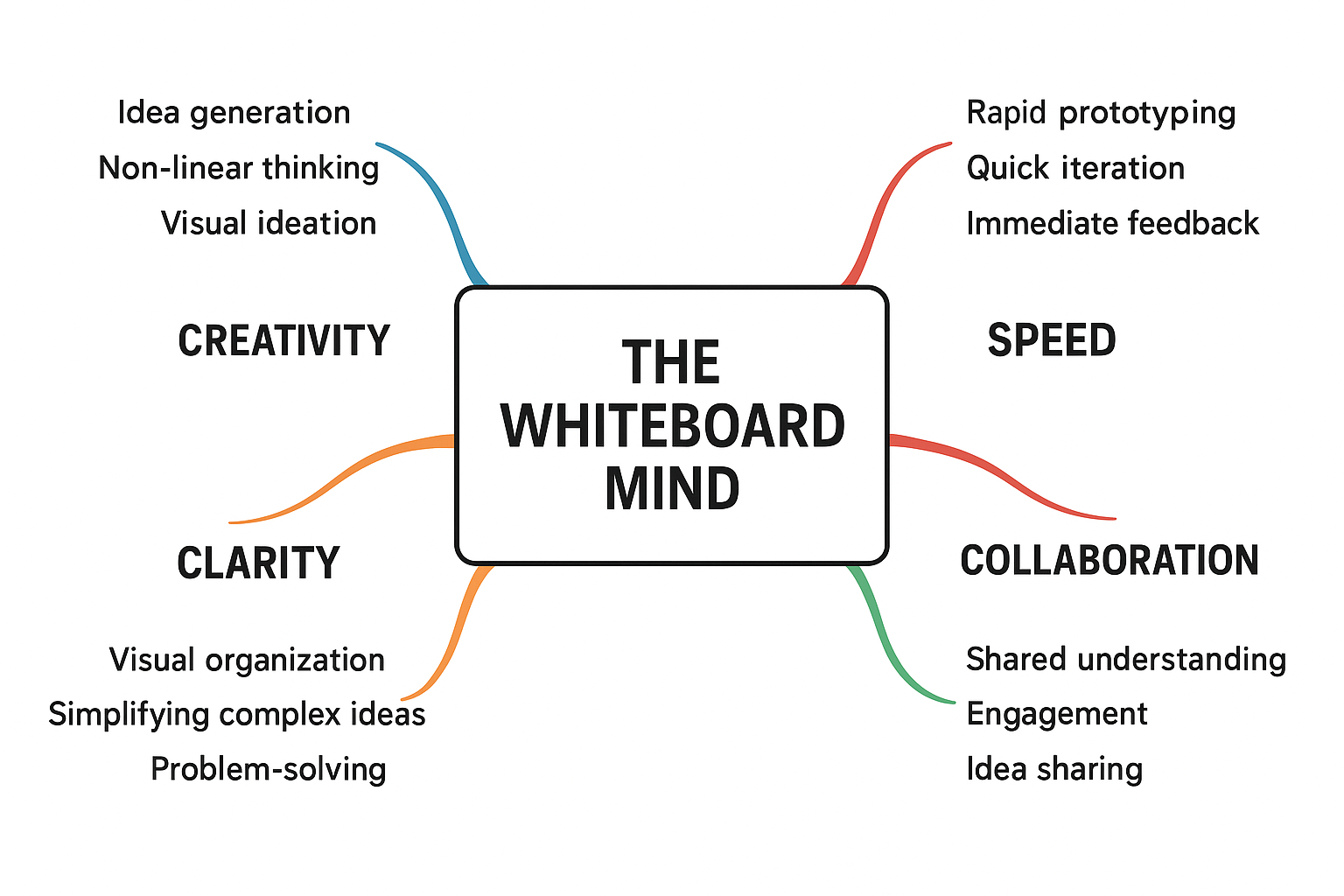
Every creative or strategic process begins in some form of chaos. Ideas compete, assumptions overlap, and clarity hides behind complexity. The whiteboard is where that chaos finds its first structure. Drawing mind maps is often the first step, not because they provide answers, but because they show relationships. From one central idea, branches grow, each representing a sub-theme, a factor, or an alternative. You can add, cross-link, or reframe them without fear of permanence. The visual form allows you to rearrange logic faster than your words can catch up.

Causal diagrams, in turn, help identify the forces at play of what leads to what, what influences what. In project planning, this is invaluable. You can trace dependencies between actions, timelines, or external conditions. You can see where interventions matter most. You can uncover loops, positive or negative, that either amplify progress or create recurring setbacks. In a sense, the whiteboard becomes a mirror of systems thinking. It holds complexity while keeping it human and accessible.

The whiteboard isn’t just a personal tool; it’s a shared language. I often use it in team meetings or group ideation sessions, as it turns abstract discussion into a collective visualisation. People see not only what is said, but how it connects. Misunderstandings surface faster because assumptions become visible. When everyone’s looking at the same diagram, they’re also looking at the same version of reality and not one filtered through individual interpretation.

It democratizes contribution, leading to one common understanding. A quiet team member can point at a link and ask, ‘Why does this connect here?’ or suggest a missing node. Visual representation invites curiosity and challenges hierarchy. It’s no longer about who talks the most, but about what the group sees together. Moreover, it encourages iteration. Unlike digital slides or documents that feel fixed, a whiteboard remains fluid. You can erase, redraw, and refine as the conversation evolves. Every stroke on the board is an act of co-creation. Even with PowerPoint presentations, I often end up on a whiteboard (if available) to explain concepts, flow, and possible results. It has proven to be an excellent tool for scenario visualisations.

There’s also the element of speed. With a marker in hand, you can think and draw at the pace of your thoughts. There’s no formatting, no tabs to open, no distractions from notifications or interfaces. When you’re solving implementation challenges or breaking down a project into actionable components, this speed matters. You can move from problem to hypothesis to possible solution in seconds. The visual rhythm keeps the momentum alive. And because it’s temporary and erasable, there’s less fear of getting it wrong. You can test a scenario, discard it, and move on. This low-cost experimentation fuels creativity and decision-making alike. In fact, the transient nature of a whiteboard is part of its strength. It reminds you that ideas are living entities to be evolved, not preserved.

When designing projects, a whiteboard allows for holistic structuring. You can begin with purpose at the centre, draw out stakeholders, resources, activities, and outcomes, and gradually watch a project take shape like a constellation. At this stage, aesthetics and functionality merge. The diagram is not just a record; it’s a design prototype. You can visualise workflows, timelines, partnerships, and even behavioural change models. Seeing everything laid out helps identify what’s missing and what’s redundant. For ideation, it’s even more liberating. The blank board is an invitation to explore. You might start sketching something unrelated, only to stumble upon an insight that reframes the entire problem. The act of drawing keeps your attention anchored and your imagination open.

Often, my Millennial and Gen Z associates argue that digital whiteboards and collaboration tools replicate all these benefits, but there’s something irreplaceable about standing in front of a board with a marker. Your posture changes, your mind sharpens. The body’s movement through space, stepping back to observe, leaning in to draw, engages multiple senses. It’s immersive in a way screens can’t replicate. A whiteboard has boundaries, forcing you to prioritise. What fits stays, and what doesn’t must be distilled. This physical constraint often leads to conceptual clarity. Maybe the old school professor in me has a bias!

Using a whiteboard and marker isn’t about rejecting modern tools; it’s about complementing them. Digital systems store and polish. Whiteboards create and provoke. For anyone who works on complex projects, leads teams, or solves multidimensional challenges, the whiteboard offers a cognitive advantage as it makes thinking tangible. It transforms abstract reasoning into something you can walk around, discuss, and reshape. It reminds us that clarity isn’t found inside the mind alone; it’s constructed through visible relationships and shared understanding.

For me, the whiteboard is more than a surface; it’s been my live, on-the-spot thinking companion. Every mark carries curiosity; every erasure, humility. It captures not just what we know, but how we learn. To think with a whiteboard is to think in motion. It’s a dialogue between mind, hand, and idea. It’s where chaos meets order, and where clarity emerges, not from control, but from exploration. In a world of digital efficiency, perhaps the most human form of innovation still begins with a marker, a blank board, and the courage to draw what we don’t yet fully understand.

Renewable ENergy Open Innovation Platform

RENOIP: Renewable ENergy Open Innovation Platform

This idea was submitted for 2011 Echoing Green Fellowship by Manu Mayank.

Describe your idea for social change in one single sentence.

 Our idea for social change is to facilitate and promote disruptive innovations in green technologies to create sustainable futures, by harnessing the capabilities of Web 2.0.

Describe your idea for social change in one single paragraph.

RENOIP aspires to become an open platform for the promotion of innovation in renewable energy and preferred purchasing for enterprises in the fields of renewable energy, with a view to helping enterprises to improve faster and better. The aim is to support all forms of innovation, improve competence, build a robust knowledge repository, and promote entrepreneurship in the field of renewable energy, focusing on tackling the great societal challenges of today for sustainable tomorrow.

What specific problem in the world are you trying to solve?  Where possible, use statistics and references to identify the size and scope of the problem. 

Meeting future energy needs in a sustainable way requires innovative breakthroughs to efficiently generate, store, and transmit energy. Innovation expertise is scattered and there’s no common platform for sharing new developments that could be widely used, especially in developing countries. There’s a sub-optimal exploitation of scientific research results and rarely get translated into market innovations. Renewable energy requires innovation-based-growth that is open for applications globally.

What, specifically, will be your programs or products?  Who will you work with? 

RENOIP is a platform being developed to handle innovation and preferred purchasing in the green energy domain. It will use existing social networks to involve new people and problem-solvers to apply their abilities on solving interesting problems. RENOIP will focus on integrated innovation through (i) a wiki- based knowledge management system, (ii) strong workflow-based problem solving and innovation system that will allow problem owners and solvers alike to interact throughout the life-cycle of a  new project or problem solution, (iii) consolidated directory of relevant experts and enterprises, (iv) product directory and development of a technology that will recommend products and innovative solutions to problems thus saving experts from reinventing the wheel, (v) Information dissemination through e-magazine that will feature resource driven by the community around green energy to keep everyone updated and in sync with the latest technologies.

Describe the impact you hope to achieve.  In what time frame? What specific metrics will help you determine whether your work is making a difference?

The innovation both in technologies & systems to harness renewable energy will thus create a progression of spin-offs affecting fields as diverse as agriculture, real estate, space exploration, and social policy. It will also produce secondary social and economic benefits. RENOIP aims to solve at least 100 issues for enterprises in the field of renewable energy in its first year of operation, and will attract 250 users and 20 enterprises monthly to join the platform. We intend to collect feedback of the end users through a variety of channels including social media, and physical feedback gathering through enterprise partners. We also intend to support social enterprises with resources to measure direct and indirect socio-economic impact of implementing the innovative practices. We are working on developing a set of indicators to map solutions, innovations, usefulness, and turn around, etc, which could be used to measure the impact of RENOIP in quantifiable terms.

How does this approach represent bold innovation versus the status quo? 

RENOIP plans to create a bridge between demand for and supply of green solutions in renewable energy sector by addressing specific technology problems and market failures that still hamper the wider take-up of energy innovation. It will support the emerging renewable energy markets by strengthening the innovation capacity of SMEs and Social Enterprises by bring global innovation capacity and knowledge through an open platform.  RENOIP has the ambition to become the foremost platform for enterprises, incubators and market facilitators, industry professionals, technical research centres, innovation experts, and investors, which will enable them to discuss, develop, and exchange ideas and better practices and to contribute to a better understanding of the innovation patterns in renewable energy sector. It will contribute to the creation of an environment in which new renewable energy enterprises can start, grow and thrive, thus supporting the sustainable development of the sector.

How much money will this organization need in the next 12 months?  In the year after?  How much have you raised so far?  From whom?  How do you plan to get the rest?

We intend to operate on a lean budget, and require $25,000 for the first 12 months, with majority of the money being spent on development of the platform, and the rest budgeted for marketing the platform. In the second year of operations, RENOIP will require around $60,000 towards marketing & PR, technical maintenance, and personnel costs. We haven’t started fundraising yet. We are developing a ‘bird-eye-view’ prototype of the OIP and intend to use it for fundraising.  

Your interest in starting this organization makes you unlike most people.  What in your personal, academic, and/or work history compels you to dedicate your life to this idea at this time? 

As partners, we share a passion for Greentech, innovation and application of technology for development. We both hold graduate degrees from premier universities. Manu holds degrees in Economics, and Planning & Development (UQ, Australia), and has worked in the fields of Environment & Economic Development for over ten years spanning Asia, Oceania, and Africa. Since 2006, his focus area has also included renewable energies (Bioenergy and solar), and he thinks that there’s an acute need for innovation that is openly available for creating wider impact from renewable energy projects in developing countries like India. Manu also has experience developing a wiki-based Knowledge Platforms on NTFPs and Bioenergy. Dipankar holds degrees in Computer Science Engineering (IITDelhi), and has founded or worked-with several brilliant technology and social startups. He has created innovative platforms like ‘Kwippy’, which had over 20,000 users & ‘ElectroSocial’, a social media platform and co-founded along with Manu ‘Green venture camp’ to promote cleantech startups, and STIR-e to promote youth social entrepreneurs in India.

What skills or experiences demonstrate that you will be able to attract money, people, and other resources to your idea?

Our combined extensive skills and experiences in technology, Greentech, startups and fundraising makes us a unique team for generating both financial and non financial resources for our idea. We also have a brief but relatively successful history of being startup entrepreneurs, promoting new ideas, and have built a strong network of experts. Manu has successful experiences in raising several million dollars for environment and development through international donors and corporations like IFAD and Ikea.  Dipankar has built a good network and rapport with angel investors inIndiawho are interested in innovative, web-based startups solving real-world problems.  We already are in discussion with six highly-esteemed experts to come on board of advisors for RENOIP. We are confident that we will be able to raise required resources for our idea to make it real and successful.  

What evidence do you have of your ability to overcome challenges and adversity?

While working with rural communities in different parts of Indiafor building their sustainable livelihoods through the use of bamboo, Manu tackled and overcame everyday challenges of terrain, language, and resources through his patience, acumen, and communication skills to help build successful rural enterprises benefiting thousands of rural poor and especially women. Dipankar having lost his father at a young age, has always worked with the odds stacked up against him due to lack of support, but still managed to get through the toughest technical school in India and has carved out an entrepreneurial career for himself, which is inspirational. For last three years we have faced many business and financial challenges and have overcome them through our team efforts, resilience, and a small but dependable social network. Our past experiences of dealing with life’s and work’s challenges & adversities has prepared us to evaluate the situation and take rational decisions to minimize it’s impact if not negate it.

Social Trading Platform India

The idea is to provide a capital market for social good. This can bring about social consciousness to the global financial markets. It holds the potential to increase access to capital for enterprises with a social mission. On a bigger scale, it will help social enterprises further develop the professionalism of their operations and create a whole ecosystem around it to support social enterprises. This will become India’s first social trading platform, providing a trading platform and an efficient capital raising mechanism for Indian Social Enterprises (SEs), including both for-profit and not-for-profit entities with a social mission. The Platform will connect these SEs with impact investors seeking to achieve both a social return and an economic return on their investment while providing capital to fund innovative social businesses. This platform will also enable philanthropic donations.

Such an exchange will bring all the relevant players in the ecosystem together, speaking the same language and assisting one another in creating greater social good. It will encourage the governments, civil societies, academics, investment banks, research companies, auditing bodies and social enterprises to agree on a framework to measure social value, common terminology, transparency, and social and financial goals.

Social enterprises seeking to list shares or bonds on the exchange will go through proper social and financial auditing (third party validation) and report regularly to investors on both their social and financial results. Investors purchasing shares and bonds on the exchange will be attracted by the transparent disclosure of social returns and will evaluate companies based on both their social and financial returns. They will understand that a social enterprise may not maximize its earnings due to the cost associated with fulfilling its social mission. And they will be willing to accept a limited financial return in order to support this mission. Of course, given the current dismal state of the market for profit-maximizing businesses, any economic return topped with a social return may feel like a windfall to an investor.

The Platform will push the envelope on the existing socially responsible investing, bring forward social enterprises and social purposes companies (in addition to microfinance) in energy, water/sanitation, media, fair-trade, health, education, and cottage industry and bring to the attention of these investors a whole new set of enterprises which would not have been noticed otherwise.

Such a platform/exchange cannot be created overnight. It will take years before The Exchange is a robust trading platform. However, with the proper assistance and support from other members of the social investing ecosystem, it can become the cornerstone of a potentially very large social enterprise economy.

Note: I am working on its operational model, and will post it once am done.