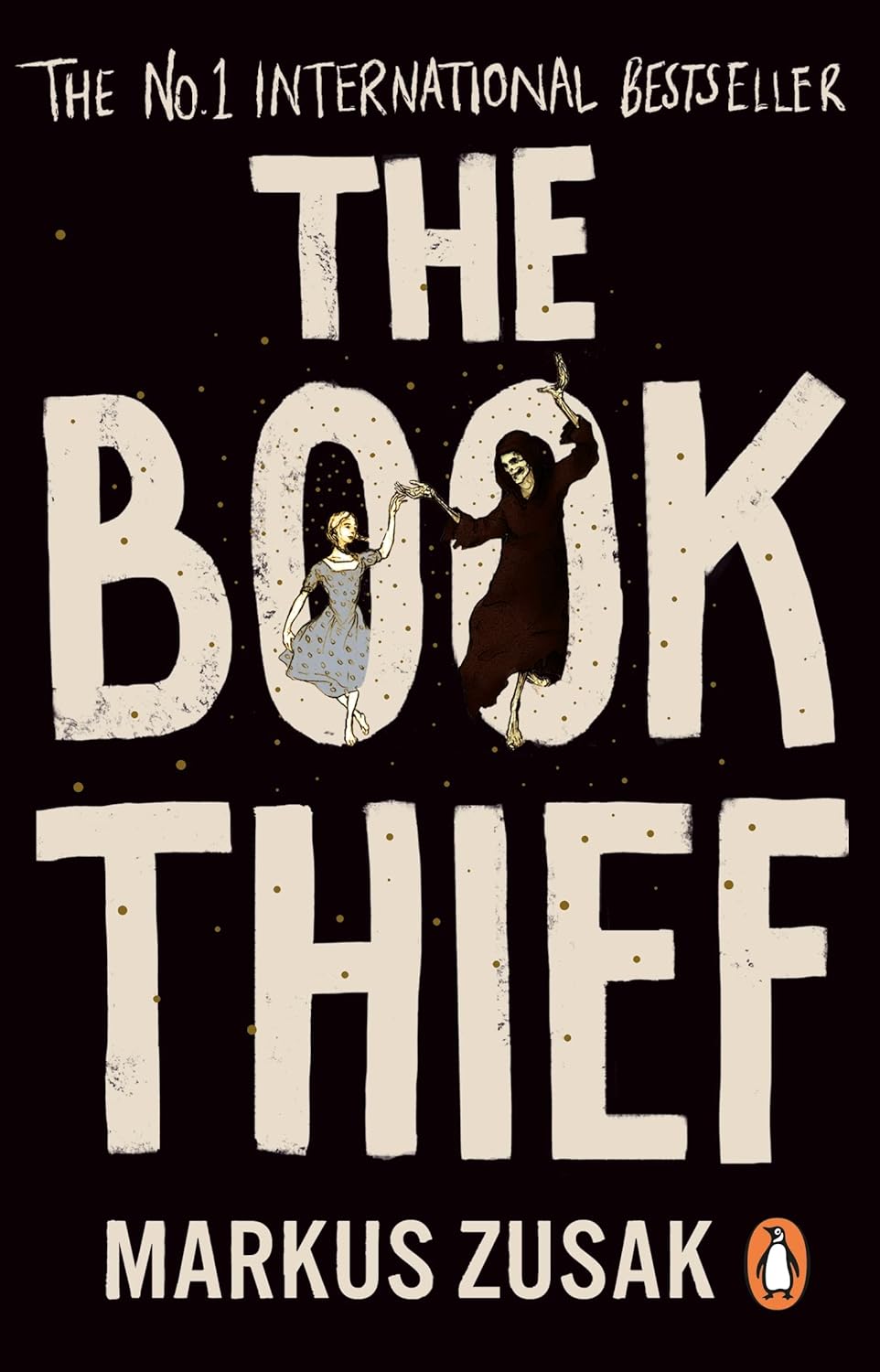
The Book Thief

Author: Markus Zusak | 560 PagesGenre: Historical Fiction | Publisher: First edition published by Alpha 2 Omega Books. My edition published by Penguin Random House (2018) | Year: 2005 | My Rating: 9/10

“The human heart is a line, whereas my own is a circle, and I have the endless ability to be in the right place at the right time. The consequence of this is that I’m always finding humans at their best and worst. I see their ugly and their beauty, and I wonder how the same thing can be both”
― Markus Zusak, The Book Thief

The Book Thief combines brutality and beauty with extraordinary grace, and I found it to be truly unique and spectacular. The novel is set in 1939 Nazi Germany, during World War II, where the story is a haunting exploration of love, loss, language, and the power of storytelling to preserve humanity. Narrated through the unexpected voice of Death, the novel redefines the familiar war narrative, which is both poetic and profoundly human.

The story centres on Liesel Meminger, a young girl sent to live with foster parents Hans and Rosa Hubermann in Molching, near Munich. After her brother dies en route to their new home in 1939, Liesel steals her first book, marking the beginning of her quiet rebellion through reading. Liesel’s foster father, Hans, patiently teaches her to read during late-night sessions in their basement. Liesel’s foster mother, Rosa, is gruff yet deeply protective. For Liesel, books become both a refuge and a means of resisting the Nazi regime’s manipulation of language.

When the Hubermanns shelter Max Vandenburg, a Jewish man fleeing Nazi persecution, Liesel’s world broadens. Her friendship with Max, rooted in fear and hope, highlights the power of imagination to endure hardship. Max’s stories, especially “The Word Shaker,” reinforce the novel’s central theme that ‘words can both harm and heal.’

The author’s decision to use Death as the narrator is both bold and effective. Death is portrayed as weary, compassionate, and reflective, observing humanity’s capacity for both cruelty and kindness. His tone shifts between irony and melancholy, providing both distance and intimacy. Death’s closing line, “I am haunted by humans,” underlines the novel’s meditation on human fragility and resilience.

Zusak removes sentimentality from tragedy through his narration by Death. I knew early in my reading that the story would end in loss, and Death tells plainly who will die, but this foreknowledge deepened rather than diminished my emotional investment. Zusak’s central theme of the power of language could not be more resonant. The Nazi regime weaponized words to manipulate a nation and justify genocide. In contrast, Liesel and Max reclaim language as a force for healing and remembrance. Books become tools of freedom, teaching Liesel not only literacy but empathy and defiance. There is also a profound theme of ordinary heroism. The Hubermanns, Liesel, and her friend Rudy Steiner resist in small, quiet ways, sharing bread with starving prisoners, hiding a Jew in their basement, refusing to let fear extinguish decency. These are acts of rebellion born not of ideology but of humanity.

The novel also explores how even in a time of death, there are moments of laughter, friendship, and love. It portrays war as a lived experience through the eyes of a child who learns too soon about loss but clings to hope through storytelling. Zusak’s prose is poetic, fragmented, and rhythmic, a departure from conventional realism. He uses vivid imagery and typographical experimentation, breaking the fourth wall and inserting short notes, sketches, and lists. These stylistic quirks mirror Death’s fragmented perception of events and add texture to the reading experience. Like his description of the sky as Death collects souls, “The sky was the colour of Jews.” It is shocking, ambiguous, and heartbreaking, capturing the moral weight of genocide in those six words. It made me pause at the sentence and page for a while, feeling the sentence rather than merely understanding. Liesel is one of contemporary literature’s most memorable protagonists, who is resilient, curious, and brave. Through her eyes, one can experience both the innocence of childhood and the disillusionment of war. Her evolution from an illiterate girl to a book thief who reads to others in bomb shelters symbolizes the redemptive arc of language.

The moral core of the novel, Hans Hubermann, embodies quiet courage. His act of painting over antisemitic graffiti and hiding Max is not grand heroism but the moral defiance of an ordinary man. Rosa, abrasive yet loving, offers a realism often absent in depictions of maternal figures. Rudy Steiner, Liesel’s best friend, brings youthful vitality and heartbreak into the story. His dream of kissing Liesel becomes a symbol of innocence stolen by war. Max, the Jewish fugitive, represents endurance and the power of imagination, writing his own story literally over the pages of “Mein Kampf,” transforming an instrument of hate into one of creation. Each character feels deeply human, flawed, frightened, and compassionate, and their relationships form the emotional spine of the novel.

The Book Thief focuses on ordinary citizens rather than soldiers or political figures. Zusak reminds us that history is lived by common people, those who make small moral choices every day. Since its first publication in 2005, The Book Thief has also been adapted into a film released in 2013. Its endurance over the years lies in its emotional honesty and narrative innovation. It teaches us that even in times of darkness, stories can keep the flame of humanity alive. The Book Thief is not just a story about war or death; it is about the defiance of the human spirit through words and empathy.

This novel reminded me that reading, too, is an act of resistance. It is a book that stays with you, not because of the horrors it depicts, but because of the beauty it finds amidst them. As Death himself observes, “It’s only small stories like this one that can make the bigger ones bearable.”

Light

Light: Empty Space (Kefahuchi Tract) 

by M. John Harrison | 336 PagesGenre: Science Fiction/Fantasy Literature | Publisher: First edition published by Gollancz. My edition published by Orion Publishing | Year: 2002 | My Rating: 9/10

“When you have done all things worth doing, you’re forced to start on things that aren’t”
― John Harrison, Light

Light is profoundly complex, dark, draining, unusual sci-fi mystery with a great ending. It has an uneven mosaic of two timelines filled with symbolism and curious characters. It’s not an easy read, nor it is likeable in the first instance. The book builds on you with the time you invest through the pages and remain invested in the story. 

The story bridging three stories from present Earth of 1999 and post Earth with distant and futuristic galactic settings in the year 2400, initially feels disjointed. Yet Harrison’s skill lies in gradually and subtly revealing the connections among these strands that are anchored by the mysterious cosmic phenomenon known as the Kefahuchi Tract. In this future, humanity is scattered across planets surrounding the Kefahuchi Tract, a space-time anomaly, a “singularity without an event horizon”. Violence and sex recur throughout in brusque, almost clinical tones as part of a broader theme that human depravity and detachment persist, whether in corporeal present or digital futurity.

In 1999 London, Michael Kaerney, quantum physicist and serial killer, is seeking an escape in a future that doesn’t yet exist – a quantum world that he hope to access through a breach of time and space. In this future, Seria Mau Genlicher has already sacrificed her body to merge into the systems of her starship, the White Cat. In this future, Ed Chianese, a drifter and adventurer, has ridden dynaflow ships, run old alien mazes, surfed stellar envelopes. Haunting them all through this maze of menace and mystery is the shadowy presence of the Shrander, a being with a horse skull for a head. 

I have wanted to read this book for so long, until I received it as a birthday gift 22 years later. This enigmatic blend of literary complexity, cyberpunk, and metaphysical dread is worth reading. However, this certainly is not a casual read. You need focus and dark scientific imagination to relish its thematic depth. Once you have read this, you would be hooked to read the two sequels Harrison wrote, completing the triology.

Unbroken

Genre: War/Action | Year: 2014 | Duration: 138 mins | Director: Angelina Jolie | Medium: DVD | Trailer: HERE | Language: English | My rating: 5/5

Favorite Dialogue: “A moment of pain is worth a lifetime of glory.”

Unbroken is based on an inspiring true story of Louis Zamperini, a World War II bombardier, and an Olympic athlete whose remarkable life story is chronicled in Laura Hillenbrand’s bestselling book, Unbroken: A World War II Story of Survival, Resilience, and Redemption (2010). The film is a powerful tale of human spirit and forgiveness.

The story follows Zamperini (Jack O’Connell), who survives a plane crash in the Pacific Ocean, captured by the Japanese navy and endure years of brutal treatment in prison camps. The film spans Louis’s early life, childhood and his troubled youth, athletic achievements, and his experiences during the war, first as a Bombardier and then as a POW. 

Jack O’Connell delivers a compelling performance, capturing both the vulnerability and strength of Zamperini as he faces unimaginable hardships. The supporting cast, including Domhnall Gleeson as fellow soldier Phil, and Takamasa Ishihara as the sadistic camp commander “The Bird,” contribute significantly to the film’s emotional weight.

Angelina Jolie’s direction is visually stunning, emphasizing the stark contrast between the beauty of nature and the brutality of war. The cinematography portrays the vastness of the ocean and the starkness of the prison camps, effectively immersing the audience in Zamperini’s harrowing journey, combined with Alexandre Desplat’s evocative score.

“Unbroken” excels in showcasing the inspiring and intensity of Zamperini’s ordeal, making it a powerful portrayal of the strength of the human spirit. However, the film differs from the original book in balance. While the book is more focused on his post-war journey of forgiveness and healing, the film focuses more on his suffering.

Overall, Unbroken is a visually compelling and emotionally charged film that pays homage to Louis Zamperini’s extraordinary life, and is certainly a must watch. For me, the DVD of this film is a collectible too.

Jungle Nama: A Story of the Sundarban

Jungle Nama: A Story of the Sundarban

by Amitav Ghosh | 88 Pages | Genre:  Literary Fiction | Publisher: Fourth Estate | Year: 2021 | My Rating: 8.5/10

“All you need do, is be content with what you’ve got, to be always craving more, is a demon’s lot.”
― Amitav Ghosh, Jungle Nama

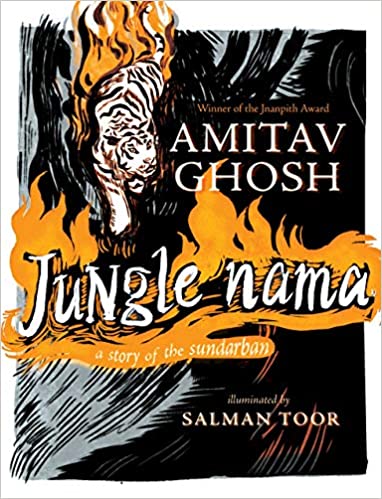
“Jungle Nama” by Amitav Ghosh is a captivating verse adaptation of a Bengali folktale from the Sundarbans, the world’s largest mangrove forest shared between India and Bangladesh. Written in a lyrical, rhythmic style, and illustrated by Salman Toor, the book tells the story of “Bon Bibi,” a benovelent goddess of the Sundarbans who safeguards the jungle and its people, and her conflict with Dokkhin Rai, a powerful demon-like figure who seeks to exploit the forest’s riches.

Ghosh’s decision to render this ancient tale in verse brings a unique musicality to the story, echoing the cadence of oral storytelling introducing music to current speech that has kept the folktale alive for generations. His prose is imbued with both reverence for the source material and a contemporary sensibility that makes the story accessible to a modern audience. Accompanying the text are hauntingly beautiful illustrations by artist Salman Toor, whose work enhances the mystical and otherworldly atmosphere of the Sundarbans and its lore.

Beyond its enchanting style, Jungle Nama explores timeless themes of balance between nature and humanity, the perils of human greed, and the importance of respecting natural boundaries. Ghosh subtly draws parallels to modern issues like climate change and environmental degradation, suggesting that the ancient wisdom in the Bon Bibi story holds valuable lessons for today’s world. Through Bon Bibi’s character, he raises questions about stewardship, sustainability, and the price of human ambition.

The book is more than a poetic retelling; it’s an immersive experience that connects readers to both nature and folklore. Ghosh’s evocative language and Toor’s illustrations work in harmony to capture the spirit of the Sundarbans and its lore, making this book a visually and intellectually rich addition to Ghosh’s body of work. The poem-like style of the book follows twelve syllables in each line, and each couplet has twenty-four syllables. After each line there is a natural pause or a caesura, replicating the cadence of the original legend.

This book by one of my all-time favourite authors is a mesmerizing read for anyone interested in myth, poetry, linguistic hybridity, and environment, offering a rare glimpse into a world where nature and spirituality are deeply intertwined.

The Man Who Cried

Genre: Romance | Year: 2000 | Duration: 100 mins | Director: Sally Potter | Medium: DVD | Trailer: HERE | Language: English, French, Yiddish | My rating: 3.5*/5*

Favorite Dialogue: “Lola: One should never look back. One should never regret. Never.”

This romantic movie by Sally Potter has no chemistry between its co-stars, Johnny Depp and Christina Ricci, even though I quite liked their individual performances as Fegele, a Russian Jew with elfin features separated from her father as a child in 1927 and later re-named as Suzie when she escapes to England, and Cesar, a Romani gypsy with brooding countenance . And therefore there was no heat and the romance seemed sterile. 

Fegele’s father leaves for the promise of wealth and better future to the land of opportunity, America, intending to bring his daughter over later. However, after he left, a band of raiders attacks Fegele’s settlement, and she is bundled off in the middle of the night by her grandmother with few gold coins to take the ship to America. She ends up living in a foster home in England. After ten years she leaves England and joins a musical troupe in Paris, with the goal of making enough money so she can go to America to locate her father. She keeps her identity as a Jew a secret – only her roommate, Lola (Cate Blanchett), her roommate’s famous opera-singing lover, Dante (John Turturro), and her landlady know the truth. With World War II looming, Suzie and Lola escapes Paris, and after some drama Suzie reaches America and finds her ailing father in Hollywood.

This beautifully recorded and scored film of love, loss and human character is worth a watch.