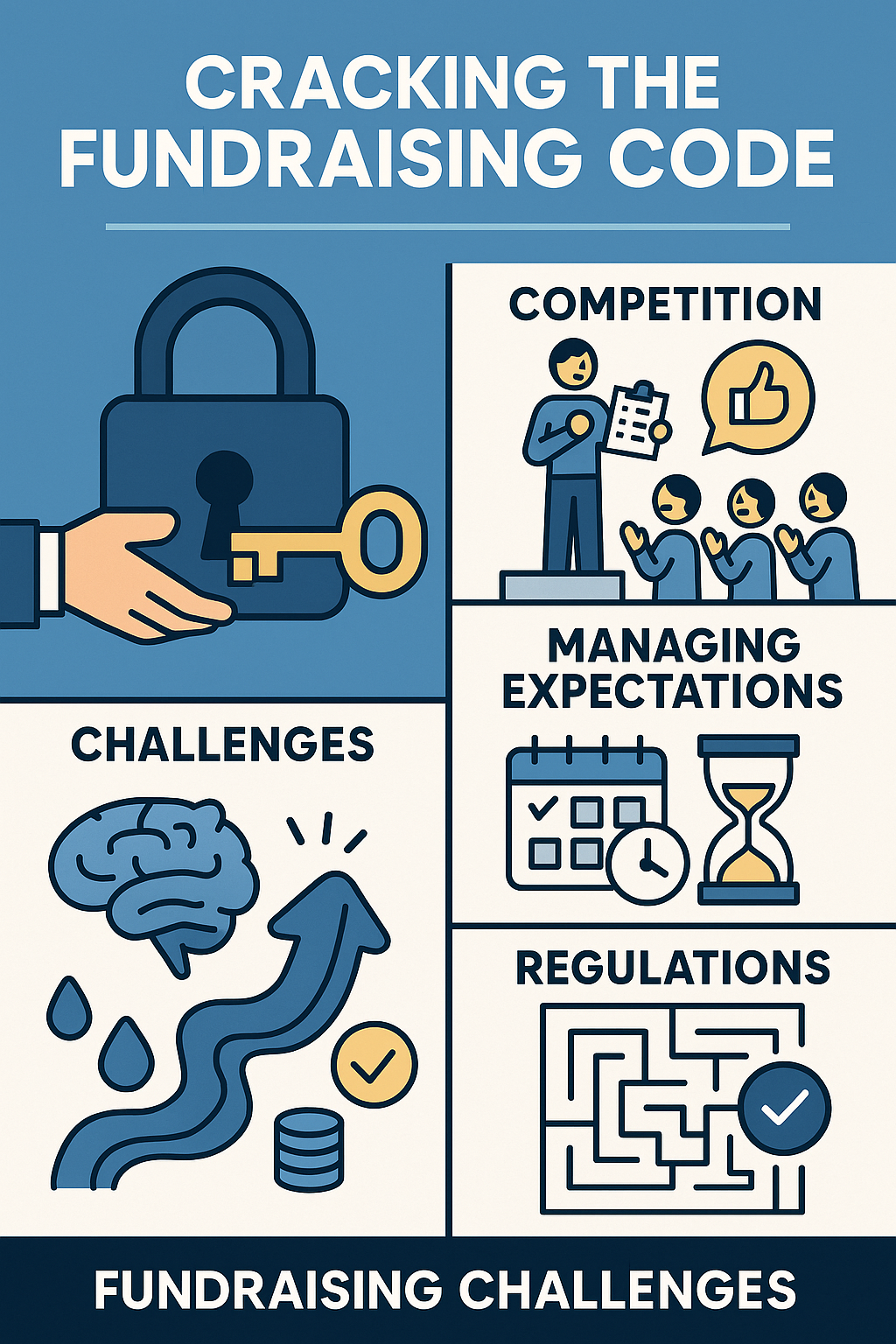
Cracking the fundraising code

Ah, fundraising, the art and science of turning good intentions into actual impact! Throughout my career I have been raising funds for social impact, for causes of basic necessities like food, water, shelter, livelihood to a green economy, bridges over rivers to even a roller coaster in a developed country. I have been actively involved in raising funds for these causes from as small as $10 up to $50 million from a variety of sources and instruments. As the Head of Development at a nonprofit organization for social impact projects in India, I’ve navigated the corridors of CSR leaderships and foundation offices, and let me tell you, it’s not always smooth sailing. Often, it feels like trying to surf a tsunami with a paper boat!

Corporate Social Responsibility isn’t just a box to tick. It’s a strategic dance between business goals, stakeholder expectations, and social impact. With so many initiatives competing for attention, securing a dedicated slice of the CSR pie often feels like requesting a moment on a crowded stage, and convincing the audience that your act is worth their applause.

Foundations receive hundreds of pitches, each expecting to win the golden ticket. Getting noticed requires more than a well-crafted proposal; it demands storytelling that resonates and relationships that endure. Sometimes, it’s less about what you say and more about how you say it, and how quickly you can make a compelling case before the next shiny pitch distracts them.

Donors want results, but impact is often a marathon, not a sprint. Managing expectations without being over promising is an art. We’ve all faced the uncomfortable moment of explaining why a project’s full fruits may take years to ripen, a diplomatic tightrope walk that can test even the most seasoned fundraiser.

India’s complex regulatory landscape can feel like a labyrinth where one wrong turn can lead to delays or disapprovals. Keeping up with FCRA regulations, tax exemptions, and reporting requirements is a full-time job, and sometimes, it’s like speaking a different language altogether. Ironically, securing funds for a project often means fundraising itself. Resource constraints can limit outreach and follow-up, turning what should be a strategic focus into a haphazard firefight.

A mix of storytelling, patience, relationship-building, and a dash of humour helps. When engaging with CSR and foundations, understanding their priorities, aligning your mission with their vision, and communicating impact clearly can turn challenges into opportunities.

To my fellow fundraisers who are navigating this maze: keep your spirits high, your pitches sharper, and remember, every “no” is just a “yes” in disguise waiting to happen!

Let’s keep the conversation going. Share your stories or tips below, because in the game of social impact, we’re all in this together.

Competitive analysis for your startup

Businesses happen in highly complex and competitive environment. It’s important to understand strengths and weaknesses your current and potential competitors.  This makes it very important for startups to understand and analyze their competitors and frame their growth strategies [both offensive and defensive] accordingly. In order to understand your competitors thoroughly, it’s impertinent that you do a systematic analysis and assessment rather than relying on informal knowledge and chunks of data that you might ‘know’.

Things that you need to know about your competitors include,

  • List of direct and potential competitors [make a list of 5 each]
  • Their strengths and weaknesses
  • What are their products/services and their USP
  • How does their product differs from your offering
  • What are their key operations strategy and how do they advertise
  • What’s the state of their business? How has been their growth in past 3 years?

In order to answer these questions, you need to develop separate competitor profile for each one of them. This kind of in-depth information will give you competitive advantage over them. You can deploy strategies through product differentiation, price discrimination, focussed advertising and sales promotions to get successful with your product offering. The competitor’s profile should include information on the,

  • Company’s background and structure
  • Financial info on their growth
  • Complete product information comprising of array of products, rate of new products development, R & D, patents and IPs, brand strength, etc.
  • Marketing strategies and their market share, alliances and geographic coverage, distribution channels, and their pricing strategies
  • Production process and operational strategies
  • Key composition in terms of human capital

You will have to get such information from both within the company and outside. Some sources for gathering information could be,

  1. Look for their website on the internet and study all the information given carefully. Also look on internet if anyone else is talking about them. Google them extensively to find info about their offerings. Check web-logs for reviews.
  2. Talk to their customers. Conduct a small survey to understand their customer satisfaction and behavior.
  3. Analyze their advertisements in different media to learn about their target audience, product features, benefits, etc.
  4. Read their promotional materials and annual reports to understand their operational strategies and growth patterns.

Doing a competitive analysis can be a challenging and interesting piece of work. You’ll learn a lot about your industry, and your insights will help you position your product better and make your Startup successful.

5 key bootstrapping strategies

I have been a bootstrapper from day one since I got bitten by the entrepreneurial bug. I learnt important key lessons from my first Startup that I applied in the next to optimize the chances of its success. Based on my learning, am sharing the following strategies for bootstrapped startups,

  1. Network hard and get connected, but work the ways on your own. Look for business mentors, hire experts, and the rest ‘Do It Yourself’. Remember that all other kinds of help and support costs money that you don’t have. It’s fine that you are a rocket scientist, a specialist, but you can train yourself to do marketing, sales pitch, finance, websites, and other work that will help your Startup grow.
  2. Rent for office space is one of the biggest expenses for any Startup. Till you start making money from your business, try to work from a home office. Rent that garage the Bill Gates way. Work virtually. Spend the rock bottom minimum money to keep your Startup running. Look for innovative ways through which you can cut down your costs, be it setting up fees or the operational costs.
  3. You don’t need to start taking huge CXO salaries the moment your Startup starts making money. Take out survival money and re-invest the rest of profits back in your Startup. Before you get into the bootstrapping mode, plan your survival finances for 12 months, instead of the mythical 6 months break even period. Believe me, in most of the cases you are not going to see any real money coming to your Startup in its first year.
  4. You will have to constantly find ways to market your Startup creatively. Use social media to its fullest. Don’t go for the glittering marketing expenses, which are huge and will eat up your initial money that may not bring results to keep you and your confidence afloat for a long time. Either find interns from graduate schools around who can do marketing for you through twitter, Facebook, e-mail, LinkedIn etc. or just do it yourself.
  5. They key to any bootstrapped Startup is perseverance. If you don’t have patience and want to strike the jackpot from the word go then either you have to be the luckiest person around or you are living in a utopian world. For the real people, steady persistence with focused course of action leads to desirable results and success.

So keep a tight lid on your costs, trust your gut feeling, and march forward with all the passion in your dream. The growth may be slower with bootstrapping, but it’s all yours. All the very best in your endeavors!

4 keys to startup advertising

Startups usually don’t do much advertising in their early stages. Entrepreneurs either think that it will be very expensive, or they don’t get this idea at all to advertise their startups and related offerings. Advertising does have the potential to make your biz get more eyeballs and hence more business. Advertising is an integral part of your overall marketing strategy . It can be done through either or a judicious mix of search engine advertising, banner advertising, magazines, newspapers, business directories, radio ads, TV commercials, billboards, mail campaigns, flyers etc. However you need to plan well before using advertising as your tactic for your Startup.

Well planned advertising can help you achieve the following,

  • Attract new customers
  • Enhance your reputation by building credibility in the market and establishing your brand image
  • Promote your product or service and boost your sales over time

Keys to successful Startup advertising,

  1. Research: The key step in your advertising is to research and know your audience. Whom do you want to target through your ads. Research into the demographics of your target customers. You should know this segment well and what mediums they generally use. That will cut down on your advertising costs and also will make your advertising focused.
  2. Planning: The mantra here is creating ‘to the point’ message that you are planning to convey, and keep it simple. You have to ensure that you are not putting across confusing messages to your potential customers. Plan your advertising carefully and use the right medium.
  3. Uniqueness: If your advertising is a boring one, it will not be effective. Try to make it distinctive and visually appealing. Also, frequency of your ads will deliver better outcomes.

Patience: And last but not the least, you need to have patience to see positive outcomes of your advertising. It will take time and effort before your targeted audience turns into your customers.