How sustainable is Sustainability?

Few words have travelled as far and wide in recent decades as “sustainability”, and has certainly surpassed another overused (in recent past) term ‘social capital’ in usage! It has become synonymous with progress in corporate boardrooms, multilateral summits, government policies, NGO goals, and grassroots movements alike. From ESG scorecards to climate pledges, from net-zero roadmaps to community-led conservation, the language of sustainability has become universal. Every government strategy, corporate report, and grassroots initiative seems anchored in the promise of a more sustainable future. Yet beneath this consensus lies a paradoxical and uncomfortable question: ‘is the sustainability agenda itself sustainable?’

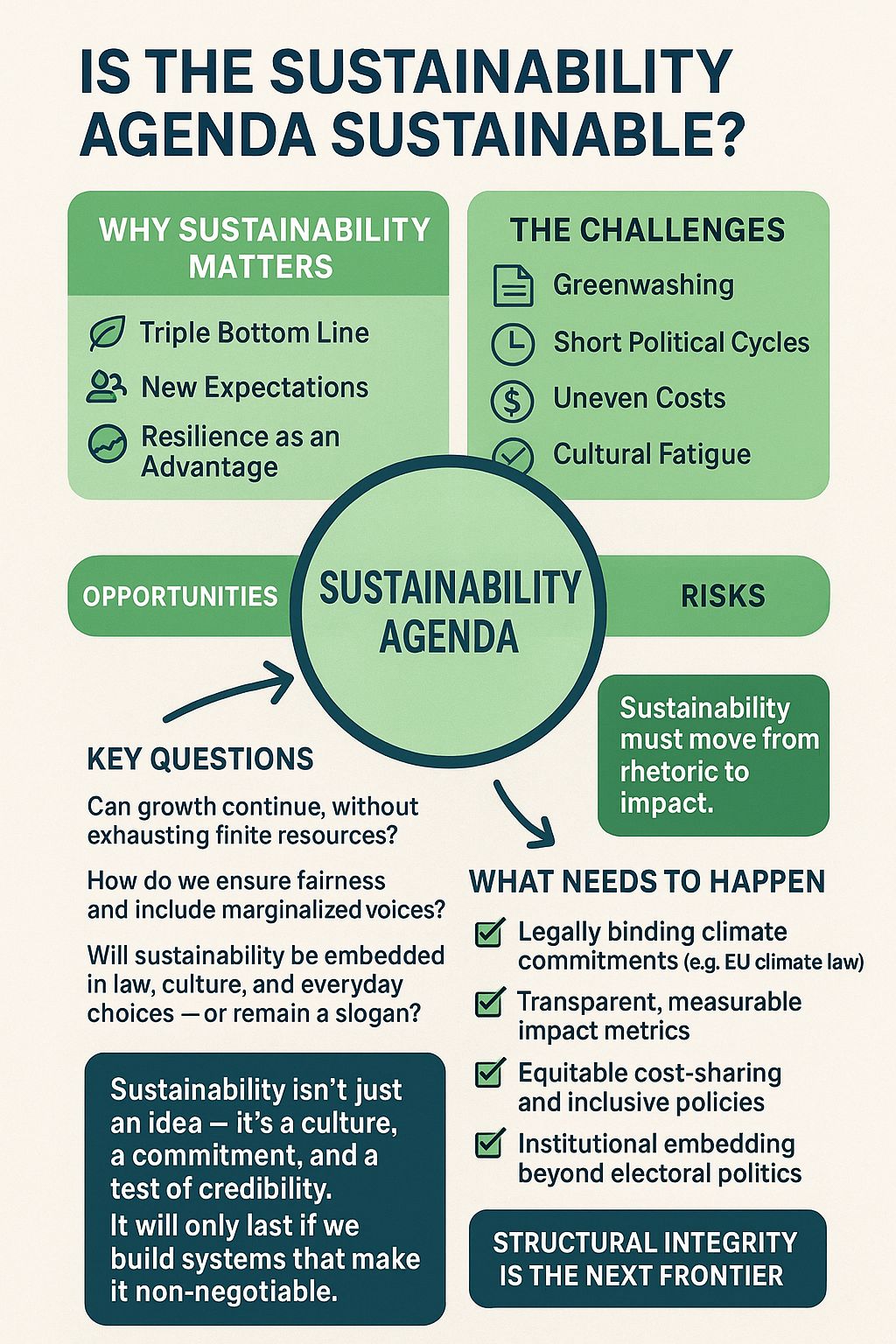
The modern sustainability agenda rests on a powerful proposition that economic growth, social equity, and environmental stewardship can be reconciled. This “triple bottom line” has mobilized unprecedented investment in renewable energy, green finance, and inclusive business models. It has inspired younger generations to demand more from institutions. And it has reframed long-term resilience as a competitive advantage, not a trade-off. But the very breadth of the agenda also makes it fragile. Sustainability risks becoming a catch-all phrase, diluted by overuse and co-opted for public relations more than systemic change. “Greenwashing” scandals, short political cycles, and the uneven costs of climate transitions all threaten to erode public trust. Without credibility and consistency, the agenda risks collapsing under its own ambition.

Sustainability requires commitments that extend far beyond the horizon of electoral politics. Yet in many countries, climate targets or ESG mandates are vulnerable to reversal when governments change. Contrast this with the European Union’s legally binding climate law, a structural safeguard that makes sustainability less of a political preference and more of a shared contract. Unless sustainability is institutionally embedded, it remains hostage to short sightedness.

Green growth advocates argue that economies can decouple prosperity from resource use. The rapid expansion of renewable energy, circular economy models, and impact investing provide evidence of possibility. Yet sceptics highlight that global consumption continues to outpace planetary boundaries. The sustainability agenda will endure only if it reconciles with the fundamental question of growth Vs limits. Can infinite growth coexist with finite resources?

No agenda, however well-intentioned, survives if it is perceived as unjust. For sustainability to be sustainable, it must embody fairness that includes redistributing costs, creating inclusive opportunities, and acknowledging diverse voices, particularly from the Global South. Social justice and legitimacy must go hand in hand.

Ultimately, sustainability is not just a strategy, it is a cultural shift. The more it embeds in consumer choices, organizational values, and educational systems, the harder it becomes to reverse. Yet cultural fatigue is real. When “sustainability” is reduced to a buzzword on every product label, development projects, and corporate brochure, it risks losing meaning. The agenda must therefore move from rhetoric to demonstrable impact, measured transparently and communicated honestly.

The sustainability agenda is both fragile and resilient. Fragile because it depends on long-term alignment across politics, markets, and societies, an alignment often in short supply. Resilient because it has transcended niche environmentalism to become a mainstream expectation that governments and corporations cannot ignore.

Its endurance will depend not on visionary statements but on institutional embedding, equitable policies, and a relentless focus on credibility. At its best, sustainability can serve as the organising principle of a new social contract, aligning business, government, and citizens toward long-term collective wellbeing. Sustainability will only be sustainable if it delivers, not someday, but today.

The next frontier is not about asking companies, governments, or communities to “do more” on sustainability. It is about demanding structural integrity – mechanisms, institutions, and accountability frameworks that ensure sustainability survives political shifts, economic pressures, and cultural fatigue.

Digital Bihar, Inclusive Growth

Image generated using AI

Bihar has a rich historical and cultural heritage and is one of the most populous states in India, with a population exceeding 13 crores[i] and a predominantly rural population. The state faces several challenges in digital literacy, access to technology, digital inclusion, economic development, and equitable growth. However, recent initiatives in e-governance, education, and entrepreneurship hold much promise and potential for contributing towards India’s vision of a digitally empowered society.

Digital literacy remains a significant challenge, with rates below 30% (national average 38% for household digital literacy[ii]), as reported by Ideas for India[iii]. Bihar’s low digital literacy follows its socio-economic conditions, including high poverty rates[iv] (33.76% below the poverty line and 51.91% multidimensional poverty as of 2021) and limited access to digital devices. Rural areas, which hold 75% of the state’s population face challenges due to inadequate infrastructure and low literacy levels. The state’s overall literacy rate, as per 2017 data, stands at 70.9%[v], with rural areas at 69.5% and urban areas at 83.1%. Female literacy, at 60.5%, is significantly lower than male literacy at 79.7%, further complicating efforts to bridge the digital divide.

The digital divide in Bihar is a significant barrier to inclusive development. According to the India Inequality Report 2022 by Oxfam India[vi], Bihar has the lowest internet penetration among Indian states and a wide urban-rural digital divide, with only 31% of rural residents using the internet compared to 67% in urban areas. This rural-urban divide is further worsened by socio-economic disparities.

The digital divide affects important sectors like education, healthcare, and finance. For example, in 2017-18 only 9% of students enrolled had access to a computer with internet for education[vii]. Initiatives like BharatNet, aimed at providing rural connectivity, have been unable to deliver effective outcomes. Bihar is one of the focus states for the Digital India Programme, but execution lags due to infrastructural challenges.

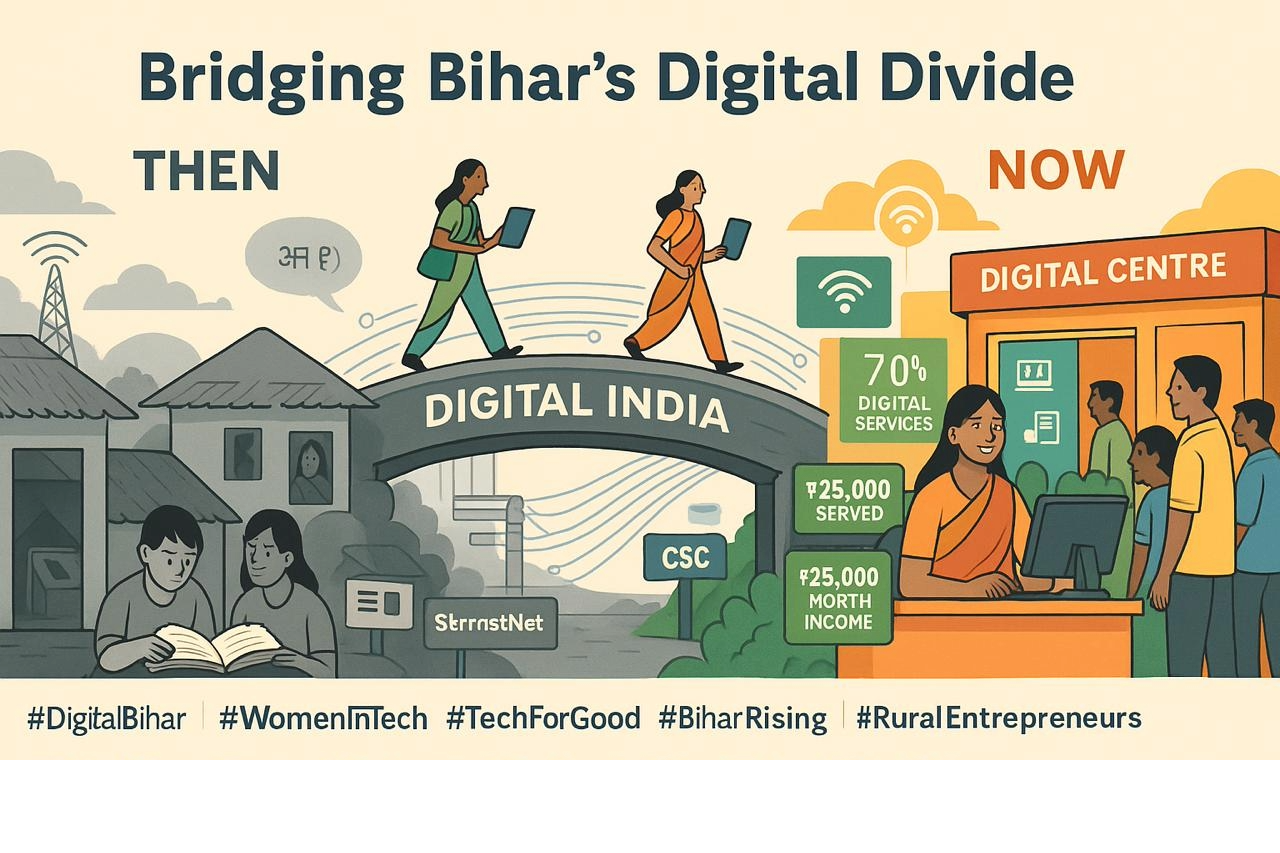
In recent years, Bihar has made significant strides in leveraging digital services in improving governance and public service delivery. The National Informatics Center (NIC) Bihar State Centre, established in 1988, plays a central role in this transformation (https://bihar.nic.in/). It supports departments such as revenue, district administration, rural development, finance, agriculture, employment, election, social welfare, and food and civil supplies with IT solutions. The ServicePlus portal is a key platform, offering services like certificate issuance and case status checks, though rural access remains a hurdle, particularly for marginalized communities, requiring better infrastructure and awareness. These barriers require continued investment in training and infrastructure to ensure widespread digital literacy. Common Service Centres (CSCs) and Vasudha Kendra are crucial for providing government and private services to rural and remote areas in Bihar, enhancing digital inclusion and accessibility. However, they are not enough to cater to the growing needs of the rural population. People travel to block towns and larger villages, to access even basic G2C services, indicating the lack of any nearby facility.

For bridging the digital divide, a digital entrepreneurship program in 500 villages from five districts, viz., Darbhanga, Samastipur, Patna, Nalanda, and Gaya was launched in 2023. Bihar is witnessing a transformative wave of service accessibility led by women digital entrepreneurs. These trailblazing women are not only redefining the entrepreneurial landscape but also catalyzing inclusive development across the state. This initiative provides capacity building and mentoring in digital skills, customer service, entrepreneurship development, financial support and resources, and digital tools to women from socially and economically disadvantaged communities, helping them become successful rural digital entrepreneurs and build a Digital Entrepreneurship Ecosystem. This holistic approach equips them to offer essential digital services in their communities, such as facilitating access to government schemes, online education, and digital financial services. From being computer illiterate to providing a host of over 70+ digital services, these digital entrepreneurs have come a long way only within 9 months of their venture-start in their villages. Some of their services include a large suite of G2C services, design & printing services, online form filling, Banking services, and Mobile payments, among several others. They have also been cross-selling and diversified in selling non-digital products. In this short period, they have already served over 250,000 rural customers (around 40% female customers), and is expected that as their businesses mature, they will be providing digital services to over 7.5 lakh population. Apart from making digital services easily accessible at the village level, they are generating income and securing their futures, with some of them steadily earning upwards of INR25,000 monthly. This program is not only bridging the digital divide but also promoting economic security and social equity, local inclusive economic development, gender equality, awareness, and opening opportunities for skills development.

While government efforts are underway, a coordinated approach involving public-private partnerships, local community engagement, and targeted digital inclusion programs is essential. Programs like these need to be scaled up across the state covering the entire 8,387 Gram Panchayats for bridging the digital divide and contributing significantly to Bihar’s and India’s digital economy.