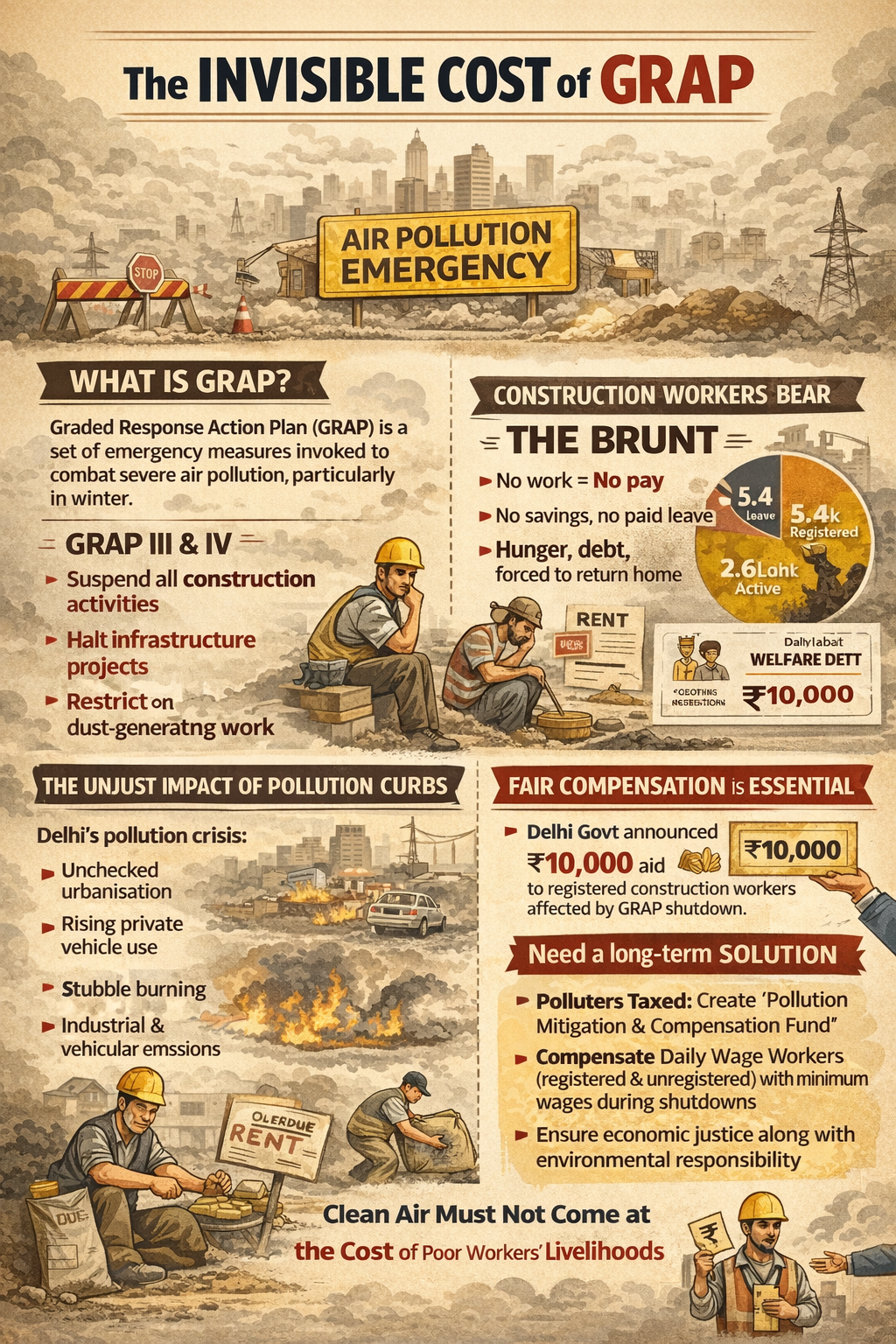
The invisible cost of GRAP 

Delhi slips into a public health emergency as air pollution reaches hazardous levels every winter. The government responds by invoking the most stringent measures under the Graded Response Action Plan (GRAP III and IV), suspending all construction and demolition activities, halting infrastructure projects, and restricting dust-generating work. These steps are necessary and justified for pollution control and the health of people. However, the cost of Delhi’s clean air policies is disproportionately borne by construction workers and daily wage labourers, whose livelihoods are abruptly and completely cut off.

Delhi has a massive daily wage construction labour force, estimated between 10-12 lakhs workers, with only around 5.4 lakhs officially registered (around 2.6 lakh active). Construction restrictions under GRAP III and IV are designed to curb particulate pollution, particularly PM10, a major contributor to Delhi’s smog. However, the construction sector is sustained almost entirely by informal labour. Migrant workers, hired through layers of contractors, work without written contracts, income security, or social protection. When work stops, wages stop instantly. There are no savings to fall back on, no paid leave, and often no local support systems. For these workers, a week-long (or longer) pollution shutdown can mean hunger, unpaid rent, mounting debt, or forced return to their native places under distress.

The injustice lies in the fact that these workers are not the architects of Delhi’s pollution crisis. Air pollution is the result of long-term structural failures, like unchecked urbanisation, rising private vehicle use, industrial emissions, poor public transport planning, weak enforcement of environmental norms, and regional factors like stubble burning. Construction workers operate within this system, responding to demand created by the city’s growth. Yet, when pollution peaks, their labour is the first to be criminalised, as if survival itself were an environmental offence.

The common defence of GRAP rests on a false dichotomy between public health and livelihoods. This framing assumes that income loss is a tolerable short-term sacrifice in the interest of long-term health. For daily wage labourers, livelihood and health are inseparable. Loss of income leads to undernutrition, stress, untreated illness, and increased vulnerability. Clean air achieved by pushing workers out of their wages is a policy failure and not a public health success. India’s environmental governance has consistently overlooked this social dimension. While regulations effectively restrict polluting activities, there is little institutional thought given to compensating those who lose income due to regulatory action. 

On 18th December 2025, the Delhi Government announced financial assistance of  INR 10,000 through Direct Benefit Transfer (DBT) to registered construction workers affected by the curbs under GRAP. While this is a welcome announcement by the Government, a clear policy solution is required in the long run for the provision of minimum wages to construction workers and daily wage labourers, both registered and unregistered, for the duration of GRAP shutdowns. This compensation should not be framed as charity or welfare, but as a rightful payment for income loss imposed by public policy in the interest of collective well-being. If the state mandates a halt to work for environmental reasons, it must also accept responsibility for the economic consequences of that mandate.

The most viable way to finance this support is through a dedicated ‘pollution tax.’ Delhi already collects various environment-linked charges, including green cess on vehicles, environmental compensation from polluting industries, and penalties for regulatory violations. These revenues can be consolidated into a Pollution Mitigation and Compensation Fund. Additional sources could include congestion charges in high-traffic zones, higher fees on large real estate developments, and stricter fines on construction firms that violate dust-control norms. Those who contribute most to pollution should bear the cost of its social mitigation.

Beyond immediate compensation, such a policy would also strengthen environmental compliance. When workers are protected from income loss, resistance to pollution-control measures will also decline. Environmental regulation will become a shared responsibility rather than an imposed punishment. Over time, this approach can build public trust in pollution governance, which is currently eroded by perceptions of unfairness and elite insulation from consequences.In the longer term, Delhi must move towards cleaner construction technologies, year-round dust control enforcement, better urban planning, and formalisation of labour. But these structural reforms will take time. Until then, compensating workers during pollution-induced shutdowns is a matter of basic justice. Environmental policy that ignores inequality risks becoming morally hollow and politically fragile. Clean air should be a shared achievement, not one built on empty stomachs and silent suffering.

First published at LinkedIn on 22nd December 2025

Data is Divine

In God we trust. All others must bring data.” This quote, made by W. Edwards Deming holds true (and may even supersede God for some as Divine).

I have been in love with data right from my school years and the mysteries of the world it holds. I have tried to develop data driven models on human relationships, the movement of animals, finding patterns in the ways of the world, and later designing programs of social impact for challenging poverty, and policy development. In the end, we all are data, from the moment we are an idea until long after we pass away.

“Data is divine” highlights the growing understanding of data’s vital significance in modern society, in much the same way that religious or spiritual values have directed civilizations throughout history. In today’s digital age, data powers innovation, decision-making, and advancement in all fields, including governance, research, business, healthcare, and lifestyle.

1. Data as a source of truth: Data is frequently regarded as an impartial depiction of reality, providing information on trends and occurrences that may be imperceptible to anecdotal experience or intuition. In this way, data has a unique position as the basis for making well-informed decisions and uncovering hidden facts.

2. The power of data in innovation: Data is driving advancements in domains like healthcare, finance, and climate science and is revolutionizing industries as it powers AI/ML and sophisticated analytics. This emphasizes how data has the “divine” ability to spark significant change. The use of data for enhancing human welfare, from preventing pandemics through data-driven epidemiology to lowering inequality by studying societal trends has been in use. When applied sensibly and morally, it can aid in resolving some of the most pressing issues facing society.

3. Data as omnipresent: From the apps we use daily to the systems that manage our cities, data is present everywhere in the modern world. Its pervasiveness is comparable to a certain “divine” quality in that it affects almost every facet of contemporary life, whether we are conscious of it or not.

4. Data and ethics: Data carries a great deal of responsibility along with its power. Similar to supernatural knowledge, there are significant ethical ramifications to the way we collect, use, and safeguard data. Data misuse can result in inequality, manipulation, and privacy violations. As a result, it is crucial to handle data with dignity, openness, and ethics.

“Data is divine” also implies that we must treat it with deference and accountability while simultaneously appreciating its immense importance in shaping our future. We need to balance the power of data with ethical considerations as our world grows more and more data driven. The following are some crucial strategies to preserve this equilibrium,

1. Data privacy and informed consent: People ought to be in charge of how their information is gathered, kept, and utilized. It is not appropriate to force them to divulge information. Companies must be open and honest about their data practices so that users know what information is being gathered and why. Clear and informed consent should not be buried in complicated terms and conditions. Data literacy is essential among general population so that they are aware of the consequences of disclosing personal information, and the dangers of data misuse.

2. Data minimization: Only gather information that is absolutely required for the current job. This reduces the possibility of abuse and shields people from needless exposure. I’ve seen in recent years how social development initiatives gather and store vast amounts of data, with donors coercing their nonprofit partners to obtain it, yet this doesn’t address any societal issues. It is crucial to have a conscious grasp of what is needed.

3. Data bias and fairness: AI/ML systems may reinforce or increase biases found in the training data. Therefore, diversifying datasets, employing inclusive development techniques, and reviewing algorithms for bias are all necessary to ensure fairness.

4. Equitable data access: One way to lessen inequality is to make sure that data access and its advantages are shared equitably among all communities. This entails preventing the reinforcement of systemic disadvantages while ensuring that marginalized groups have access to data-driven insights.

5. Data governance and accountability: To ensure that data is utilized properly, organizations and governments must establish robust data governance policies and ethical frameworks. To stay up with the latest developments in technology, these policies must be revised regularly. It is imperative to establish unambiguous lines of accountability for the handling and utilization of data. Data practices can be kept moral and in line with social standards with the support of independent oversight organizations or ethics boards.

6. Regulation and legal safeguards: Strong data protection laws that impose restrictions on how businesses and organizations can gather, keep, and handle personal data must be enforced by governments. Laws that address issues like accountability for algorithmic judgments, eliminating discrimination, and safeguarding human rights in AI-driven systems are crucial for the ethical application of automation and artificial intelligence. Because technology is changing so quickly, regulatory models must be adaptable and flexible to support innovation and enable quick responses to emerging ethical dilemmas.

7. Data for social good: Data can and should also be used positive social impact including lowering inequality and poverty, combating climate change, and improving public health. Governments, corporations, and civil society organizations working together can help guarantee that data is used morally and for the good of society. These collaborations may result in common frameworks for the ethical use of data.

A multifaceted strategy including legislation, transparency, public education, and proactive governance is needed to strike a balance between the power of data and ethical issues. Prioritizing the defence of individual rights, maintaining equity, and advancing the common good while fostering innovation should be the main goals of ethical data use. Through cultivating a culture of accountability and responsibility, we can leverage data’s promise (and divinity) without sacrificing moral principles.

Disclaimer: The opinions expressed are those of the author and do not purport to reflect the views or opinions of any organization, foundation, CSR, non-profit or others

Cover Photo: This is an AI generated image.