Economics of Diwali

As we celebrate the sparkle of Diwali festivities with lights, the Indian economy, too, is glowing with festive energy. Diwali is not only a cultural and spiritual event but also an economic phenomenon that mobilizes consumption, trade, and emotion on a scale unmatched by any other festival in India. It is a festival where faith, finance, and family come together to illuminate not just homes but entire markets.

Diwali blends culture and commerce. Traditionally marking the return of Lord Ram to Ayodhya after 14 years of vanavasa (exile), the festival has evolved into India’s largest consumption cycle. According to industry estimates, Diwali season alone accounts for 30–40% of annual sales in sectors like jewellery, automobiles, electronics, apparel, and consumer goods.

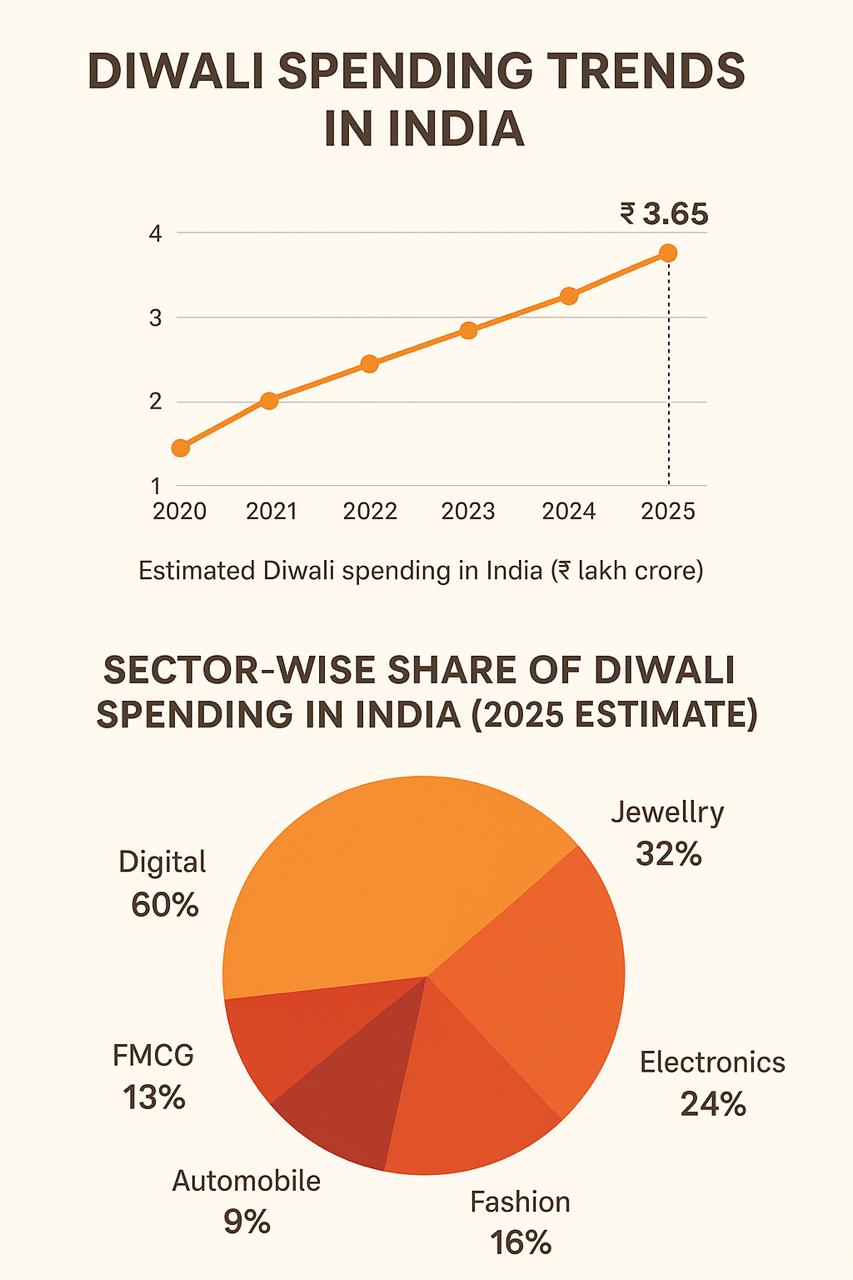
In 2024, India’s festive spending during Diwali week was estimated at INR 3.2 lakh crore, reflecting a 17% rise over 2023, driven by rising disposable incomes, pent-up post-pandemic demand, and digital retail penetration. Retail chains, e-commerce platforms, and even microenterprises depend on this period to recover annual profits. For small traders, Diwali is often the difference between a good year and a bad one. The festival also synchronizes the Indian economy’s emotional rhythm—consumer sentiment peaks as the festival approaches, heightened by work bonuses, gifts, and an almost cultural belief that new purchases bring prosperity.

Two days before Diwali, Indians celebrate Dhanteras, considered the most auspicious day to buy gold, silver, or anything of value. Historically, this practice was rooted in agrarian prosperity cycles during which, farmers who had completed the harvest season invested their earnings in tangible assets like metals. Today, the sentiment remains, but the scale has exploded. The symbolism has migrated from the vault to the marketplace, aligning tradition with modern consumption.

Diwali’s economic landscape has been radically redrawn by digital commerce. In 2024, online festive sales crossed INR 90,000 crore, driven by e-commerce platforms like Amazon, Flipkart, and Meesho. Tier-II and Tier-III cities accounted for more than 60% of new shoppers, an indication that India’s digital inclusion is now deeply linked with its festive economy.

Algorithms have replaced astrologers in predicting purchasing patterns. AI-driven recommendations, influencer marketing, and digital payment ecosystems like UPI have made the act of buying faster and impulsive. While urban consumers enjoy massive discounts, small offline retailers struggle to match online prices. Many traditional businesses like sweet shops, garment stores, and gift outlets are now adapting with hybrid models, selling on WhatsApp or through community platforms. The local bazaar is not dying; it is simply going online.

Behind the glitter of malls and advertisements lies a quieter but equally powerful story of the informal and rural economy that powers Diwali. Across India, millions of artisans, potters, weavers, and small manufacturers depend on the season for a significant portion of their income. From handmade diyas in Bihar to terracotta idols from Bankura, paper lanterns in Maharashtra, and bamboo crafts from Northeastern states, Diwali sustains local creative economies that embody both tradition and entrepreneurship. In recent years, several NGOs and social enterprises have helped rural producers connect directly with urban buyers through digital platforms. For instance, self-help groups (SHGs) supported by government programs like NRLM (National Rural Livelihoods Mission) and private CSR initiatives now sell festive handicrafts on e-commerce sites and social media. The “Make in Village” movement during Diwali is becoming a quiet counter-narrative to imported mass-produced goods. Every diya sold is not just a source of light but a livelihood.

Gifting is central to Diwali’s economic ecosystem. From corporate gift hampers to sweets exchanged among families, the ritual symbolizes goodwill, reciprocity, and status. In 2024, India’s corporate gifting industry was valued at ₹12,000 crore, with strong growth projected for 2025. Beyond sweets and dry fruits, companies now gift experiences like wellness vouchers, eco-friendly hampers, and handmade products to reflect social consciousness and sustainability. The gifting economy also reveals deeper social psychology. Gifts during Diwali are not just commodities; they are currencies of relationship. In economic terms, they create “social capital”, the trust and goodwill that sustain business and personal networks alike.

In last decade or so, Diwali’s environmental impact has come under scrutiny. Delhi is the best (or worst) example of this intense air pollution from firecrackers making the environment unbreathable, plastic waste from packaging, and excessive electricity consumption have led to rising calls for a Green Diwali. The market is responding with conscious choices. In 2025, the sale of eco-friendly crackers and biodegradable decorations is expected to grow by 30%. Solar-powered lighting, organic sweets, and recycled packaging are becoming mainstream. Conscious consumers, especially younger urban Indians, are now demanding sustainable alternatives that align celebration with responsibility. The shift from conspicuous consumption to conscious consumption marks a new chapter in the economics of Diwali, one where prosperity is measured not just by spending, but by sustainability.

However, Diwali’s prosperity is not evenly distributed. Inflation affects the purchasing power of lower-income families who often face higher food and fuel prices during the season despite the recent GST reforms, which has significantly brought down the prices of most of the consumer goods. While the urban affluent splurge on gadgets and gold, many households cut back on essentials.

This divergence reflects the broader K-shaped recovery post-pandemic of the Indian economy, where upper segments surge ahead while those on the lower segments struggle. The festive glow, though radiant, hides shadows of inequality. For small retailers, rising input costs and competition from online giants have squeezed margins. For daily wage earners, the festival may mean temporary income spikes but little long-term security. Diwali illuminates both the promise and paradox of India’s growth story.

At its core, Diwali celebrates renewal of hope, homes, and human spirit. Economically too, it acts as a reset button for the nation’s consumer sentiment. The act of cleaning homes, buying new things, and lighting lamps mirrors the cyclical nature of economic optimism. For policymakers and economists, the festive season is a real-time barometer of demand. For families, it’s a reminder that prosperity is not just about wealth, but about togetherness and gratitude. In many ways, Diwali teaches an enduring lesson in economics that growth is sustainable only when it is inclusive, joyful, and mindful.

The economics of Diwali is not just about expenditure, but it is also about the exchange of energy, emotion, and enterprise. It reflects India’s evolving story of modernization rooted in tradition, digital transformation anchored in ritual, and capitalism softened by culture. The future of India’s festive economy will shine brightest when it balances profit with purpose, growth with gratitude, and consumption with conscience.

Social Capital in India: Old wine new bottle

Photo source: http://entrepid.sg

India faced the problems of economic development and poverty eradication twice on a massive scale. Firstly, it was felt acutely just after independence and secondly, it is being felt still more acutely, today, when under the pressure of globalization, India has to turn to United States of America and western countries for its development. When Indiabecame independent from the British rule in 1947, Pt. Jawaharlal Nehru as the first Prime Minister of India, felt the need to develop an independent economic system. To strengthen independence and make it more meaningful for the common man, the issue was hotly debated. The American and western experts termed the debate on independent economic system as a futile exercise. They argued that as India was divided into so many castes, religions, languages and regions it could not create a large, well organised market system. They believed that Indians were people with spiritual leanings who cared more for the world here after. And therefore, it was believed that these Indian common men had little interest in savings or profit making. They even quoted Shankaracharya, in their support whose teachings said, ‘O fools, wealth can never give you satisfaction. So renounce all desires. Be wise and contented and happy with your lot.’

In this way the western masters did all they could to dissuade India from modern industrialisation. But JL Nehru and the subsequent PM Smt. Indira Gandhi never felt discouraged and made concerted efforts to develop an independent economy and achieved unprecedented success in this direction.

Surprisingly enough, these advisors have appeared again, this time in the form of institutional system like World Bank. They claim that lack of Social Capital is at the root of growing socio-economic disparity, corruption and rising crimes in the country. Therefore,India should desist from opposing international economic system (as witnessed inCancun) and make an all-out effort to create Social Capital. Robert Putnam, Francis Fukuyama and World Bank worked as Think Tank behind this campaign. Putnam was the chief exponent of the modern concept of Social Capital. He discussed this concept in detail in his famous book, ‘Making Democracy Work: Civic traditions in Modern Italy’ published in1993. In his opinion ‘Social Capital’ is closely associated with the kind of social organization which is based on mutual trust and accepted standards of social conduct. These elements work as networks that develop the work culture of the society that pave the way for combined social efforts for economic progress and prosperity. In other words, ‘they create a social affinity that helps people work together and thereby increase production’.

Francis Fukuyama underlined the importance of ‘Social Capital’ in his book ‘Trust and the Great depression’. He further emphasised its role in his pamphlet ‘Social Capital and Civil society’, which he wrote for International Monetary Fund. According to Fukuyama Social Capital is essential for modern economy to function efficiently. No liberal democracy can function without it nor can modern culture survive without it.

World Bank considers Social Capital as the lost link of development. The concept of Social Capital with its inherent implications is not entirely new for India. Right form the ancient times people were instructed to work together. It has been the basis of joint family, caste-system, society and religion. Lord Buddha preached, ‘Sangham Sharanam Gachhami’. Today it is said that ‘strength lies in unity’ (‘Sanghe Shakti Kalyuge’ in modern times). The question is if we already know the importance of Social Capital, it means that there is nothing new in the concept. It is only old wine in a new bottle. Then what is the justification for launching such a great campaign again!

The reason is not far to seek. Western countries and their experts and their mouthpieces in the form of Organizations viz., International Monetary Fund and the world bank, nourished by them do not want that developing nations should see their economic backwardness and mismanagement in their historical perspective and take positive steps to redress them. Nor do they want that these nations should launch a crusade against the present unjust International economic system. These western powers want that the developing countries should follow their dictates, in every area of economic development, as modern day economic colonies. So, they try to convince the people of the developing Countries that they alone are responsible for their present miseries. If they stop fighting among themselves and create an atmosphere of mutual co-operation and trust they will progress with rapid speed.

It is useless to blame Capitalism and Imperialism. If land-lords and farm-workers, Capitalists and imperialists, forwards and backwards, developed and developing nations shun the path of confrontation and live amicably by creating mutual trust, the problems of poverty, exploitation and backwardness will be solved in due course. The spokesmen of the present concept of Social Capital strongly believe that in a country like India, the root and source of Social Capital still exist, but they can be revived not by Government machinery but by non governmental organizations. As the present political system has become utterly corrupt, these organizations should keep above politics while discharging their duties.

They are opposed even to Gram Panchayat and decentralisation because they are fully under the control of the Government. In this way, they want to keep all developmental work beyond the jurisdiction of the government. The supporters of Social Capital are in the favour of making all development work non-political. They have faith only in non-governmental organizations. But as we all know that these NGOs are not above controversy. Most of them are interested only in earning money by fair or foul means. They receive money from many donor agencies, which are not above suspicion themselves. The data collected by NGOs may be used by the foreign agencies against the government, which may go against our national interests. In short, these so called NGOs are not free from corruption. More over, the Social Capital generated by NGOs is not equally used for the benefit of every section of the society.

Today India needs all-round social, economic, political and cultural changes to create congenial conditions for development. This is a tremendous task which can be accomplished by political parties alone by using people’s power. This is because; the party in power is answerable to the people and the parliament. The NGOs which create Social Capital do not own any such responsibility. In India, NGOs like Ram Krishna Mission, Bharat Sevashrana, etc have been functioning for decades. They have done commendable work, but have never claimed that they can bring about comprehensive economic and political development. Today NGOs which are known for their integrity can not do more than providing temporary relief. However, permanent changes can be brought with a proactive partnership between the government and the civil societies. Therefore, it is wrong and even dangerous to think of development without government and political power.

In the end attention should also be drawn to the fact that some people want to encourage casteist, regional and communal organizations in the name of creating and developing Social Capital. It is a signal of danger which should be taken note of. If Brahmins form their organization to help their kinsmen and backward and schedule castes work on the same lines, it will aggravate only sectarian feelings. India, which is already divided on sectarian lines will break into fragments if programs of Social Capital are implemented with such narrow minded aims and ambitions.

Economics of your startup

Usually entrepreneurs describe their products & services as they see them. It’s important to describe them from your customers’ point of view. Look the difference between features and benefits of your product/service, and think about them. You need to build features into your product so that you can sell the benefits. You also need to think hard and strategize on what after-sale services you will be giving? Some examples can be delivery, guarantee/warranty, service contracts, support, follow-up, and refund policy.

Customers

Identify your targeted customers, their characteristics, and their demographics. The description will be completely different depending on whether you plan to sell directly to customers/end users or to other businesses. If you are planning to sell a consumer product, but want to do it through a channel of distributors, wholesalers, and retailers, you must carefully analyze both the end consumer and the middleman businesses to which you will sell.

Competition

You need to think and carefully answer the following questions for your startups. What products and companies will compete with you? Will they compete with you across the board, or just for certain products, certain customers, or in certain locations? Will you have important indirect competitors? How will your products or services compare with the competition?

You need to honestly think about your product/service weaknesses. Sometimes it is hard to analyze our own weaknesses. Better yet, get some disinterested strangers to assess you. This can be a real eye-opener. And remember that you cannot be all things to all people. In fact, trying to be causes many business failures because efforts become scattered and diluted. You want an honest assessment of your startup’s strong and weak points.

Niche & Strategy

Now that you have systematically analyzed your industry, your product, your customers, and the competition, you should have a clear picture of where your company fits into the world. Consistent with your niche, you can outline a strategy for your startup.

Pricing

Develop your method of setting prices for your product/service. Does your pricing strategy fit with what was revealed in your competitive analysis? For most startups, having the lowest price is not a good policy. It robs you of needed profit margin; customers may not care as much about price as you think; and large competitors can under price you anyway. Usually you will do better to have average prices and compete on quality and service.

Sales Forecast

After you have laid down comprehensive information and plan for your startup in detail, it’s time to attach some numbers to your idea and prepare your sales forecast.  You may want to do two forecasts: 1) a “best guess”, which is what you really expect, and 2) a “worst case” low estimate that you are confident you can reach no matter what happens.

Do keep visiting our Blog for a specific post on Sales Forecast and a Free spreadsheet.