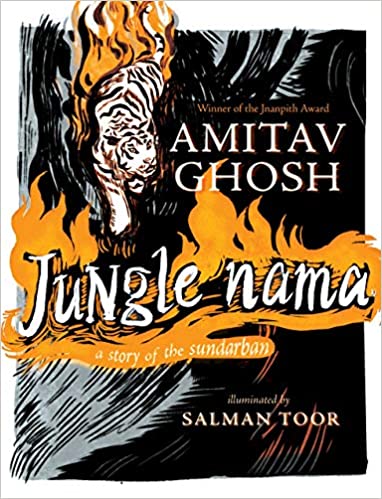
Jungle Nama: A Story of the Sundarban

Jungle Nama: A Story of the Sundarban

by Amitav Ghosh | 88 Pages | Genre:  Literary Fiction | Publisher: Fourth Estate | Year: 2021 | My Rating: 8.5/10

“All you need do, is be content with what you’ve got, to be always craving more, is a demon’s lot.”
― Amitav Ghosh, Jungle Nama

“Jungle Nama” by Amitav Ghosh is a captivating verse adaptation of a Bengali folktale from the Sundarbans, the world’s largest mangrove forest shared between India and Bangladesh. Written in a lyrical, rhythmic style, and illustrated by Salman Toor, the book tells the story of “Bon Bibi,” a benovelent goddess of the Sundarbans who safeguards the jungle and its people, and her conflict with Dokkhin Rai, a powerful demon-like figure who seeks to exploit the forest’s riches.

Ghosh’s decision to render this ancient tale in verse brings a unique musicality to the story, echoing the cadence of oral storytelling introducing music to current speech that has kept the folktale alive for generations. His prose is imbued with both reverence for the source material and a contemporary sensibility that makes the story accessible to a modern audience. Accompanying the text are hauntingly beautiful illustrations by artist Salman Toor, whose work enhances the mystical and otherworldly atmosphere of the Sundarbans and its lore.

Beyond its enchanting style, Jungle Nama explores timeless themes of balance between nature and humanity, the perils of human greed, and the importance of respecting natural boundaries. Ghosh subtly draws parallels to modern issues like climate change and environmental degradation, suggesting that the ancient wisdom in the Bon Bibi story holds valuable lessons for today’s world. Through Bon Bibi’s character, he raises questions about stewardship, sustainability, and the price of human ambition.

The book is more than a poetic retelling; it’s an immersive experience that connects readers to both nature and folklore. Ghosh’s evocative language and Toor’s illustrations work in harmony to capture the spirit of the Sundarbans and its lore, making this book a visually and intellectually rich addition to Ghosh’s body of work. The poem-like style of the book follows twelve syllables in each line, and each couplet has twenty-four syllables. After each line there is a natural pause or a caesura, replicating the cadence of the original legend.

This book by one of my all-time favourite authors is a mesmerizing read for anyone interested in myth, poetry, linguistic hybridity, and environment, offering a rare glimpse into a world where nature and spirituality are deeply intertwined.

Bamboo Charcoal and Activated Carbon

Bamboo charcoal and active carbon are new products developed in recent years. Bamboo being of special microstructure possesses extreme absorbing and other special capacities after carbonization. Their uses in the areas of new technology are of importance.

Variety of Bamboo Charcoal: There are many kinds of bamboo charcoal. In line with their origin, bamboo charcoal can be divided into two parts: raw bamboo charcoal and charcoal stick of chips. Raw bamboo charcoal is made of small sized bamboo, old bamboo, and bamboo tops, roots, which are not fit for making other bamboo products. Charcoal stick of chips is made of residue from bamboo processing industries. In the process of making different kinds of industrialized products, there will be residue, which should be broken in chips, dried, and pressed into sticks before carbonization.

Full Post HERE

Bamboo Based Industries in India

India has huge natural bamboo stocks that have been an integral part of Indian culture for many millennia. Bamboo in many ways is the mainstay of the rural Indian economy, sparking considerable social and ecological spin-offs. In the early part of the century, large tracts of bamboo occurred in many parts of the country but were treated by forestry sector (which was then cast in a production forestry mode) as a weed of little economic value and were used mostly by the rural communities for crafts, making implements and as housing material. It was the discovery of bamboo as a source of long-fibre by the Forest Research Institute in Dehradun that started the process of using bamboo in a variety of industrial applications, so far unexplored, with several paper mills and rayon mills being set up. But in the absence of a clear policy of husbanding of the resource there was rapid degradation and decimation of the resource in much of the country. Bamboo resources plummeted so alarmingly that at present the resource is limited to few pockets in the country. Two-thirds of the bamboo in the country is restricted to the North-Eastern Region (NER) while the remaining one-third is spread across the country.

Full Post HERE

Bamboo as plantation crop for biomass

The Biomass Feedstock Development Program at Oak Ridge National Laboratory (ORNL) recently released a publication entitled Bamboo: An Overlooked Biomass Resource? Bamboo is the common term for a group of woody grasses comprised of 1250 species. It is relatively fast growing and attains maturity within five years. The shortest species stands only four inches (10 cm) at maturity while the tallest reach 130 feet (40 m) with stem (culm) diameters of 12 inches (30 cm). Read the full post HERE

Bamboo in natural disaster mitigation

Bamboo can play a role in disasters and relief in the following ways:

1. Bamboo’s ability to withstand vibrations help in mitigating disasters. Buildings made of bamboo survive earthquakes while concrete structures collapse. Latin American houses built with bamboo have survived earthquakes.

 2. Bamboo’s soil binding properties helps in preventing land degradation, soil erosion and land slides. It preserves watersheds. Underground roots can spread over a 100 square metre area. When rains fail bamboo rhizomes increase soil moisture. This can help in drought proofing.

Read the full post HERE