Light

Light: Empty Space (Kefahuchi Tract) 

by M. John Harrison | 336 PagesGenre: Science Fiction/Fantasy Literature | Publisher: First edition published by Gollancz. My edition published by Orion Publishing | Year: 2002 | My Rating: 9/10

“When you have done all things worth doing, you’re forced to start on things that aren’t”
― John Harrison, Light

Light is profoundly complex, dark, draining, unusual sci-fi mystery with a great ending. It has an uneven mosaic of two timelines filled with symbolism and curious characters. It’s not an easy read, nor it is likeable in the first instance. The book builds on you with the time you invest through the pages and remain invested in the story. 

The story bridging three stories from present Earth of 1999 and post Earth with distant and futuristic galactic settings in the year 2400, initially feels disjointed. Yet Harrison’s skill lies in gradually and subtly revealing the connections among these strands that are anchored by the mysterious cosmic phenomenon known as the Kefahuchi Tract. In this future, humanity is scattered across planets surrounding the Kefahuchi Tract, a space-time anomaly, a “singularity without an event horizon”. Violence and sex recur throughout in brusque, almost clinical tones as part of a broader theme that human depravity and detachment persist, whether in corporeal present or digital futurity.

In 1999 London, Michael Kaerney, quantum physicist and serial killer, is seeking an escape in a future that doesn’t yet exist – a quantum world that he hope to access through a breach of time and space. In this future, Seria Mau Genlicher has already sacrificed her body to merge into the systems of her starship, the White Cat. In this future, Ed Chianese, a drifter and adventurer, has ridden dynaflow ships, run old alien mazes, surfed stellar envelopes. Haunting them all through this maze of menace and mystery is the shadowy presence of the Shrander, a being with a horse skull for a head. 

I have wanted to read this book for so long, until I received it as a birthday gift 22 years later. This enigmatic blend of literary complexity, cyberpunk, and metaphysical dread is worth reading. However, this certainly is not a casual read. You need focus and dark scientific imagination to relish its thematic depth. Once you have read this, you would be hooked to read the two sequels Harrison wrote, completing the triology.

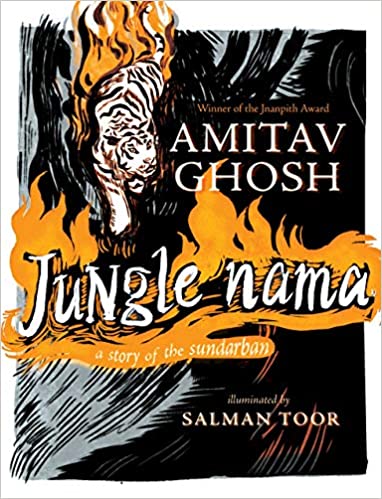
Jungle Nama: A Story of the Sundarban

Jungle Nama: A Story of the Sundarban

by Amitav Ghosh | 88 Pages | Genre:  Literary Fiction | Publisher: Fourth Estate | Year: 2021 | My Rating: 8.5/10

“All you need do, is be content with what you’ve got, to be always craving more, is a demon’s lot.”
― Amitav Ghosh, Jungle Nama

“Jungle Nama” by Amitav Ghosh is a captivating verse adaptation of a Bengali folktale from the Sundarbans, the world’s largest mangrove forest shared between India and Bangladesh. Written in a lyrical, rhythmic style, and illustrated by Salman Toor, the book tells the story of “Bon Bibi,” a benovelent goddess of the Sundarbans who safeguards the jungle and its people, and her conflict with Dokkhin Rai, a powerful demon-like figure who seeks to exploit the forest’s riches.

Ghosh’s decision to render this ancient tale in verse brings a unique musicality to the story, echoing the cadence of oral storytelling introducing music to current speech that has kept the folktale alive for generations. His prose is imbued with both reverence for the source material and a contemporary sensibility that makes the story accessible to a modern audience. Accompanying the text are hauntingly beautiful illustrations by artist Salman Toor, whose work enhances the mystical and otherworldly atmosphere of the Sundarbans and its lore.

Beyond its enchanting style, Jungle Nama explores timeless themes of balance between nature and humanity, the perils of human greed, and the importance of respecting natural boundaries. Ghosh subtly draws parallels to modern issues like climate change and environmental degradation, suggesting that the ancient wisdom in the Bon Bibi story holds valuable lessons for today’s world. Through Bon Bibi’s character, he raises questions about stewardship, sustainability, and the price of human ambition.

The book is more than a poetic retelling; it’s an immersive experience that connects readers to both nature and folklore. Ghosh’s evocative language and Toor’s illustrations work in harmony to capture the spirit of the Sundarbans and its lore, making this book a visually and intellectually rich addition to Ghosh’s body of work. The poem-like style of the book follows twelve syllables in each line, and each couplet has twenty-four syllables. After each line there is a natural pause or a caesura, replicating the cadence of the original legend.

This book by one of my all-time favourite authors is a mesmerizing read for anyone interested in myth, poetry, linguistic hybridity, and environment, offering a rare glimpse into a world where nature and spirituality are deeply intertwined.

Code Dependent: Living in the Shadow of AI

Code Dependent: Living in the Shadow of AI

by Madhumita Murgia | 320 Pages | Genre: Non-Fiction | Publisher: Pan Macmillan | Year: 2024 | My Rating: 5/10

My life—and yours—is being converted into such a data package that is then sold on. Ultimately, we are the products.”
― Madhumita Murgia, Code Dependent

Code Dependent is a collection of case studies about people who are affected by technology, without the rigour and analysis that I was expecting. But then it is not an academic or research-oriented book, but more in the popular non-fiction genre. Several of the case studies in the book reflected on the dark side of technology and social media manipulation of individuals and communities, and their rights, privacy, freedom and future.

The book is an account of how the algorithms used by tech in our daily lives through the user-friendly apps like Google Maps, Uber, Instagram, Facebook and others are changing us and the way we see the world. Our data and us as data is continuously being used for targeted advertisements to make businesses grow fatter.

Murgia defines AI as “a complex statistical software applied to finding patterns in large sets of real-world data.” I believe that AI is much more than Statistical Pattern Recognition (SPR), and this viewpoint of the author is quite narrow.

I agree with Murgia’s take on emergence of new data colonialism around the worlds, especially in under-developed and poor economies, where sub-contracting create numerous jobs as data workers, but wealth created in not shared equitably. ‘Informed Consent’ seemed misinterpreted in the book, and subjective.

There was less of ‘AI’ and more of ominous ‘shadows’ in the book. While the book talks about algorithmic bias against people, it certain has flavours of human bias against technology from the author. The book read more on data transparency than demystifying the positives and negatives of AI and technology. Pessimistic views due to advancement in technology is more pronounced throughout the book.

The book is still a fascinating read, with glimpses of ‘how AI is altering the very experience of being human’.

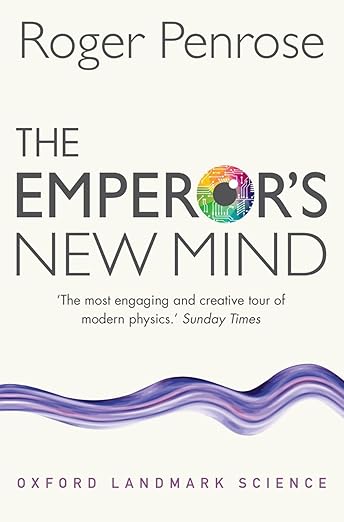
The Emperor’s New Mind

Author: Roger Penrose | 640 Pages | Genre: Non-Fiction | Publisher: Oxford University Press | Year: 1989 | My Rating: 10/10

I argue that the phenomenon of consciousness cannot be accommodated within the framework of present-day physical theory.”
― Roger Penrose, The Emperor’s New Mind

Sir Roger Penrose’s “The Emperor’s New Mind” is a captivating exploration of the intersection between mathematics, physics, consciousness, and the cognitive mind. Renowned for his contributions to theoretical physics and cosmology, Penrose brings his deep understanding of complex scientific concepts to the realm of cognition and artificial intelligence in this thought-provoking work. He covers a wide range of topics, from classical physics and Gödel’s incompleteness theorem to the puzzles of quantum mechanics and the philosophy of mind. He explains complex scientific ideas with remarkable clarity and delves into the question of what constitutes consciousness and the nature of human thought. He critiques the current state of artificial intelligence and posits that human understanding and awareness transcend mere computation. Through a blend of philosophical inquiry and scientific analysis, he argues against the idea that machines can fully replicate human cognitive processes. The book highlights the unique qualities of human thought, suggesting that there are aspects of consciousness that remain elusive to mechanistic interpretations.

Penrose also explores the implications of his theories for fields such as neuroscience and philosophy, offering insights into the workings of the human brain and the potential limitations of current scientific understanding. He integrates ideas from his previous works, such as the concept of objective reality and the nature of mathematical truths, providing a cohesive framework for his arguments.

The book is also notable for its engagement with the nature of mathematics and reality. Penrose argues that mathematics has an existence independent of the human mind, a stance known as mathematical Platonism. This perspective is central to his critique of artificial intelligence and his belief that the brain’s functioning may be linked to quantum processes. It truly is a profound and insightful exploration of consciousness and the nature of thought, bridging the gap between science and philosophy. It makes one ponder the complexities of the mind and the potential for understanding what makes us human in an age increasingly dominated by artificial intelligence.

This book is a must-read for anyone with a scientific temper, a love for complex and abstract ideas, and a deep interest in the fundamental questions of consciousness, cognitive science, and the philosophy of mind, offering an enriching perspective on the enduring mysteries of human existence.

Garbology: Our Dirty Love Affair with Trash

by Edward Humes | 325 Pages | Genre: Non-Fiction | Publisher: Avery | Year: 2013 | My Rating: 9/10

“The American Dream is inextricably linked to an endless, accelerating accumulation of trash.”
― Edward Humes, Garbology

I discovered this brilliant book by Pulitzer Prize-winning journalist, Edward Humes, when I was searching for books on plastic waste management after attending the screening of a thought-provoking documentary, A Plastic Ocean, by an award-winning filmmaker and journalist, Craig Leeson.

While the book examines how the USA became addicted to garbage, it is a story all around the world with similar environmental and socioeconomic dilemmas of the modern world. The book makes one think that while recycling the waste is the need of the hour, it is the continuous creation of waste in an endless loop that needs to be addressed. The book brings forth examples of activists and outstanding entrepreneurs who are trying to solve the menace of waste. The book also presents an economic history of garbage in the US along with surprising and even shocking statistics and concludes with a compilation of practical steps that individuals can take to reduce the environmental impacts of their generated waste. However, much more is required than just individual practices to overcome plasticisation. Planet and People need to take precedence over profits and combined efforts by communities and businesses alike along with political will are required to win the war on waste. 

I loved the chapter, ‘Down to the sea in chips’ on marine plastics pollution, and their impacts, which is a global environmental concern, converting our once pristine oceans into plastic soup.

This book is a must-read for all, especially if you are a consumer of modern life.