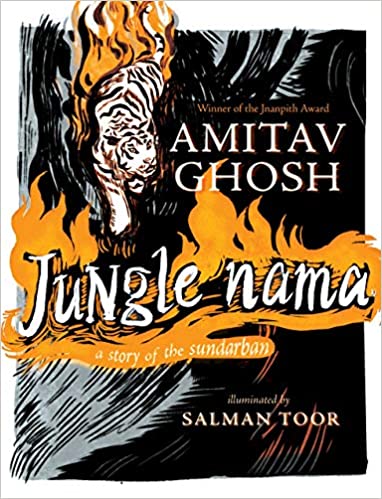
Jungle Nama: A Story of the Sundarban

Jungle Nama: A Story of the Sundarban

by Amitav Ghosh | 88 Pages | Genre:  Literary Fiction | Publisher: Fourth Estate | Year: 2021 | My Rating: 8.5/10

“All you need do, is be content with what you’ve got, to be always craving more, is a demon’s lot.”
― Amitav Ghosh, Jungle Nama

“Jungle Nama” by Amitav Ghosh is a captivating verse adaptation of a Bengali folktale from the Sundarbans, the world’s largest mangrove forest shared between India and Bangladesh. Written in a lyrical, rhythmic style, and illustrated by Salman Toor, the book tells the story of “Bon Bibi,” a benovelent goddess of the Sundarbans who safeguards the jungle and its people, and her conflict with Dokkhin Rai, a powerful demon-like figure who seeks to exploit the forest’s riches.

Ghosh’s decision to render this ancient tale in verse brings a unique musicality to the story, echoing the cadence of oral storytelling introducing music to current speech that has kept the folktale alive for generations. His prose is imbued with both reverence for the source material and a contemporary sensibility that makes the story accessible to a modern audience. Accompanying the text are hauntingly beautiful illustrations by artist Salman Toor, whose work enhances the mystical and otherworldly atmosphere of the Sundarbans and its lore.

Beyond its enchanting style, Jungle Nama explores timeless themes of balance between nature and humanity, the perils of human greed, and the importance of respecting natural boundaries. Ghosh subtly draws parallels to modern issues like climate change and environmental degradation, suggesting that the ancient wisdom in the Bon Bibi story holds valuable lessons for today’s world. Through Bon Bibi’s character, he raises questions about stewardship, sustainability, and the price of human ambition.

The book is more than a poetic retelling; it’s an immersive experience that connects readers to both nature and folklore. Ghosh’s evocative language and Toor’s illustrations work in harmony to capture the spirit of the Sundarbans and its lore, making this book a visually and intellectually rich addition to Ghosh’s body of work. The poem-like style of the book follows twelve syllables in each line, and each couplet has twenty-four syllables. After each line there is a natural pause or a caesura, replicating the cadence of the original legend.

This book by one of my all-time favourite authors is a mesmerizing read for anyone interested in myth, poetry, linguistic hybridity, and environment, offering a rare glimpse into a world where nature and spirituality are deeply intertwined.


10,000 BC

Genre: Action/ Adventure | Year: 2008 | Duration: 109 mins | Director: Roland Emmerich | Medium: VCD (BIG Home Video) | Trailer: HERE | Language: English | My rating: 2.5*/5*

Favorite Dialogue: ” D’Leh (Steven Strait) [in the pit, to Saber-tooth]: Do not eat me when I save your life!”

Roland Emmerich takes the sciences of evolutionary biology and anthropology and turns them into fiction. This film was actually so historically inaccurate that not even the giant ostrich attack & sabre-tooth scene made up for it. As the film progressed with the voice-over of the narrator (the legendary Omar Sharif) telling that this is a “story of blue eyes” and all the trappings that come along with magical realism, it became clearly obvious that 10,000 BC is a bad ripoff of Mel Gibson’s Apocalypto. It seemed as if Emmerich had lost all sense of time in 10,000 BC, as the film showed Egyptian pyramids being built using woolly mammoths, ships, horseback riding, and Steel. It’s ice age in 10,000 BC, and then the hero D’Leh (Steven Strait) walks over a hill and suddenly he’s in the Nile Valley of 2,000 BC! Was Emmerich trying to put in a further taste of science fiction through time travel?

After an attack on their village Yagahl, by ‘four-legged demons’ (horse-riding slave raiders), D’Leh and his mentor, Tic’Tic (Cliff Curtis), brave the snow-capped mountains, forests with dinosaur-like ostriches, wide savannah and parched desert in search of those who were abducted along with D’Leh’s beloved Evolet (Camilla Belle). In between this journey, D’Leh has to learn to fulfill his destiny as a leader to save his people. 

This awfully directed and archaeologically inaccurate drama can be avoided.

Binny and Family

Genre: Drama | Year: 2024 | Duration: 139 mins | Director: Ssanjay Tripaathy | Medium: Theater (PVR-INOX) in 2024 | Trailer: HERE | Language: Hindi | My rating: 3/5

Favorite Dialogue: Zindagi ki expiry date toh hoti hai par zindagi jeene ki nahin

Binny and Family is an emotional (and often melodramatic) roller coaster family drama depicting teenage angst, the thought divide across three generations, and shifting values of a nuclear non-resident Indian family. The film is mostly set in London and partly in a small town of Bihar, depicting different lifestyles and local flavors of people, cultures, and confused desis overseas, which also gets very well portrayed through the tug of war and conflicted relationship between a teenager and her parents and grandparents.

As a non-resident Bihari hailing from a middle class family, I could relate to several scenes like the makeover of the house prior to visiting parents, temporary changes in day-to-day life, familiar conversations, the subtle difference between ‘lihaaj’ and ‘unexpressed love’ that many like me have with their parents.

For a small size family, the film seemed a bit stretched at times! Some portions could have been edited, especially the school and romance routines, which didn’t fit in with the narrative. There was no chemistry between Binny and her crush, Dhruv (played by Tai Khan). In fact, the friend-zoned BP (played so well by Naman Tripathy) and Binny had better chemistry and could have been explored further in the story. From “Ladki jaat ho. Kuch anhoni ho gaya to kisko muh dikhange hum log” to sporting hat and being a cool grandfather seemed unrealistic within a short span of time.

Pankaj Kapoor, Rajesh Kumar and confident debutantes’ Anjini Dhawan and Naman Tripathi are a delight to watch. Even with ‘all that could have been better and viewing fatigue at times’, it’s still worth watching.

Importance of family counseling in entrepreneur selection

A person requires to possess both ‘can do’ attitude and aptitude for business to start on an entrepreneurial journey. But is that enough? Often an entrepreneur’s success is celebrated as an individual, but seldom the support system in the form of family and friends are discussed due to which the entrepreneur has achieved success. This is irrespective of the nature and size of business, geography, gender and backgrounds of the entrepreneur, and investment that goes in the venture.

While there’s no age to starting a business, the development programs I am working with focuses on women and girls in the age group of 18-50 years from poor and low-income households in the rural areas, with a desire to be self-employed and in future create employment for the youth in their respective villages. Selection processes of such aspiring entrepreneurial women vary depending on the model and approach of the programs. For the conventional businesses existing vocational skills and basic business acumen is analyzed, for others apart from these qualities, level of confidence, ability to invest their time, efforts, and money, general awareness, and other aptitude tests are conducted to measure the eligibility. What remains common across, and I believe is one of the most crucial factors for them to succeed from the word go is the support of their families, which remains the backbone of their ventures during and after the programmatic support. Therefore, post shortlisting of a potential entrepreneurial candidate, family counselling becomes the ultimate decider for her to join the program. And no, it has nothing to do with patriarchy. It’s same for any gender, and I think anywhere in the world. I have been a serial entrepreneur in my past, and have experienced in firsthand that without family support, I could have only done so much.

Family background including the size, type, and economic status can influence entrepreneurs’ and, therefore, entrepreneurship development. Even if the entrepreneurial spirit doesn’t necessarily run in the family, their support plays a vital role in an entrepreneur’s journey. Through their belief, encouragement, constant motivation, and involvement, families provide a nurturing environment for entrepreneurial growth.

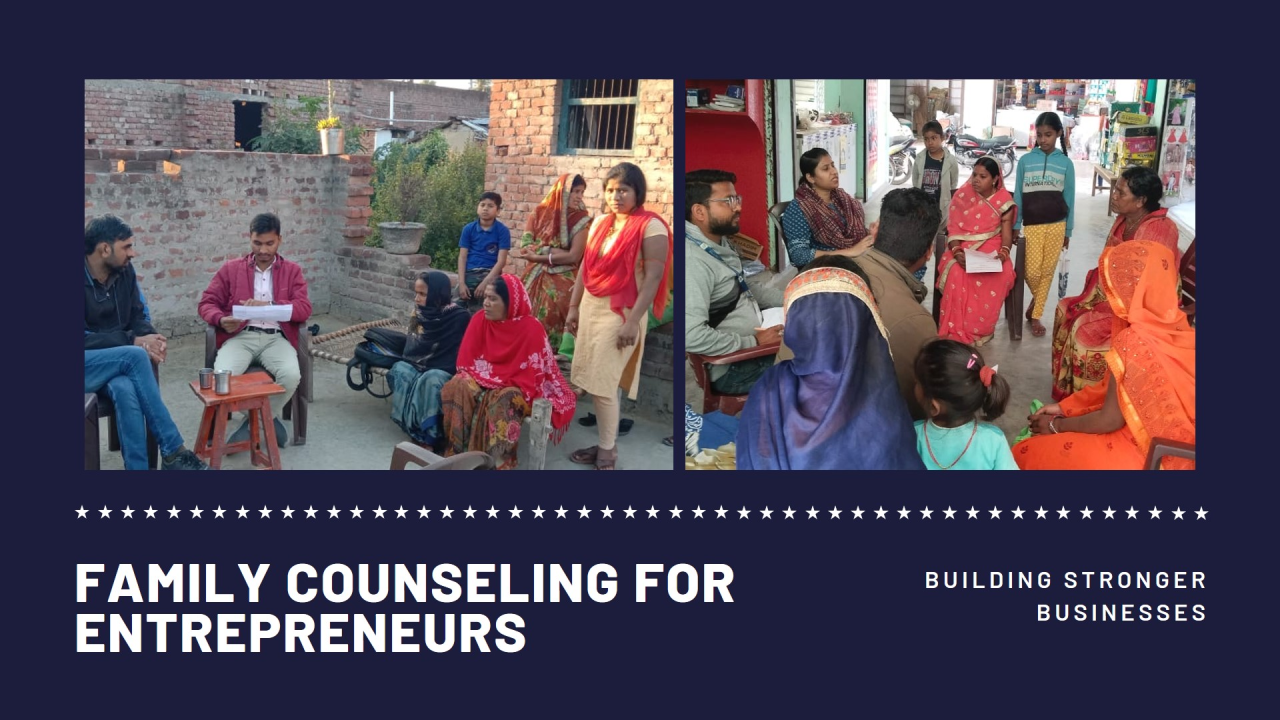
In the process of meeting the family at their house in the village and discussing about their current livelihood and income sources, level of education in the household, aspirations and future plans, nature of relationship with the potential entrepreneurial candidate, sharing about the program, and earning their commitment of being the wind  beneath the wings of their daughters, daughters-in-law, wife, and in turn building trust is the main agenda of the family counselling. This support is the most important step and measure for induction of an aspiring candidate in our entrepreneurship program. Garnering this support is half the battle won for the aspiring entrepreneur.

The hard work has to be of the entrepreneur, but families give financial assistance and provides the seed capital for the start-up, provides emotional assistance keeping the morale high during those challenging and difficult times that every entrepreneur undergoes, promote the venture in their long curated networks both within and outside their villages through word-of-mouth, volunteer their time at the business to attend to customers and promotion, and more importantly celebrate even the small moments of joy together.

Apart from money and market, family support is the third pillar of the tripod, which drives entrepreneurial success.

If you want to know more about designing rural women entrepreneurship projects and/or learn about family-counselling for rural entrepreneurship, feel free to connect.

(First published on LinkedIn on 6th March 2024)

2012 in review

The WordPress.com stats helper monkeys prepared a 2012 annual report for this blog.

Here’s an excerpt:

The new Boeing 787 Dreamliner can carry about 250 passengers. This blog was viewed about 1,800 times in 2012. If it were a Dreamliner, it would take about 7 trips to carry that many people.

Click here to see the complete report.