Kabul Disco

kabul-discoKabul Disco

by Nicolas Wild | 148 Pages | Genre: Graphic Novel | Publisher: HarperCollins India | Year: 2009 | My Rating: 8/10

“What do I draw?” he asks.

“Make it symbolic by representing the ethnic balance: 45% are Pushtuns, 36% are Tajiks, 12% are Uzbeks, 14% are Hazaras, And then there are a few Nuristanis, of course. Draw some wearing shalwar kamiz with turbans, patoos or pakols. Then others wearing three piece suits. Out of the 300 members, 25% are women.”

“Of course,” he says. Only: “I just wanted to know, what do Pushtuns, Tajiks, Uzbeks, Hazaras, Nuristanisshalwar kamiz, patoos, pakols and women look like?”

– Nicolas Wild, Kabul Disco

Nicolas Wild has written a marvelous satire on the big global business that is Afghanistan and its reconstruction post American bombing of the Country to get rid of Taliban and Osama. This novel thus is an entertaining account of the French graphic artist’s life in the Afghanistan working with a development agency, of international NGOs, coalition forces, nascent democracy and the not-so-diminished Taliban. At times hilariously ridiculous, and at others poignant in its observation of the prevalent times, the book brings to life the contrasting mindsets of the two cultures. Wild captures the pretentious, privileged, vaguely Eurotrash existence of the professional expat do-gooder with a suitably wicked eye. He has hilariously portrayed the protected lifestyles, the local “utility men”, the SUVs, the suspiciously connected American and, of course, the expat party scene. Skillfully he has kept the political references limited to comments on the Bush administration, and sexual tension is kept to a minimum.

This ironical and hilarious graphic novel is my Read of the Week.

The White Tiger

whiteThe White Tiger

by Aravind Adiga | 318 Pages | Genre: Fiction| Publisher: HarperCollins India| Year: 2008 | My Rating: 9/10

“You Chinese are far ahead of us in every respect, except that you don’t have entrepreneurs. And our nation, though it has no drinking water, electricity, sewage system, public transportation, sense of hygiene, discipline, courtesy, or punctuality, does have entrepreneurs. Thousands and thousands of them. Especially in the field of technology. And these entrepreneurs – we entrepreneurs – have set up all these outsourcing companies that virtually run America now.”

– Aravind Adiga, The White Tiger

In his debut novel, which won the Man Booker Prize in 2008, Aravind Adiga has brilliantly portrayed the modern India with its newfound economic prowess through its narrator, Balram Halwai aka Munna with an obsession for China, Chandeliers, and Corruption, rising from being a ‘country mouse’ from a nondescript village of Bihar to a business entrepreneur in technology driven Bangalore. Balram’s narrative is framed as a letter to the visiting Chinese Premier, written over seven nights while sitting at his office in Bangalore. In his letter he talks about the initial years of his life spent in Laxmangarh attending school for few years before moving to work with a tea stall, and later moving to Dhanbad with his brother Kishan, where he learnt how to drive and became a driver for a weak-willed son of a feudal landlord from his village. For him ‘the darkness’ represents the areas around river Ganges deep in the heartland marked by medieval hardship, where brutal landlords hold sway, children are pulled out of school into indentured servitude and elections are routinely bought and sold. Later he moved to Delhi with his employers, which he has described as moving from ‘darkness’ to ‘light’, and one rainy day he slit the throat of his employer with a broken bottle of Johnnie Walker Black, which he justifies as an act of class warfare, took seven hundred thousand rupees in cash and fled to Bangalore. His life in Delhi has taught him the corruption of government and politics, inequality between rich and poor, which he uses to set up his business of transportation for call centers with a motto of ‘driving technology forward’.

This novel as a penetrating piece of social commentary, attuned to the inequalities that persist despite India’s new prosperity is my Read of the Week.

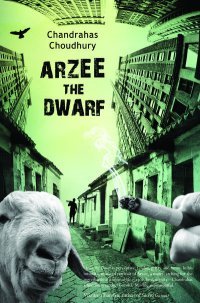
Arzee The Dwarf

arzee_the_dwarfArzee The Dwarf

by Chandrahas Choudhury | 184 Pages | Genre: Fiction| Publisher: HarperCollins India| Year: 2009 | My Rating: 8/10

“I am myself in my thoughts too much,
I seek recourse to myself too soon,
My days don’t stand up without a crutch,
I sing my own song out of tune.
I stand before the mirror too long,
Stare big at the eyes that return my gaze,
My shadow seems to me more strong
Than my shrunken heart, that lonely place.
My worries hang about me like clouds,
And my creditors they come calling,
My being is riven by spooks and doubts,
The walls of my house are falling.
In mine own alleys I traipse and turn,
Dreamlike I float through nights and days,
I watch the hours slowly burn,
And do not leave on time my trace.
I myself speak and myself hear,
And myself act and myself see,
My own self extends far and near,
And so I cannot myself be.”

– Chandrahas Choudhury, Arzee The Dwarf

In his debut novel, Chandrahas Choudhury has skillfully captured the nuances of intimate life and dreams of Arzee, who’s a midget, working at an old cinema hall in Mumbai as a deputy projectionist. Even though all the thirteen chapters revolve around him and he’s the protagonist of this novel, Choudhury has not projected him as a larger-than-life hero, which makes his world as interesting as that of a common man, yet one cannot stop feeling sympathy for that man whose all troubles stem from him being a midget or a dwarf. So much so that the characters around him forget his last name Gandhi, and instead address him as ‘Arzee the dwarf’. The beauty of this books lies in its prolific prose and colloquial dialogues portraying time and space, old world charm portrayed through the dying Noor cinema and modern day problems of love, money, and self-image, the memorable characters that even ‘The Babur’ the projection machine, which is Indian mutation of its German name Bauer seems to breath life. The novel ends without a definite ending as if Choudhury was overcautious to continue, leaving the readers to decipher it themselves about the new turns Arzee’s life is to take.

This novel full of pathos and pragmatism is my Read of the Week.

The Shadow Lines

shadow-linesThe Shadow Lines

by Amitav Ghosh | 288 Pages | Genre: Fiction| Publisher: Penguin Books India| Year: 1988 | My Rating: 8.5/10

“He said to me once that one could never know anything except through desire, real desire, which was not the same thing as greed or lust; a pure, painful and primitive desire, a longing for everything that was not in oneself, a torment of the flesh, that carried once beyond the limits of one’s mind to other times and other places, and even, if one was lucky, to a place where there was no border between oneself and one’s imagine in the mirror.”

— Amitav Ghosh, The Shadow Lines

Amitav Ghosh captures the lines connecting time and events, and people with each other bound by ties of blood and history. This work of fiction is narrated by and follows the life of a young boy growing up in Calcutta with his grand mother and parents, and later in Delhi and London for his higher education. His Grandmother and Mayadebi are sisters, who grew up in Dhaka pre-partition. After the death of her husband, grandmother works at a school to raise her son without depending upon any charity, while Mayadebi marries a Diplomat and lives a life of luxury. Two characters plays pivotal role in the narrator’s life are Ila, a distant cousin of his from Mayadebi’s side to whom he is attracted yet his yearnings go unrequited, and Tridib, who’s Maya’s son. The story unfolds through flashbacks, then progresses occasionally in the present.

This book with numerous characters and intricate web of memories moving back and forth, is my Read of the Week.

Zero

zeroZERO: The Biography of a Dangerous Idea

by Charles Seife | 248 Pages | Genre: Mathematics/Science | Publisher: Penguin Books| Year: 2000 | My Rating: 10/10

“The Babylonians invented it, the Greeks banned it, the Hindus worshipped it, and the Church used it to fend off heretics. Today, zero lies at the heart of one of the biggest scientific controversies of all time, the quest for the theory of everything. Used unwisely, Zero has the power to destroy logic.”

Charles Seife has presented the complexity of esoteric math and philosophy for popular readership without taking the beauty of numbers throughout his book, Zero. The books starts with the prehistory of numerals, before the number system was discovered. It was only with the advent of numerical notation and arithmetic that zero as a discrete concept became necessary, first as a simple place holder in the Babylonian number system, and later, with the Greeks, as an important astronomical tool even though they didn’t like zero at all.

It was India that first domesticated zero, through the Hindu familiarity with the concepts of infinity and the void. Rigveda states, ‘There was neither non-existence nor existence then; there was neither the realm of space nor the skywhich is beyond. What stirred? Where?’ Zero is between the void and the absolute.

This elegant and enlightening book about the strangest number in the universe is my ‘Read of the Week’. This book is among my most favourites forever.