Role of values and ethics in community practice
January 19, 2026 Leave a comment
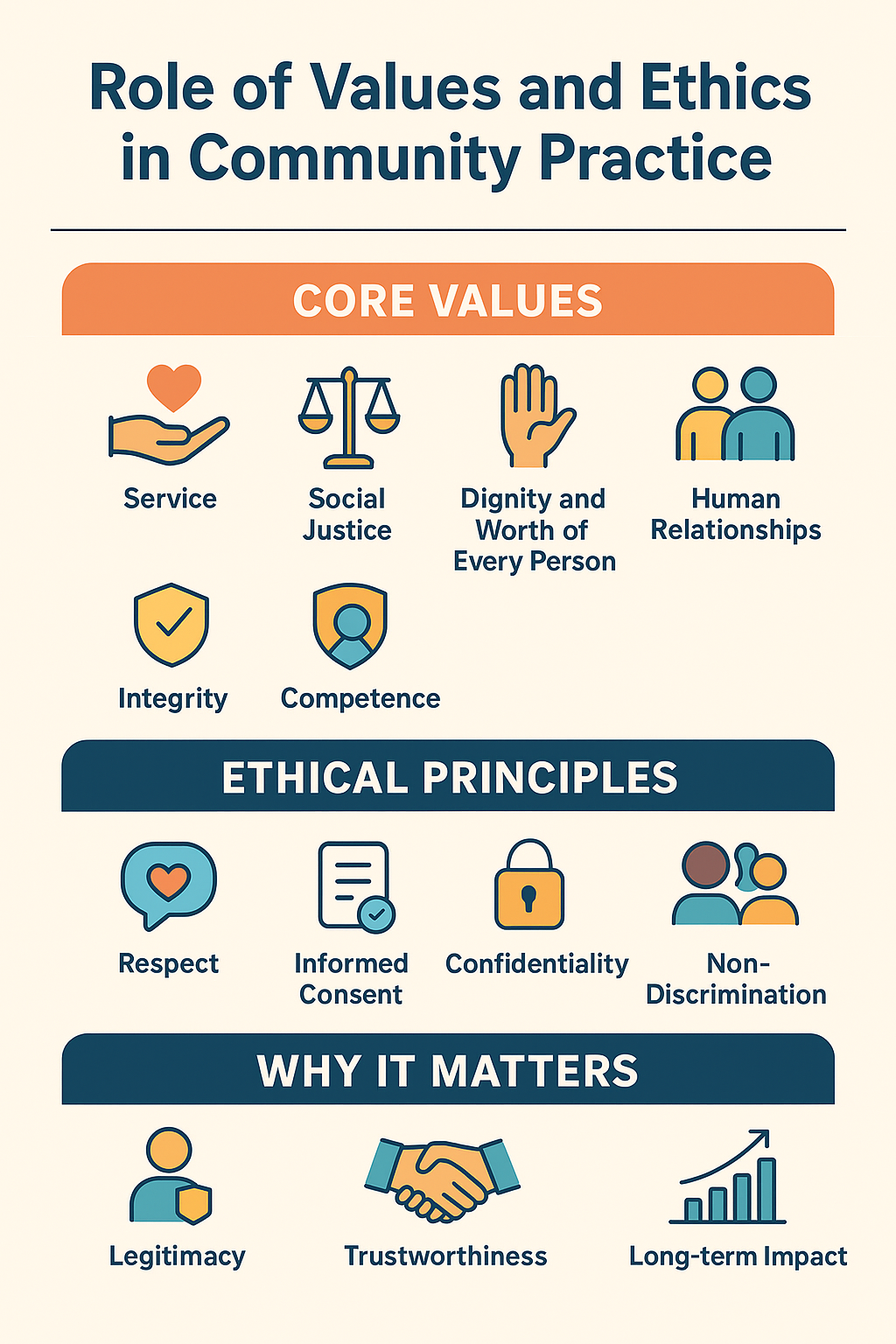
Community practice sits at the intersection of social change, participatory development, and human wellbeing. It involves working with individuals, groups, and institutions to enhance quality of life, challenge structural inequalities, and strengthen collective agency. Yet, this transformative process is impossible without a strong foundation of values and ethical principles. Values shape the vision and intention behind community action, while ethics guide the methods and behaviours used to pursue that vision. The integrity of community practice, including its legitimacy, trustworthiness, and long-term impact, depends on how practitioners understand and embody these principles. The presentation on Values and Ethics emphasises core values such as service, social justice, dignity and worth of every person, human relationships, integrity, and competence, alongside ethical guidelines including respect, informed consent, confidentiality, and non-discrimination. These are essential elements of responsible and democratic engagement with communities.
Values represent deeply held beliefs about how the world should be and how people ought to behave. They are moral compasses that guide decisions, priorities, and relationships. Values reflect strong beliefs about desired conditions of life and preferred moral behaviour. In community practice, values shape not only personal conduct but also the philosophies of development interventions, determining whether they foster empowerment or dependency, solidarity or charity, rights or favours.
The value of Service embodies commitment to supporting individuals, families, and communities through concrete actions, volunteerism, and compassionate engagement. During the COVID-19 pandemic, undergraduate and high school student volunteers in India demonstrated extraordinary service through fundraising, relief distribution, care work, and digital support for vulnerable households. Their example illustrates that service is not passive goodwill but active participation in alleviating suffering and building resilience. In development studies, service aligns with Paulo Freire’s notion of praxis, which is reflection combined with action to transform reality.
Community practice is inherently political as it confronts power structures, resource inequities, and systemic barriers that perpetuate marginalization. Social justice means equality, human rights, diversity, and opportunities, ultimately contributing to a happier world. A social justice lens ensures that community work moves beyond charitable assistance to structural transformation. From a development studies perspective, the struggle for social justice requires practitioners to advocate for fair distribution of resources, break discriminatory norms, and amplify voices historically excluded from decision-making. Community practice, therefore, demands values aligned with the SDG 5, SDG 10, and SDG 16.
Recognizing each individual’s inherent dignity and worth is central to ethical community practice. This aligns with human rights frameworks and Amartya Sen’s capabilities approach, which sees development as expanding freedoms and choices. When community practitioners honour dignity, they see people not just as beneficiaries but as partners, experts in their own lived experience. Respecting dignity involves listening without judgment, avoiding stereotypes, and making sure that interventions do not reduce agency.
Building strong relationships and networks for meaningful community development is very important. Trust is the currency of community practice, developed through transparency, empathy, and accountability. Sustainable change cannot be imposed; it emerges from collaborative relationships among stakeholders such as residents, civil society institutions, governments, and markets. Relational practice aligns with theories of social capital, which argue that cohesive communities with strong networks are better positioned to solve collective problems. When practitioners prioritise relationships, they enable shared ownership and long-term stewardship of change processes.
Integrity, which is non-negotiable and rooted in keeping promises, respecting boundaries, and never betraying trust, is essential for legitimacy in community work. Without integrity, community actors can reproduce harmful dynamics of exploitation or manipulation. Practitioners must therefore be consistent in values and actions, resist corruption, and maintain transparency in financial decisions, participation processes, and communication. Integrity also requires humility in recognizing limitations, acknowledging mistakes, and being accountable for consequences. In a context where communities may have experienced decades of unmet promises, integrity becomes a radical act of restoration.
Competence requires practitioners to continuously build knowledge, develop skills, engage in research, and translate learning into action. Competence includes interdisciplinary understanding of poverty, gender, climate resilience, social policy, participatory methodologies, and cultural sensitivity. Competence protects communities from poorly designed interventions that may cause unintended harm. Attending conferences, reading research, and grounding practice in evidence strengthens professionalism and promotes innovation. Competence also means knowing when to collaborate with subject-matter experts instead of assuming expertise.
Ethics provide guidelines to translate values into action. Ethical principles like commitment, respect, informed consent, privacy & confidentiality, non-discrimination, self-determination, social diversity, and boundaries in physical contact and communication are important. These principles prevent abuse of power, ensure fairness, and build trust. Respect and Informed Consent ensure that community members’ rights are upheld and that participation is voluntary and based on understanding. Informed consent is especially important when dealing with research, data collection, health interventions, or sensitive personal histories. Confidentiality and Privacy protect personal information and reinforce psychological safety. Violating confidentiality can cause social harm and erode trust permanently. Self-determination requires practitioners to facilitate agency rather than impose solutions. Communities must remain decision-makers in development processes, consistent with participatory development frameworks. Non-discrimination and respect for diversity demand active challenge to caste, gender, disability, sexuality, religion, and class barriers. A commitment to inclusion transforms communities into spaces of belonging. Ethical conduct concerning physical boundaries, language, and sexual harassment protects dignity and safety. Such ethics create a culture of accountability that strengthens collective values.
Values and ethics together shape the culture of development practice. They influence how decisions are made, how conflicts are resolved, and how change is pursued. Without ethical foundations, community work risks becoming transactional or extractive. Conversely, when values and ethics guide practice, communities become co-architects of development and not mere beneficiaries. Values and ethics also guide practitioners through complexity. Community practice involves tension, competing expectations, and uncertain environments. Ethical frameworks provide a compass and define clear boundaries, ensuring that actions remain aligned with justice and human dignity.
Values and ethics are not supplementary components of community practice. Values such as service, social justice, integrity, dignity, competence, and the importance of human relationships guide development practitioners to commit to empowerment rather than charity and partnership rather than control. Ethical principles like informed consent, confidentiality, respect, and non-discrimination protect the rights of communities and uphold trust. Together, they create moral, relational, and intellectual foundations necessary for transformative development processes. Ultimately, community practice grounded in strong values and ethics nurtures societies where human potential can flourish, justice is prioritized, and diversity is celebrated. When practitioners act with humility, integrity, and commitment, they not only support community change but also become participants in shaping a more equitable and compassionate world.
Read more
- Freire, P. (1970). Pedagogy of the Oppressed. Penguin.
- International Federation of Social Workers (2018). Global Social Work Statement of Ethical Principles.
- Jenkins, R., & Goetz, A. M. (1999). Accounts and accountability: Theoretical implications of the Right to Information movement in India. Third World Quarterly, 20(3).
- Roy, B. (2010). Learning from Barefoot College. TED.
- Sen, A. (1999). Development as Freedom. Oxford University Press.
(The presentation is from a lecture I delivered in 2022, for graduate students of development practice.)
(The cover image is generated using AI)

 Manu Mayank