Gustaakh Ishq
December 29, 2025 Leave a comment
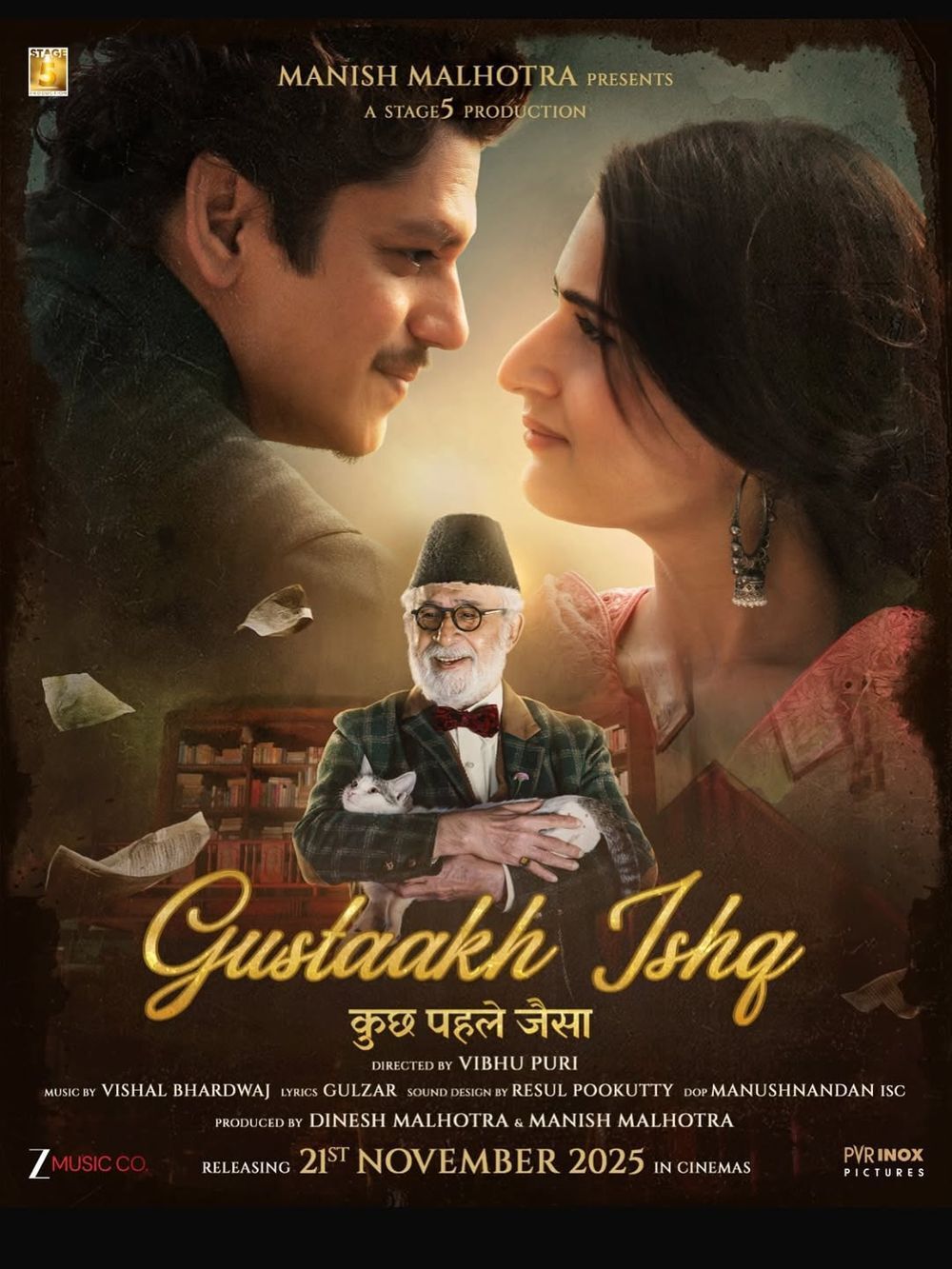
Genre: Romance | Year: 2025 | Duration: 128 mins | Director: Vibhu Puri | Medium: Theatre (PVR Cinemas) | Trailer: HERE | Language: Hindi | Cast: Naseeruddin Shah, Vijay Varma, Fatima Shaikh, and others | My rating: 4/5
Favourite Dialogue: “जेब में कलम रखने से शायर नहीं बनते, कलम ज़ख्मों में रखनी पड़ती है”
Gustaakh Ishq evokes the spirit of mid-20th-century Urdu-Hindi cinema full of ‘mushaira’ evenings, old printing presses, dusty lanes and small towns of India, peeling walls, hearts heavy with memories, understated longing and emotional restraint. It is a romance steeped in nostalgia, where even silence has a voice. The film beautifully interweaves mood, texture and poetry. There are moments when the film feels like a delicate ghazal, which is slow, heartfelt, and rich in unspoken emotions. As one of the song’s shayari goes,
‘मेरा लहज़ा कैक्टस–सा खुरदुरा, तेरी बातें रात–रानी की तरह…’
Such lines, and many others woven through the film, give it a lyrical soul. The music with songs like ‘Ul Jalool Ishq’ and ‘Aap Is Dhoop Mein’ sprinkles the narrative with the charm and warmth of classic romance.
Set in the crumbling lanes of a North Indian town, the film’s lead character, Nawabuddin (Vijay Varma), a man desperate to save his late father’s printing press, seeks out an ageing, reclusive poet, Aziz Beg (Naseeruddin Shah), hoping to publish his forgotten poetry. Along the way, Nawabuddin becomes attracted to Aziz’s daughter Minni/Mannat (Fatima Sana Shaikh), and the old-world romance between generations, art and longing unfold. Naseeruddin Shah is the emotional anchor of the film, and his character radiates dignity, nostalgia and weariness, carrying the weight of rueful regrets and mutable hope. Vijay Varma brings earnestness with his character’s love for verse and sincerity, offering a believable link across generations. And Fatima Sana Shaikh as Mannat becomes the soft heartbeat of the film.
The film’s greatest strength lies in its texture and intimacy. The director’s gaze lingers lovingly on the details, creating a world that feels lived-in and emotionally honest. The cinematography does not chase beauty but rather discovers it in decay. The film is like a visual poem, which is its emotional backbone. Lines of poetry drift through the narrative like ghosts of feeling,
‘तुम्हारी ख़ामोशी भी एक इल्ज़ाम बन गई, और हम हर रोज़ खुद को दोषी पाते रहे’
Conversations are sparse, glances that linger a second too long, gestures left unfinished, words swallowed, this sensibility, where silence itself feels accusatory, defines the emotional climate of the film.
The performances of all the actors deserve special mention. Naseeruddin Shah brings a weary grace to the role of someone who has lived too much and lost too often. His eyes carry entire libraries of regret. Vijay Varma’s portrayal of Nawabuddin anchors the film with sincerity and his yearning to preserve art in a world that no longer cares feels achingly real. Mannat, a woman whose stillness hides tremors of rebellion, played by Fatima Sana Shaikh with quiet strength, is the film’s most layered character.
One of the most striking aspects of the film is how it treats love. This is not love as possession or dramatic union. This is love as distance, as restraint, as something that exists more powerfully in what is unsaid. In one of the film’s most beautiful moments, this sentiment finds voice,
‘हमने चाहा भी तो चाहने की गुस्ताख़ी न की, दिल दिया भी तो जताने की ग़लती न की’
The background score deserves credit, where the music does not intrude, but it hums like an old wound. Songs are well placed when emotions can no longer be contained by silence. Lyrics feel like extensions of the characters’ inner lives rather than commercial breaks. One such line captures the film’s aching spirit,
‘इश्क़ वो दरिया है जिसमें शोर नहीं होता, बस लहरें होती हैं, और हम डूबते रहते हैं’
Yet, for all its beauty, Gustakh Ishq is not without flaws. The screenplay sometimes confuses stillness with stagnation. Certain emotional turns are hinted at rather than explored, leaving the viewer wanting deeper psychological meaning. The bond between Nawabuddin and Minni, despite its lyrical foundation, sometimes feels emotionally underdeveloped in execution. Perhaps that is the nature of this film, as it is not designed to entertain as much as to envelop. It is more like a fog of memory and longing through which one must walk slowly. Another verse in the film captures this ethos perfectly,
‘कुछ रिश्ते किताबों जैसे होते हैं, शोर नहीं करते, बस चुपचाप समझा देते हैं’
For viewers used to fast-moving plots, clear romantic arcs, or dramatic catharsis, this film may feel meandering, slow, and even frustrating. The pacing demands patient acceptance of nuance, subtle gestures, and quiet sorrow. For those willing to surrender to its rhythm and appreciate the small pauses, soft glances, whispered verses and the ache between two silences, it offers genuine beauty.
If you appreciate cinema that smells of old books, handwritten letters, melancholic poetry and tender regret, and if you believe that sometimes love doesn’t demand grand gestures but hushed confession, the kind of love that bruises quietly rather than bleeding loudly, then this film will likely stay with you.
(For my love for Hindi-Urdu poetry, I ended up sprinkling this review with some poetry from the film in Hindi (Devanagari) script)


 Manu Mayank