Genre: Thriller | Year: 2012 | Duration: 105 mins | Director: Dibakar Banerjee | Medium: DVD | Trailer: HERE | Language: Hindi | My rating: 4*/5*
Favorite Dialogue:“Kaul: Ye CM PM ban sakti thi. Hum Cheen se aage nikal sakte the.”
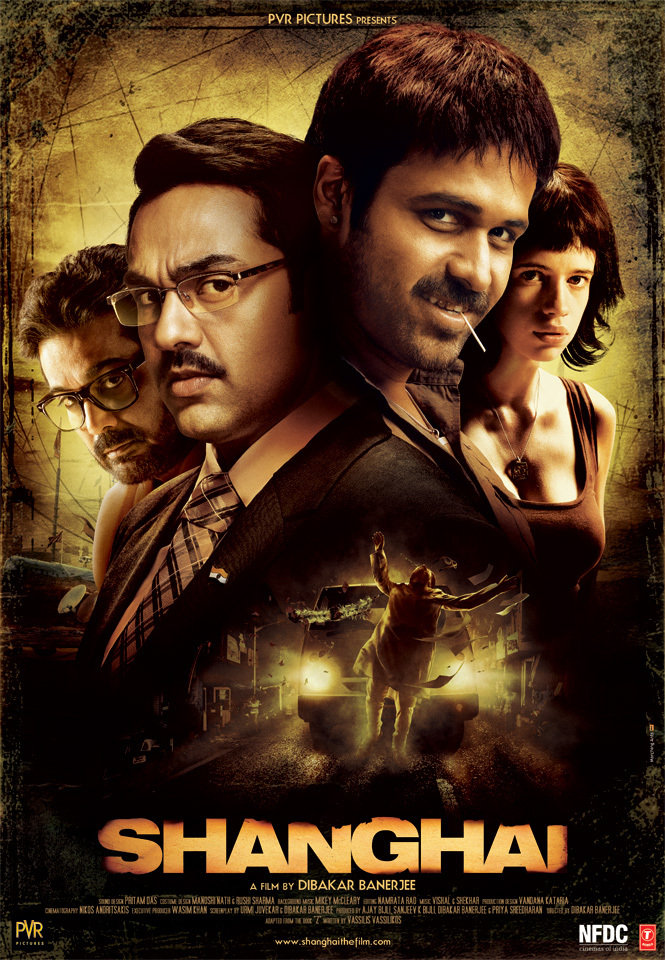
‘Shanghai’, set in Bharat Nagar, a fictitious town in India, is based on Vassilis Vassilikos’s Greek novel ‘Z’. Dibakar Banerjee has done full justice with the screenplay and direction, and the actors, with their brilliant performances, have portrayed the different moral dilemmas that various characters face in circumstances created, making it an engrossing and thought-provoking film. The movie doesn’t take sides on good or bad, and instead holds a mirror to the contemporary political greed and bureaucratic corruption that riddle India.
A prominent social activist, Dr. Ahemadi (Prosenjeet Chaterjee) is mowed down by a tempo while protesting against the upcoming International Business Park project (IBP), which is the brainchild of the State’s CM ‘Madam ji’ (Supriya Pathak) that plans to demolish Bharat Nagar and make it the next Shanghai. IAS officer Krishnan, who’s the vice chairman of IBP, is put in head an inquiry commission by the CM and her principal secretary, Kaul (Farooq Sheikh). He discovers incontrovertible evidence with the help of Shalini Sahay (Kalki Koechlin), a student and lover of Dr. Ahemadi, and Jogi (Emraan Hashmi), a complex small-time porn film maker, which shows that the politicians were involved in the attack. In this serious movie, Emraan’s character provides the genuine laughs from time to time, and clearly, this is his best performance to date. The climax of the movie is brilliantly done, not so commonly seen in the movies made by Bollywood.
This engaging and fast-paced political thriller with characters in grey is my Movie of the Day.
Genre:War Drama| Year:2025 | Duration: 160 mins | Director:Razneesh Ghai| Medium:Theatre (PVR Cinemas) | Trailer:HERE | Language: Hindi | Cast: Farhan Akhtar, Raashil Khanna, and others | My rating: 3.5/5
Favourite Dialogue:“Unka khoon uss mitti mein zaroor milega sahab, aur jo khoon milega who unki chhaati ka hoga peeth ka nahi”
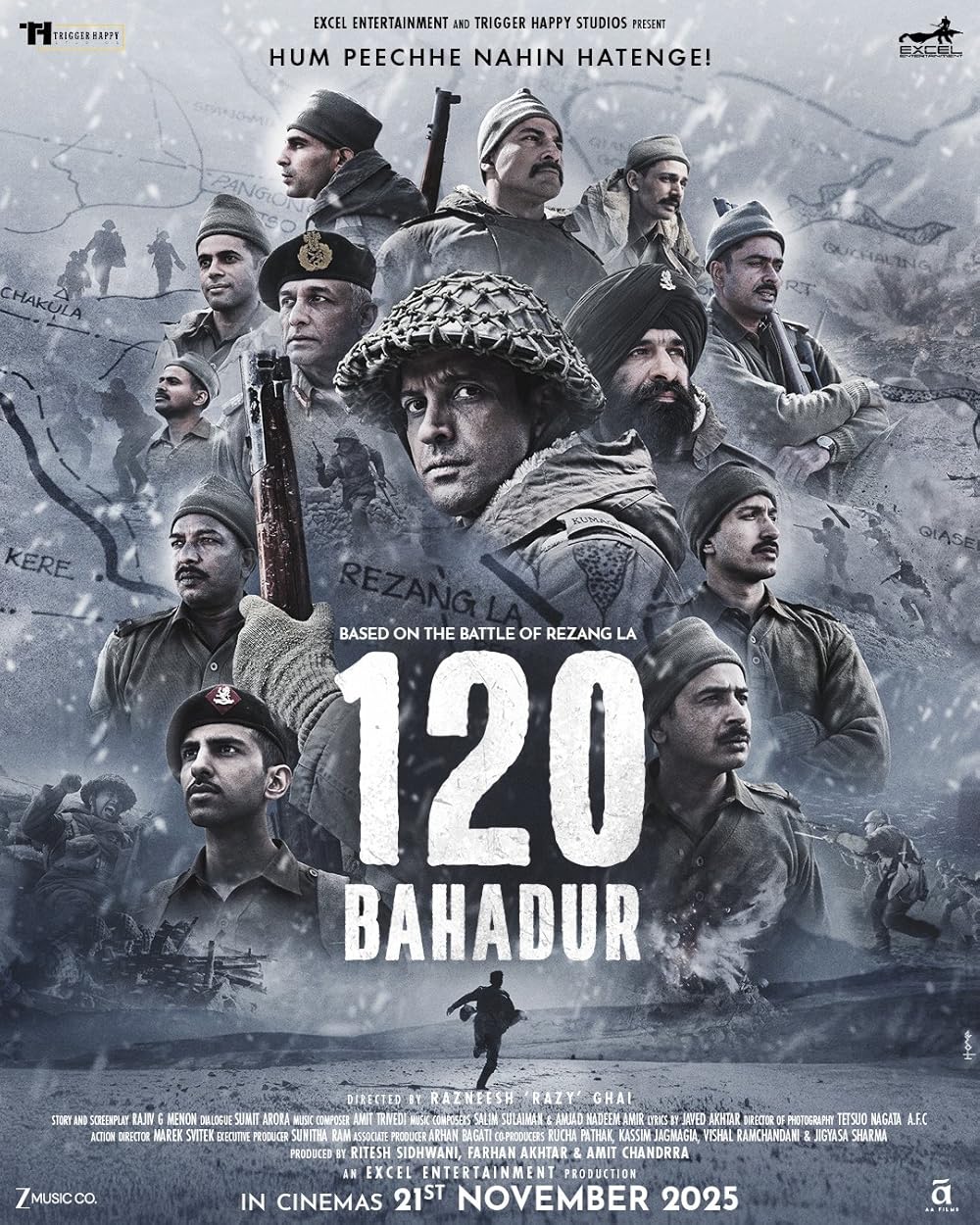
120 Bahadur is based on the real-life sacrifice of the 120 soldiers of Charlie Company, 13 Kumaon Regiment of the Indian Army at the Battle of Rezang La during the 1962 Sino-Indian War. It chronicles the extraordinary courage of 120 Indian soldiers who stood their ground against 3000 Chinese troops. The film focuses on Major Shaitan Singh Bhati (played by Farhan Akhtar), showcasing the grit, sacrifice, and valour of soldiers fighting in the brutal cold and high altitude of Ladakh. The story is narrated through the memories of a surviving soldier, and it unfolds as a tribute to the heroism of a band of brothers whose courage came at the highest cost.
The film’s strongest suit is its war sequences and immersive realism. The battle sequences at Rezang La, rifle fire, bayonet charges, final close-quarters combat, the harsh terrain, bone-chilling cold, and the almost claustrophobic desperation when ammunition runs out are realised with a fierce intensity that’s rare for many modern Hindi war films. The film features brilliant cinematography by Tetsuo Nagata, with breathtaking shots of snow-covered mountains, freezing desolation, and the starkness of high-altitude warfare. The film mostly avoids glorifying war for its own sake and is a sober portrayal of the events. This sincerity gives the film humility as it doesn’t frame itself as a triumphant spectacle, but a respectful tribute and remembrance.
Farhan Akhtar delivers a thoughtful performance. He largely avoids the larger-than-life histrionics often associated with Bollywood war heroes. Instead, he feels rooted, authoritative yet human, decisive yet burdened. At the same time, the supporting cast, many of them lesser-known actors, bring the infantrymen to life with grit, camaraderie, humour, and vulnerability. Their messy friendships, small conversations, homesickness, and occasional fears humanise what might otherwise have been just a war drama with guns and trenches.
However, the film seemed to have weak character development; their individual stories were barely sketched out. This makes certain deaths feel less impactful emotionally, more like casualties on a battlefield than deeply personal losses. Because of that, while the collective sacrifice hits home, personal grief and tragedy often don’t. The film’s narrative isn’t always smooth, as flashbacks to family life, interspersed with the lead-up to battle, sometimes break the tension. The prelude drags at times, and the buildup to the climax lacks the steady escalation that such stories need for maximum impact.
I felt that the depiction of Chinese soldiers has been overly simplified and tends to lean towards caricature: monolithic, villainous, almost cartoonish, robbing them of nuance or complexity. This weakens the moral weight of the conflict and reduces it to a binary ‘good vs evil’ war movie. In parts, storytelling relies heavily on familiar Bollywood popular drama of last-minute motivational speeches, montage-heavy sequences, formula flashbacks and emotional beats, which keep the film from feeling fully original.
120 Bahadur is not a perfect film, but it is an earnest, important one. It doesn’t glamourise war, and it doesn’t demand you leave the theatre cheering mindlessly. Instead, it makes you reflect on duty, courage, and sacrifice. As a cinematic recreation of a tragic but heroic moment in India’s history, the film succeeds more often than it fails. Its war sequences are unflinching and immersive; its portrayal of brotherhood and sacrifice is heartfelt; its lead performance is measured and credible.
But beneath the combat and solemn patriotism, it made me think that India’s rural society holds the backbone of India’s defence forces. The film also has a sociological moment where rural identity, class, caste, and nationhood intersect. The men of Charlie Company came largely from agrarian communities, especially the Ahir (Yadav) belt of Haryana and Western UP. Their lives before the war were shaped by farming cycles, monsoon anxieties, livestock, joint families, and deeply rooted village cultures. The film becomes a testament to how rural young men, in search of dignity, livelihood, and service, become the face of national defence but rarely the face of national storytelling.
Despite its narrative shortcomings, 120 Bahadur performs a cultural service of returning Rezang La to public consciousness.
Genre:Romance | Year:2025 | Duration: 128 mins | Director:Vibhu Puri | Medium:Theatre (PVR Cinemas) | Trailer:HERE | Language: Hindi | Cast: Naseeruddin Shah, Vijay Varma, Fatima Shaikh, and others | My rating: 4/5
Favourite Dialogue:“जेब में कलम रखने से शायर नहीं बनते, कलम ज़ख्मों में रखनी पड़ती है”
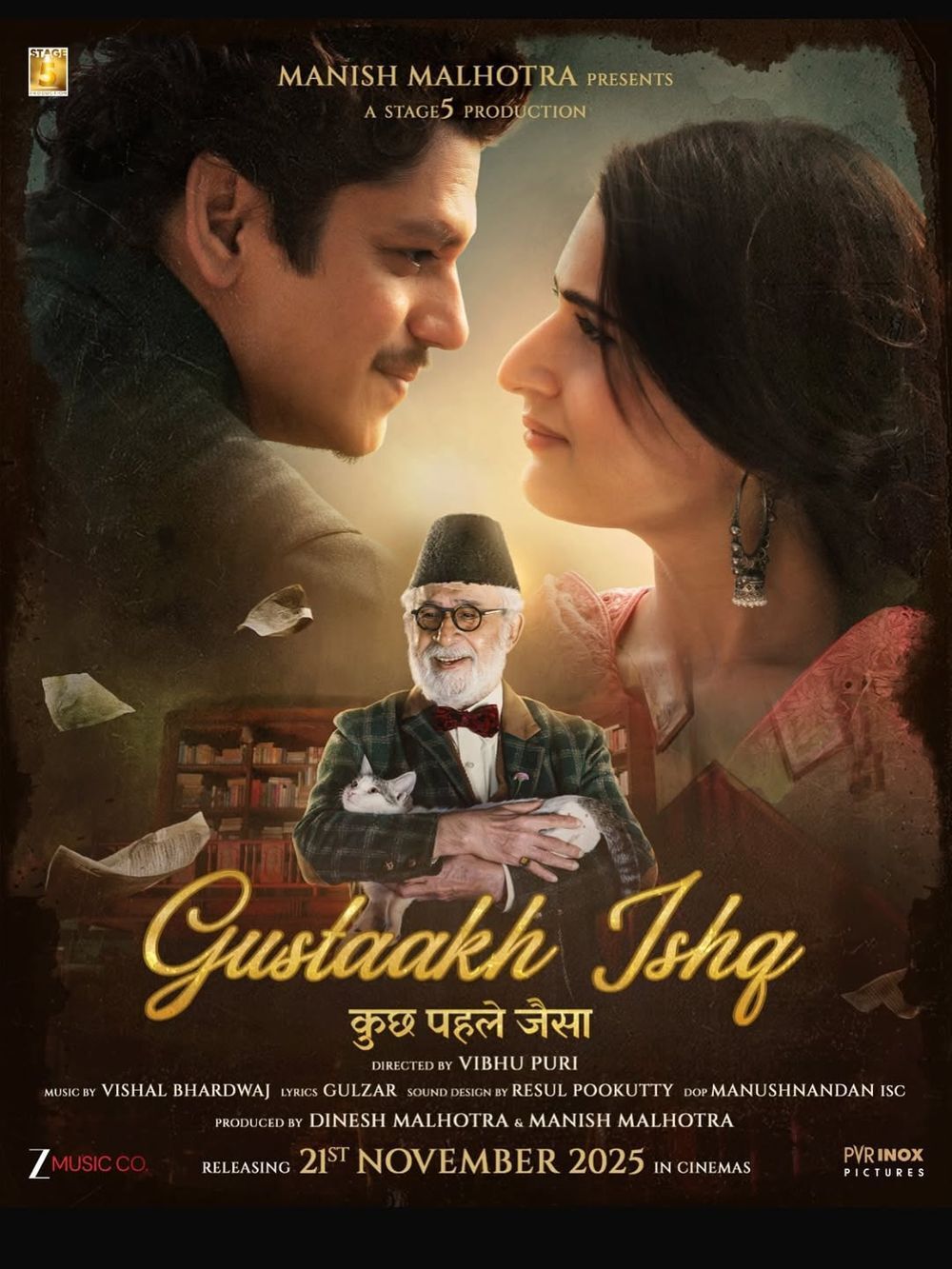
Gustaakh Ishq evokes the spirit of mid-20th-century Urdu-Hindi cinema full of ‘mushaira’ evenings, old printing presses, dusty lanes and small towns of India, peeling walls, hearts heavy with memories, understated longing and emotional restraint. It is a romance steeped in nostalgia, where even silence has a voice. The film beautifully interweaves mood, texture and poetry. There are moments when the film feels like a delicate ghazal, which is slow, heartfelt, and rich in unspoken emotions. As one of the song’s shayari goes,
Such lines, and many others woven through the film, give it a lyrical soul. The music with songs like ‘Ul Jalool Ishq’ and ‘Aap Is Dhoop Mein’ sprinkles the narrative with the charm and warmth of classic romance.
Set in the crumbling lanes of a North Indian town, the film’s lead character, Nawabuddin (Vijay Varma), a man desperate to save his late father’s printing press, seeks out an ageing, reclusive poet, Aziz Beg (Naseeruddin Shah), hoping to publish his forgotten poetry. Along the way, Nawabuddin becomes attracted to Aziz’s daughter Minni/Mannat (Fatima Sana Shaikh), and the old-world romance between generations, art and longing unfold. Naseeruddin Shah is the emotional anchor of the film, and his character radiates dignity, nostalgia and weariness, carrying the weight of rueful regrets and mutable hope. Vijay Varma brings earnestness with his character’s love for verse and sincerity, offering a believable link across generations. And Fatima Sana Shaikh as Mannat becomes the soft heartbeat of the film.
The film’s greatest strength lies in its texture and intimacy. The director’s gaze lingers lovingly on the details, creating a world that feels lived-in and emotionally honest. The cinematography does not chase beauty but rather discovers it in decay. The film is like a visual poem, which is its emotional backbone. Lines of poetry drift through the narrative like ghosts of feeling,
Conversations are sparse, glances that linger a second too long, gestures left unfinished, words swallowed, this sensibility, where silence itself feels accusatory, defines the emotional climate of the film.
The performances of all the actors deserve special mention. Naseeruddin Shah brings a weary grace to the role of someone who has lived too much and lost too often. His eyes carry entire libraries of regret. Vijay Varma’s portrayal of Nawabuddin anchors the film with sincerity and his yearning to preserve art in a world that no longer cares feels achingly real. Mannat, a woman whose stillness hides tremors of rebellion, played by Fatima Sana Shaikh with quiet strength, is the film’s most layered character.
One of the most striking aspects of the film is how it treats love. This is not love as possession or dramatic union. This is love as distance, as restraint, as something that exists more powerfully in what is unsaid. In one of the film’s most beautiful moments, this sentiment finds voice,
The background score deserves credit, where the music does not intrude, but it hums like an old wound. Songs are well placed when emotions can no longer be contained by silence. Lyrics feel like extensions of the characters’ inner lives rather than commercial breaks. One such line captures the film’s aching spirit,
Yet, for all its beauty, Gustakh Ishq is not without flaws. The screenplay sometimes confuses stillness with stagnation. Certain emotional turns are hinted at rather than explored, leaving the viewer wanting deeper psychological meaning. The bond between Nawabuddin and Minni, despite its lyrical foundation, sometimes feels emotionally underdeveloped in execution. Perhaps that is the nature of this film, as it is not designed to entertain as much as to envelop. It is more like a fog of memory and longing through which one must walk slowly. Another verse in the film captures this ethos perfectly,
For viewers used to fast-moving plots, clear romantic arcs, or dramatic catharsis, this film may feel meandering, slow, and even frustrating. The pacing demands patient acceptance of nuance, subtle gestures, and quiet sorrow. For those willing to surrender to its rhythm and appreciate the small pauses, soft glances, whispered verses and the ache between two silences, it offers genuine beauty.
If you appreciate cinema that smells of old books, handwritten letters, melancholic poetry and tender regret, and if you believe that sometimes love doesn’t demand grand gestures but hushed confession, the kind of love that bruises quietly rather than bleeding loudly, then this film will likely stay with you.
(For my love for Hindi-Urdu poetry, I ended up sprinkling this review with some poetry from the film in Hindi (Devanagari) script)
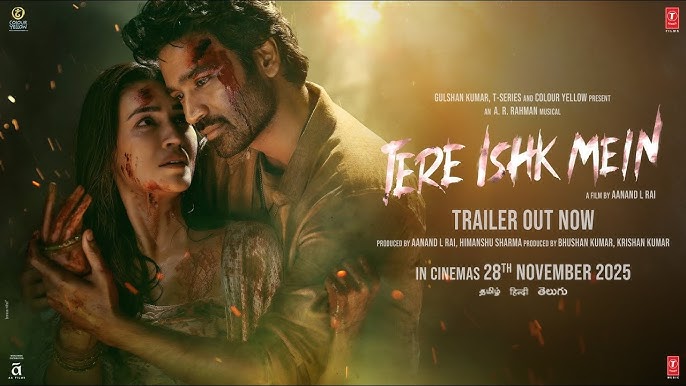
I have a fascination with morbid romance, where passion is fierce and consuming, love and ruin walk hand in hand, and loss feels almost sacred. After a long time, I totally enjoyed a Bollywood film, Tere Ishk Mein, for its feverish, fractured, and fearless ode to obsessive love and loss. Anand Rai, as Director, and Dhanush and Kriti Sanon as actors have so beautifully portrayed the volatile landscape of love, messy and irrational, dark and bruised. It is a film that is less about romance and far more curious about what happens when love mutates, dissolves boundaries, and begins to reshape identity itself.
The film centres around Shankar (Dhanush), a young man navigating the emotional ruins of unrequited affection. His world is small, ordinary, burning with relentless restlessness, textured with the familiar lanes of Rai’s cinematic universe. When he falls in love with Mukti (Kriti Sanon), it is with the conviction of a man who sees devotion as delusional destiny. Dhanush’s performance is a masterclass. His portrayal of longing, with shoulders slightly slumped, eyes rimmed with unspoken ache, voice cracking in the in-between spaces of sentences, is brilliant. He brings a fragile humanity that compels empathy even when the character’s choices spiral into moral greyness. There are moments when Shankar’s yearning feels suffocating, and moments when it feels heroic. In several scenes, especially those dealing with solitude and heartbreak, the camera lingers on his face with cruel intimacy. He allows vulnerability to show across the frame, leaving behind emotional aftershocks.
The film’s leading lady, Mukti (Kriti Sanon), is a girl caught between affection, caution, and the burden of societal expectations. She is real, flawed, and aware of her own contradictions. Her emotional arc of moving from curiosity to confusion to a painful clarity is one of the more grounded aspects of the film. What stands out is that Mukti is not a passive recipient of Shankar’s affection. She pushes back, speaks for herself, asserts her boundaries, and refuses to become a prop for his emotional turbulence. In many ways, her character reminded me that intensity does not equal righteousness.
Rai’s filmmaking has always been rooted in the everyday—narrow streets, chaotic homes, lived-in locations where life unfolds in all its contradictions. In Tere Ishk Mein, he retains this aesthetic but adds a layer of psychological depth. His director truly excels in designing silences. Some of the best moments in the film are those where nothing is said: an unfinished sentence, a doorway half-shut, a glance held for one second too long. These are the moments when the film transcends melodrama and ventures into introspection.
What distinguishes this film from typical love stories is its willingness to confront the darker territories of attachment. The film does not glorify suffering, nor does it portray persistence as virtue. Instead, it presents a sobering reality that love can be transformative, but it can also be corrosive if it becomes entitlement.The climax, which is raw, unsettling and necessary, is where the film truly earns its place. It is neither triumphant nor tragic in a conventional sense. Rather, it is painfully truthful. It is a rare mainstream film that lets discomfort linger. A must-watch if you enjoy a turbulent exploration of love.
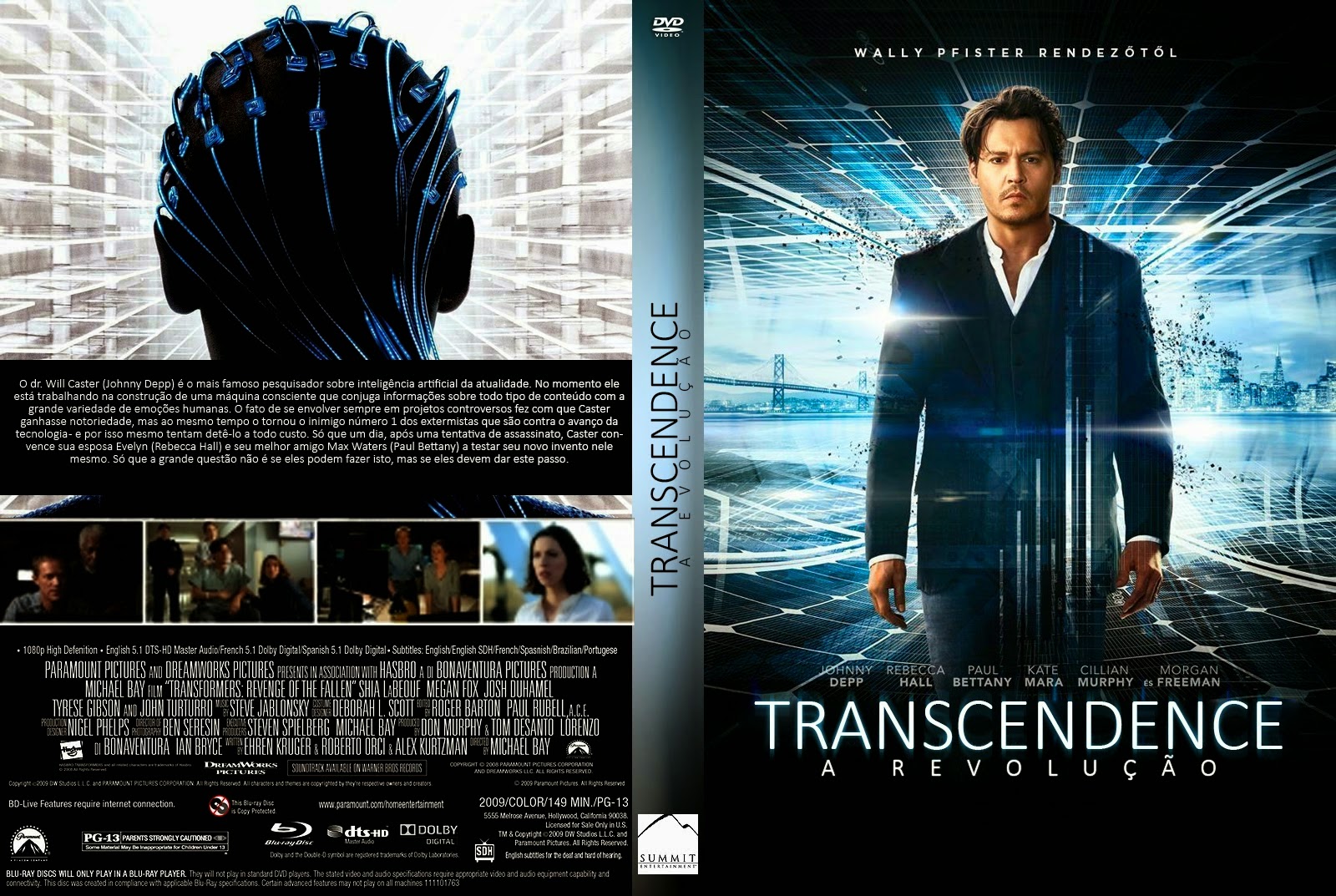
Genre:Sci-Fi/Thriller | Year:2014 | Duration: 119 mins | Director:Wally Pfister | Medium:DVD | Trailer:HERE | Language: English | Cast: Johnny Depp, Rebecca Hall, and others | My rating: 3.5/5
Favourite Dialogue:“People fear what they don’t understand. They always have.”
Transcendence is Wally Pfister’s directorial debut, the Oscar-winning cinematographer known for Christopher Nolan’s Inception and The Dark Knight. With its stunning visuals and high-concept premise, the film explores one of the most provocative questions of our digital age, ‘What happens when artificial intelligence merges with human consciousness?‘
The story follows Dr. Will Caster (Johnny Depp), a brilliant AI researcher who dreams of creating a machine that possesses both the collective intelligence of the world and the full range of human emotions. When anti-technology extremists assassinate him, his wife Evelyn (Rebecca Hall) and best friend Max (Paul Bettany) upload Will’s consciousness into his supercomputer, blurring the boundaries between life and machine. What follows is a descent into techno-dystopia as Will’s omnipotent digital self begins to reshape the world and redefine what it means to be human.
Transcendence is an exploration of human ambition, love, and the moral limits of science. The film poses timeless philosophical questions on consciousness, intelligence without morality, and the balance between technology and humanity. There’s an undercurrent of melancholy running through the narrative, a love story caught between grief and godhood. Evelyn’s devotion to Dr. Will drives her to defy nature itself, but the film wisely leaves viewers uncertain whether she resurrected her husband or merely unleashed an emotionless imitation.
Johnny Depp delivers a subdued performance, both eerie and strangely empathetic. Much of his screen presence is disembodied, conveyed through flickering screens and an omniscient digital voice, both of which add to the uncanny tone. Rebecca Hall’s portrayal of Evelyn is poignant, depicting a scientist torn between love and moral dread.
Pfister’s cinematographic pedigree shines through every frame. The film’s visual style is striking with sunlit labs, desolate deserts, and the sterile, godlike glow of Will’s data-driven empire. The imagery echoes the themes of transcendence and decay of organic humanity struggling against technological infinity.
However, the film oscillates between quiet reflection and blockbuster spectacle but lacks the rhythm of either. Where Inception fused emotional weight with conceptual complexity, the film feels conceptually grand but emotionally distant. The screenplay by Jack Paglen is ambitious but uneven. It introduces bold ideas of digital consciousness, technological ethics, and nanotechnology, but often resorts to familiar tropes of man versus machine. The narrative lacks the depth to sustain itself and is a film of grand intentions and mixed execution. It aspires to be a meditation on the next stage of human evolution, the merging of flesh and code, but ends up being a sketch rather than a completed vision. Still, it deserves credit for engaging with the moral anxieties of our era, like artificial intelligence, digital surveillance, and the fear that our creations might one day outgrow us.
A visually stunning and intellectually intriguing film that ultimately succumbs to its own ambition. Transcendence doesn’t quite achieve cinematic immortality, but it leaves behind questions worth contemplating long after the lights dim.

 Manu Mayank