The invisible cost of GRAP
January 5, 2026 Leave a comment
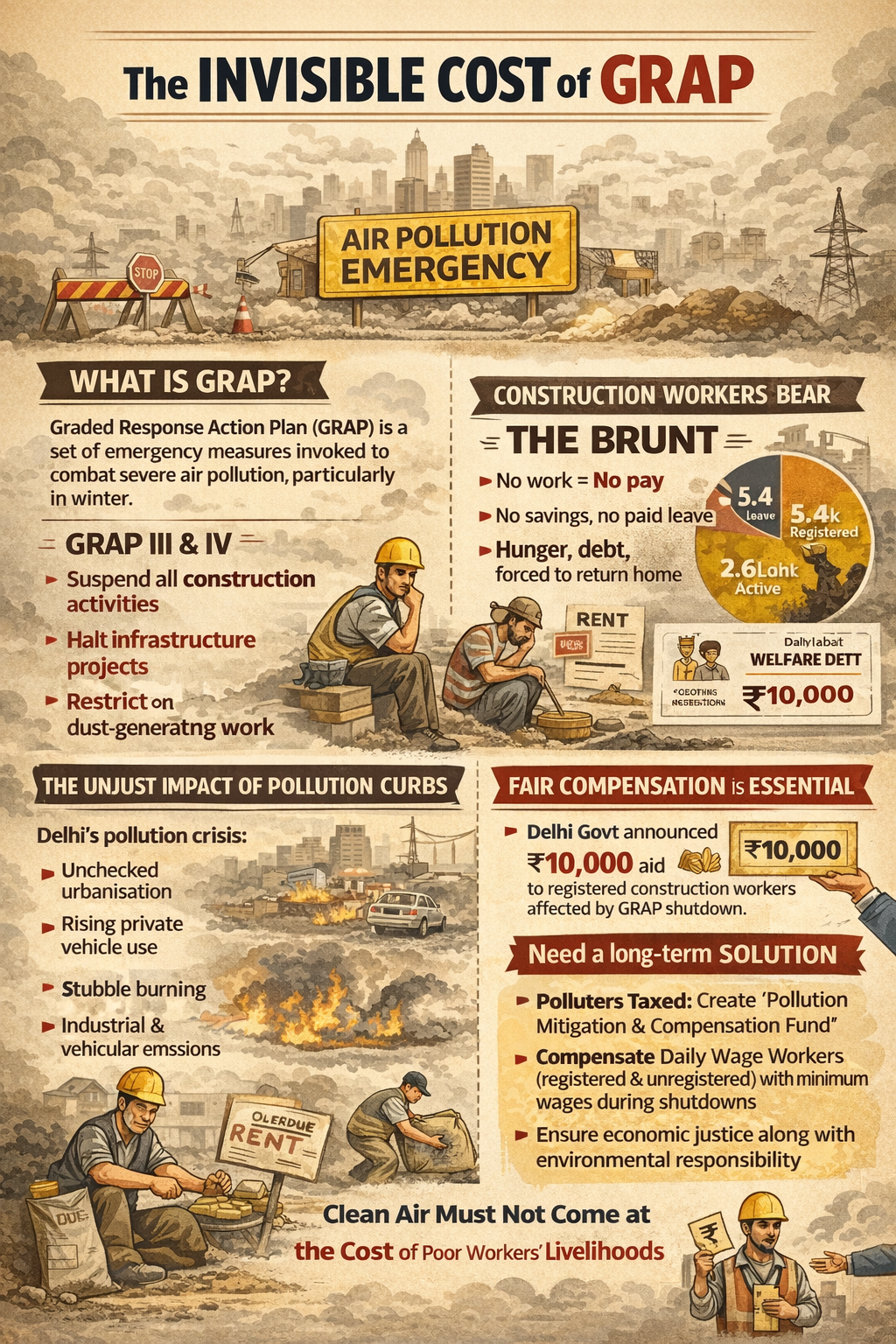
Delhi slips into a public health emergency as air pollution reaches hazardous levels every winter. The government responds by invoking the most stringent measures under the Graded Response Action Plan (GRAP III and IV), suspending all construction and demolition activities, halting infrastructure projects, and restricting dust-generating work. These steps are necessary and justified for pollution control and the health of people. However, the cost of Delhi’s clean air policies is disproportionately borne by construction workers and daily wage labourers, whose livelihoods are abruptly and completely cut off.
Delhi has a massive daily wage construction labour force, estimated between 10-12 lakhs workers, with only around 5.4 lakhs officially registered (around 2.6 lakh active). Construction restrictions under GRAP III and IV are designed to curb particulate pollution, particularly PM10, a major contributor to Delhi’s smog. However, the construction sector is sustained almost entirely by informal labour. Migrant workers, hired through layers of contractors, work without written contracts, income security, or social protection. When work stops, wages stop instantly. There are no savings to fall back on, no paid leave, and often no local support systems. For these workers, a week-long (or longer) pollution shutdown can mean hunger, unpaid rent, mounting debt, or forced return to their native places under distress.
The injustice lies in the fact that these workers are not the architects of Delhi’s pollution crisis. Air pollution is the result of long-term structural failures, like unchecked urbanisation, rising private vehicle use, industrial emissions, poor public transport planning, weak enforcement of environmental norms, and regional factors like stubble burning. Construction workers operate within this system, responding to demand created by the city’s growth. Yet, when pollution peaks, their labour is the first to be criminalised, as if survival itself were an environmental offence.
The common defence of GRAP rests on a false dichotomy between public health and livelihoods. This framing assumes that income loss is a tolerable short-term sacrifice in the interest of long-term health. For daily wage labourers, livelihood and health are inseparable. Loss of income leads to undernutrition, stress, untreated illness, and increased vulnerability. Clean air achieved by pushing workers out of their wages is a policy failure and not a public health success. India’s environmental governance has consistently overlooked this social dimension. While regulations effectively restrict polluting activities, there is little institutional thought given to compensating those who lose income due to regulatory action.
On 18th December 2025, the Delhi Government announced financial assistance of INR 10,000 through Direct Benefit Transfer (DBT) to registered construction workers affected by the curbs under GRAP. While this is a welcome announcement by the Government, a clear policy solution is required in the long run for the provision of minimum wages to construction workers and daily wage labourers, both registered and unregistered, for the duration of GRAP shutdowns. This compensation should not be framed as charity or welfare, but as a rightful payment for income loss imposed by public policy in the interest of collective well-being. If the state mandates a halt to work for environmental reasons, it must also accept responsibility for the economic consequences of that mandate.
The most viable way to finance this support is through a dedicated ‘pollution tax.’ Delhi already collects various environment-linked charges, including green cess on vehicles, environmental compensation from polluting industries, and penalties for regulatory violations. These revenues can be consolidated into a Pollution Mitigation and Compensation Fund. Additional sources could include congestion charges in high-traffic zones, higher fees on large real estate developments, and stricter fines on construction firms that violate dust-control norms. Those who contribute most to pollution should bear the cost of its social mitigation.
Beyond immediate compensation, such a policy would also strengthen environmental compliance. When workers are protected from income loss, resistance to pollution-control measures will also decline. Environmental regulation will become a shared responsibility rather than an imposed punishment. Over time, this approach can build public trust in pollution governance, which is currently eroded by perceptions of unfairness and elite insulation from consequences.In the longer term, Delhi must move towards cleaner construction technologies, year-round dust control enforcement, better urban planning, and formalisation of labour. But these structural reforms will take time. Until then, compensating workers during pollution-induced shutdowns is a matter of basic justice. Environmental policy that ignores inequality risks becoming morally hollow and politically fragile. Clean air should be a shared achievement, not one built on empty stomachs and silent suffering.
(Cover image generated using AI)
First published at LinkedIn on 22nd December 2025



 Manu Mayank