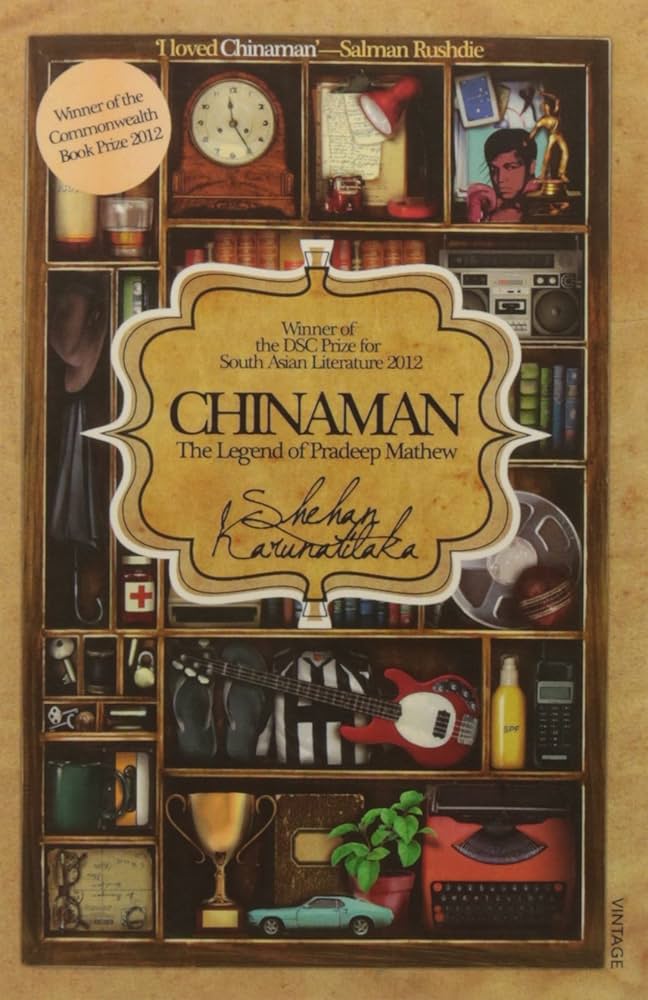
Chinaman: The Legend of Pradeep Mathew

Author: Shehan Karunatilaka | 528 Pages | Genre: Fiction | Publisher:  Random House India|  Year: 2011 | My Rating: 9/10

“Sports can unite worlds, tear down walls and transcend race, the past, and all probability. Unlike life, sports matter.”-Shehan Karunatilaka, Chinaman

Chinaman: The Legend of Pradeep Mathew is one of those rare novels that begins as a playful, humorous love letter to cricket and gradually reveals itself as an exploration of obsession, loss, nationalism, truth, and the fragility of memory. The novel is both deeply local and universally resonant. While the novel has a story of sports mystery, its real subject is Sri Lanka’s beauty, contradictions, wounds, and unspoken histories. The story is narrated by Karunasena, a retired, alcoholic Sri Lankan sports journalist who spends his final years trying to piece together the fate, brilliance, and disappearance of Pradeep Mathew, a fictional left-arm spin bowler. Karunasena, physically failing and emotionally frayed, embarks on this investigation out of professional regret and to give his last days purpose, direction, and meaning. 

At the heart of the novel is a brilliant structural trick: Mathew may or may not have existed. Karunatilaka plays with documentation, statistics, commentary, interviews, cricketing lore, and Karunasena’s alcohol-induced lapses so convincingly that you might end up Googling the character. In blurring fact and fiction, the novel not only mimics the texture of cricket fandom but also comments on the ways nations construct their narratives. Sri Lanka, recovering from war and silences, becomes a metaphorical parallel of a country with many missing pages.

Karunatilaka’s writing is witty, sharp, and deeply musical. The novel is filled with irreverent one-liners, drunken ramblings, philosophical musings, cricketing trivia, newspaper excerpts, statistics, and lists. It reads like a mashup of journalistic diary, sports documentary, and detective fiction. Although cricket drives the narrative, Chinaman is not even a cricket book. Cricket becomes an entry into race, caste, class, corruption, media ethics, and the politics of memory formation. Sri Lanka’s cricketing establishment becomes a microcosm of the island itself. Mathew, a Tamil, is hinted to be sidelined, unrecognised, erased. The mystery of why such a brilliant athlete disappeared becomes research on institutional prejudice, the violence of bureaucracies, and the quiet, everyday injustices that never make headlines. Karunatilaka never moralises; instead, he simply places cricket where it has always belonged in the South Asia of not just being a sport, but a sociological text.  

The book’s experimental narrative may not resonate equally with everyone. Those unfamiliar with cricket’s technical language, historical rivalries, or South Asian cricketing culture might initially feel disoriented. The nonlinear storytelling, shifting formats, incomplete endings, and metafictional commentary demand patience. But these elements are intentional as they replicate the experience of uncovering a half-lost story, of living in a place where history itself is contested terrain.I thought the book was a triumph of narrative experimentation, cultural commentary, and emotional depth. It is funny without being frivolous, political without being didactic, tragic without losing hope. It is about cricket, but also about journalism, friendship, nationhood, obsession, and the human need to make meaning before time runs out.

Few novels manage to be simultaneously entertaining, intellectually provocative, and heartbreaking. For lovers of cricket, South Asian literature, postcolonial storytelling, or simply great fiction, Chinaman is a highly recommended read.

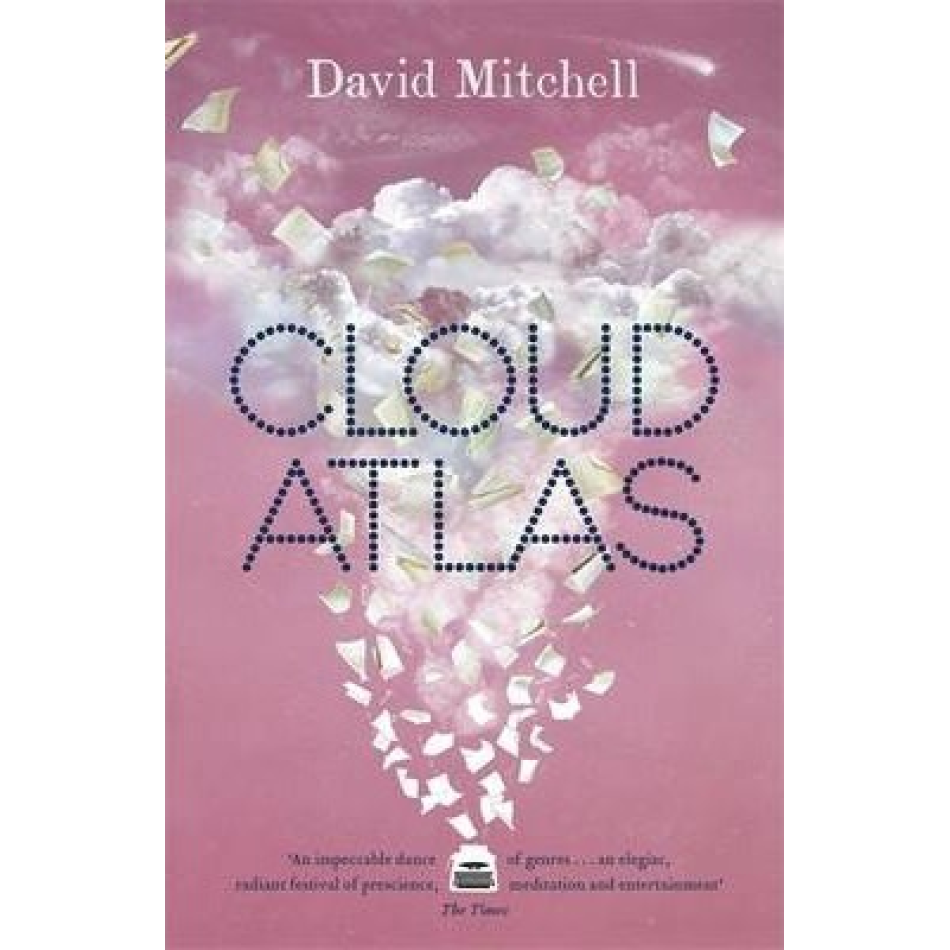
Cloud Atlas

by David Mitchell | 544 PagesGenre: Fiction | Publisher: Hodder & Stoughton | Year: 2004 | My Rating: 9.5/10

“A half-read book is a half-finished love affair.”
― David Mitchell, Cloud Atlas

Some novels entertain, others provoke. David Mitchell’s Cloud Atlas does both and then something rarer still, it bends the time itself! Since its publication in 2004, this novel has become a cult classic, not only for its intricate structure but also for its audacious attempt to string together the vast tapestry of human existence from past, present and future. The book is one of the most original, unusual, and polarising works on this century.

Mitchell presents us with six interconnected stories that span centuries and genres, a 19th-century Pacific voyage, letters from a young composer in Belgium, a taut thriller set in 1970s California, a satirical farce about a vanity publisher, the interrogation of a genetically engineered clone in a near-future Korea, and a tale told in a fractured dialect after civilization’s collapse. At first, these stories seem like discrete novellas. Yet as each thread is interrupted and later resumed, patterns begin to emerge, as symbols, names, and echoes that ripple across time.

Reading Cloud Atlas is like listening to a symphony in six movements. Each section has its own rhythm, its own instrumentation, yet together they build a haunting, resonant chorus about power, exploitation, love, and resilience. The stories have drama, thrill, humour and fantasy, and takes a deep look into the nature of humanity and moral choices. Mitchell’s message is clear but never heavy-handed, history is cyclical, cruelty and greed recur, but so too do acts of kindness, rebellion, and hope.

A movie was released in 2012 based on the adaptation of the book by the same name featuring Tom Hanks and Halle Berry. The main difference between the book and the movie is the structure and depth, with the book offering distinct, in-depth narratives and complexities, while the movie uses a faster, intercutting cinematic style that emphasizes visual connections and emotion over intellectual understanding, though sometimes oversimplifying plot points like Sonmi-451’s ending. 

This brilliantly written book’s shift in style across the stories can be dizzying, and the patience it demands is substantial. But when the final notes fall into place, the reward is profound, a recognition that our lives, however fleeting, echo forward and backward, part of something infinitely larger.

Cloud Atlas is not just a novel, it is a meditation on the human nature, a daring cartography of time.

I am including some of my most favourite quotes from this book, which is totally worth mentioning with this review.

  • “Power, time, gravity, love. The forces that really kick ass are all invisible.”
  • “My life amounts to no more than one drop in a limitless ocean. Yet what is any ocean, but a multitude of drops?.”
  • “Anticipating the end of the world is humanity’s oldest pastime.”
  • “Nothing is as eloquent as nothing.”

The White Tiger

whiteThe White Tiger

by Aravind Adiga | 318 Pages | Genre: Fiction| Publisher: HarperCollins India| Year: 2008 | My Rating: 9/10

“You Chinese are far ahead of us in every respect, except that you don’t have entrepreneurs. And our nation, though it has no drinking water, electricity, sewage system, public transportation, sense of hygiene, discipline, courtesy, or punctuality, does have entrepreneurs. Thousands and thousands of them. Especially in the field of technology. And these entrepreneurs – we entrepreneurs – have set up all these outsourcing companies that virtually run America now.”

– Aravind Adiga, The White Tiger

In his debut novel, which won the Man Booker Prize in 2008, Aravind Adiga has brilliantly portrayed the modern India with its newfound economic prowess through its narrator, Balram Halwai aka Munna with an obsession for China, Chandeliers, and Corruption, rising from being a ‘country mouse’ from a nondescript village of Bihar to a business entrepreneur in technology driven Bangalore. Balram’s narrative is framed as a letter to the visiting Chinese Premier, written over seven nights while sitting at his office in Bangalore. In his letter he talks about the initial years of his life spent in Laxmangarh attending school for few years before moving to work with a tea stall, and later moving to Dhanbad with his brother Kishan, where he learnt how to drive and became a driver for a weak-willed son of a feudal landlord from his village. For him ‘the darkness’ represents the areas around river Ganges deep in the heartland marked by medieval hardship, where brutal landlords hold sway, children are pulled out of school into indentured servitude and elections are routinely bought and sold. Later he moved to Delhi with his employers, which he has described as moving from ‘darkness’ to ‘light’, and one rainy day he slit the throat of his employer with a broken bottle of Johnnie Walker Black, which he justifies as an act of class warfare, took seven hundred thousand rupees in cash and fled to Bangalore. His life in Delhi has taught him the corruption of government and politics, inequality between rich and poor, which he uses to set up his business of transportation for call centers with a motto of ‘driving technology forward’.

This novel as a penetrating piece of social commentary, attuned to the inequalities that persist despite India’s new prosperity is my Read of the Week.

The Shadow Lines

shadow-linesThe Shadow Lines

by Amitav Ghosh | 288 Pages | Genre: Fiction| Publisher: Penguin Books India| Year: 1988 | My Rating: 8.5/10

“He said to me once that one could never know anything except through desire, real desire, which was not the same thing as greed or lust; a pure, painful and primitive desire, a longing for everything that was not in oneself, a torment of the flesh, that carried once beyond the limits of one’s mind to other times and other places, and even, if one was lucky, to a place where there was no border between oneself and one’s imagine in the mirror.”

— Amitav Ghosh, The Shadow Lines

Amitav Ghosh captures the lines connecting time and events, and people with each other bound by ties of blood and history. This work of fiction is narrated by and follows the life of a young boy growing up in Calcutta with his grand mother and parents, and later in Delhi and London for his higher education. His Grandmother and Mayadebi are sisters, who grew up in Dhaka pre-partition. After the death of her husband, grandmother works at a school to raise her son without depending upon any charity, while Mayadebi marries a Diplomat and lives a life of luxury. Two characters plays pivotal role in the narrator’s life are Ila, a distant cousin of his from Mayadebi’s side to whom he is attracted yet his yearnings go unrequited, and Tridib, who’s Maya’s son. The story unfolds through flashbacks, then progresses occasionally in the present.

This book with numerous characters and intricate web of memories moving back and forth, is my Read of the Week.

Extremely Close and Incredibly Loud

extremely_loud_and_incredibly_close_bookExtremely Close and Incredibly Loud

by Jonathan Safran Foer| 368 Pages | Genre: Fiction| Publisher: Penguin Books| Year: 2005 | My Rating: 9.5/10

This brilliant fiction is a story of a  very intelligent  and sensitive, alternately exasperating and hilarious nine-years old boy, Oscar Schell, who goes across five boroughs of New York looking for the right lock, which can be opened by a ‘black’ key his father left, who died in 9/11 bombing of the World Trade Centre. This incredible novel explores shattering emotions and human connections through the prism of a disaster.

Oscar being an internet whizkid is an information sponge and a walking encylopedia chatting. His calling card, which he uses while meeting people, reads: “Inventor, Jewelry Designer, Jewelry Fabricator, Amateur Entomologist, Francophile, Vegan, Origamist, Pacifist, Percussionist, Amateur Astronomer, Computer Consultant, Amateur Archeologist, Collector of: rare coins, butterflies that died natural deaths, miniature cacti, Beatles memorabilia, semiprecious stones, and other things” .He even goes to the extent of flattering women his mother’s age by complimenting them on their beauty and sometimes telling them that he’d like to kiss them! His search brought him into contact with survivors of all sorts on an exhilarating, affecting, often hilarious, and ultimately healing journey.

I have first read this book in 2009 and fell in love with Foer’s style of writing. The use of pictures, visuals and the mesmerising style of writing is so refreshingly inventive. This book which made me laugh and yet mourn the grief of Oscar Schell is my ‘Read of the Week’.