The invisible cost of GRAP 

Delhi slips into a public health emergency as air pollution reaches hazardous levels every winter. The government responds by invoking the most stringent measures under the Graded Response Action Plan (GRAP III and IV), suspending all construction and demolition activities, halting infrastructure projects, and restricting dust-generating work. These steps are necessary and justified for pollution control and the health of people. However, the cost of Delhi’s clean air policies is disproportionately borne by construction workers and daily wage labourers, whose livelihoods are abruptly and completely cut off.

Delhi has a massive daily wage construction labour force, estimated between 10-12 lakhs workers, with only around 5.4 lakhs officially registered (around 2.6 lakh active). Construction restrictions under GRAP III and IV are designed to curb particulate pollution, particularly PM10, a major contributor to Delhi’s smog. However, the construction sector is sustained almost entirely by informal labour. Migrant workers, hired through layers of contractors, work without written contracts, income security, or social protection. When work stops, wages stop instantly. There are no savings to fall back on, no paid leave, and often no local support systems. For these workers, a week-long (or longer) pollution shutdown can mean hunger, unpaid rent, mounting debt, or forced return to their native places under distress.

The injustice lies in the fact that these workers are not the architects of Delhi’s pollution crisis. Air pollution is the result of long-term structural failures, like unchecked urbanisation, rising private vehicle use, industrial emissions, poor public transport planning, weak enforcement of environmental norms, and regional factors like stubble burning. Construction workers operate within this system, responding to demand created by the city’s growth. Yet, when pollution peaks, their labour is the first to be criminalised, as if survival itself were an environmental offence.

The common defence of GRAP rests on a false dichotomy between public health and livelihoods. This framing assumes that income loss is a tolerable short-term sacrifice in the interest of long-term health. For daily wage labourers, livelihood and health are inseparable. Loss of income leads to undernutrition, stress, untreated illness, and increased vulnerability. Clean air achieved by pushing workers out of their wages is a policy failure and not a public health success. India’s environmental governance has consistently overlooked this social dimension. While regulations effectively restrict polluting activities, there is little institutional thought given to compensating those who lose income due to regulatory action. 

On 18th December 2025, the Delhi Government announced financial assistance of  INR 10,000 through Direct Benefit Transfer (DBT) to registered construction workers affected by the curbs under GRAP. While this is a welcome announcement by the Government, a clear policy solution is required in the long run for the provision of minimum wages to construction workers and daily wage labourers, both registered and unregistered, for the duration of GRAP shutdowns. This compensation should not be framed as charity or welfare, but as a rightful payment for income loss imposed by public policy in the interest of collective well-being. If the state mandates a halt to work for environmental reasons, it must also accept responsibility for the economic consequences of that mandate.

The most viable way to finance this support is through a dedicated ‘pollution tax.’ Delhi already collects various environment-linked charges, including green cess on vehicles, environmental compensation from polluting industries, and penalties for regulatory violations. These revenues can be consolidated into a Pollution Mitigation and Compensation Fund. Additional sources could include congestion charges in high-traffic zones, higher fees on large real estate developments, and stricter fines on construction firms that violate dust-control norms. Those who contribute most to pollution should bear the cost of its social mitigation.

Beyond immediate compensation, such a policy would also strengthen environmental compliance. When workers are protected from income loss, resistance to pollution-control measures will also decline. Environmental regulation will become a shared responsibility rather than an imposed punishment. Over time, this approach can build public trust in pollution governance, which is currently eroded by perceptions of unfairness and elite insulation from consequences.In the longer term, Delhi must move towards cleaner construction technologies, year-round dust control enforcement, better urban planning, and formalisation of labour. But these structural reforms will take time. Until then, compensating workers during pollution-induced shutdowns is a matter of basic justice. Environmental policy that ignores inequality risks becoming morally hollow and politically fragile. Clean air should be a shared achievement, not one built on empty stomachs and silent suffering.

First published at LinkedIn on 22nd December 2025
My Kind of Street Cafe

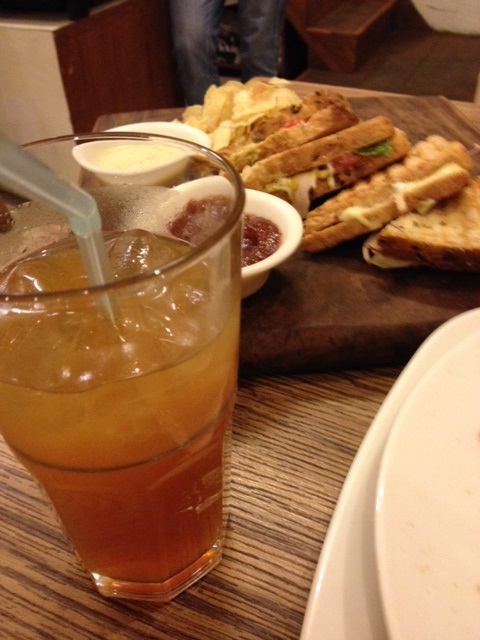
photo 4I am a regular to SDA Market (New Delhi) for my coffee fix at Cafe Qahwa and Costa, and recently discovered this small joint by the name of ‘My Kind of Street Cafe’. It has got basic seating in a casual dining setting, with a quirky DIY menu, which is like a mix of ‘Choose your own at Subway’ and Nick’s Kitchen at Mcleodganj. You gotta choose the ingredients of your sandwich from the given list on the menu and mark them with a sketch pen. The idea is novel, however it photo 2could have been better if I didn’t have to repeat what I had chosen to the host. Simpler option could have been had they given me a pen/paper to write what I wanted! Knowing that its a start-up and they have their chinks to fix, kudos to their novelty and food quality. Their Ham-n-Cheese sandwich was utterly delicious. Its good value for money with sumptuous servings and mouth-watering food.

Dinner for Two would cost around Rs 1,000.

My Rating: 4/5 (Taste, Service, Ambience, Value for money, Variety)

Must Try: Ham/Cheese Sandwich, Lemon Grilled Fish, Chicken Pita, any of their cake slices, Stuffed chicken

Sagar Ratna at Defence Colony Market

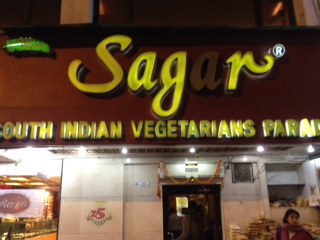
photo (10)When it comes to eating south Indian fast food, we often go for Sagar Ratna, which is more like a byword for the southern cuisine.  Recently we went for dinner the restaurant’s Defcol market outlet. This chain offer wallet-friendly fair for vegetarians,serving  Karnataka photo (12)cuisine, which tastes a little different from more commonly available Tamil style of making idlis and dosas. Menu is simple with a variety of finger licking snacks, dosas, utthapams, , desserts and beverages on a double-sided single card menu tab. Seating is not very fancy but is very clean and functional. Service is courteous and fast. You will hardly ever find a Sagar Ratna joint empty!

Dinner for four would cost around Rs 1,500.

My Rating: 3.5/5 (Taste, Service, Ambience, Value for money, Variety)

Must Try: Rava Onion Dosa, Paper Masala Dosa, Aaloo Bonda, Dahi Vada

Old Rao Dhaba on NH 8

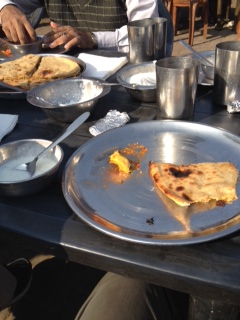
photo (7)As a frequent road traveler to Alwar starting early morning from Delhi, I often make a pit-stop at Dharuhera, Rewari for breakfast. NH-8 is dotted by several highway dhabas, and the most common name among them is ‘Rao’ with different prefixes & suffixes. The most authentic and oldest one is called ‘Old Rao Hotels & Caterers‘, which is 24 X 7 super busy joint and its parking lot is filled with small and big cars. It’s a large yet simple eating joint with plastic tables and chairs, and an photo (9)open kitchen, and you are not going to find the servers in neat uniforms. However if you are looking for some fresh and hot food desi style, this place offers good value for money. I have had numerous breakfasts and have tried them for a few dinners too. The dishes that I always stick to here are Aaloo Paranthas & Curd for breakfast, and Butter Paneer & Naan for dinner. Their stuffed bread offerings are good and mouth watering. Breakfast for four would cost around Rs 500.

My Rating: 3/5 (Taste, Service, Ambience, Value for money, Variety)

Must Try: Stuffed Parantha, Butter Paneer


The White Tiger

whiteThe White Tiger

by Aravind Adiga | 318 Pages | Genre: Fiction| Publisher: HarperCollins India| Year: 2008 | My Rating: 9/10

“You Chinese are far ahead of us in every respect, except that you don’t have entrepreneurs. And our nation, though it has no drinking water, electricity, sewage system, public transportation, sense of hygiene, discipline, courtesy, or punctuality, does have entrepreneurs. Thousands and thousands of them. Especially in the field of technology. And these entrepreneurs – we entrepreneurs – have set up all these outsourcing companies that virtually run America now.”

– Aravind Adiga, The White Tiger

In his debut novel, which won the Man Booker Prize in 2008, Aravind Adiga has brilliantly portrayed the modern India with its newfound economic prowess through its narrator, Balram Halwai aka Munna with an obsession for China, Chandeliers, and Corruption, rising from being a ‘country mouse’ from a nondescript village of Bihar to a business entrepreneur in technology driven Bangalore. Balram’s narrative is framed as a letter to the visiting Chinese Premier, written over seven nights while sitting at his office in Bangalore. In his letter he talks about the initial years of his life spent in Laxmangarh attending school for few years before moving to work with a tea stall, and later moving to Dhanbad with his brother Kishan, where he learnt how to drive and became a driver for a weak-willed son of a feudal landlord from his village. For him ‘the darkness’ represents the areas around river Ganges deep in the heartland marked by medieval hardship, where brutal landlords hold sway, children are pulled out of school into indentured servitude and elections are routinely bought and sold. Later he moved to Delhi with his employers, which he has described as moving from ‘darkness’ to ‘light’, and one rainy day he slit the throat of his employer with a broken bottle of Johnnie Walker Black, which he justifies as an act of class warfare, took seven hundred thousand rupees in cash and fled to Bangalore. His life in Delhi has taught him the corruption of government and politics, inequality between rich and poor, which he uses to set up his business of transportation for call centers with a motto of ‘driving technology forward’.

This novel as a penetrating piece of social commentary, attuned to the inequalities that persist despite India’s new prosperity is my Read of the Week.