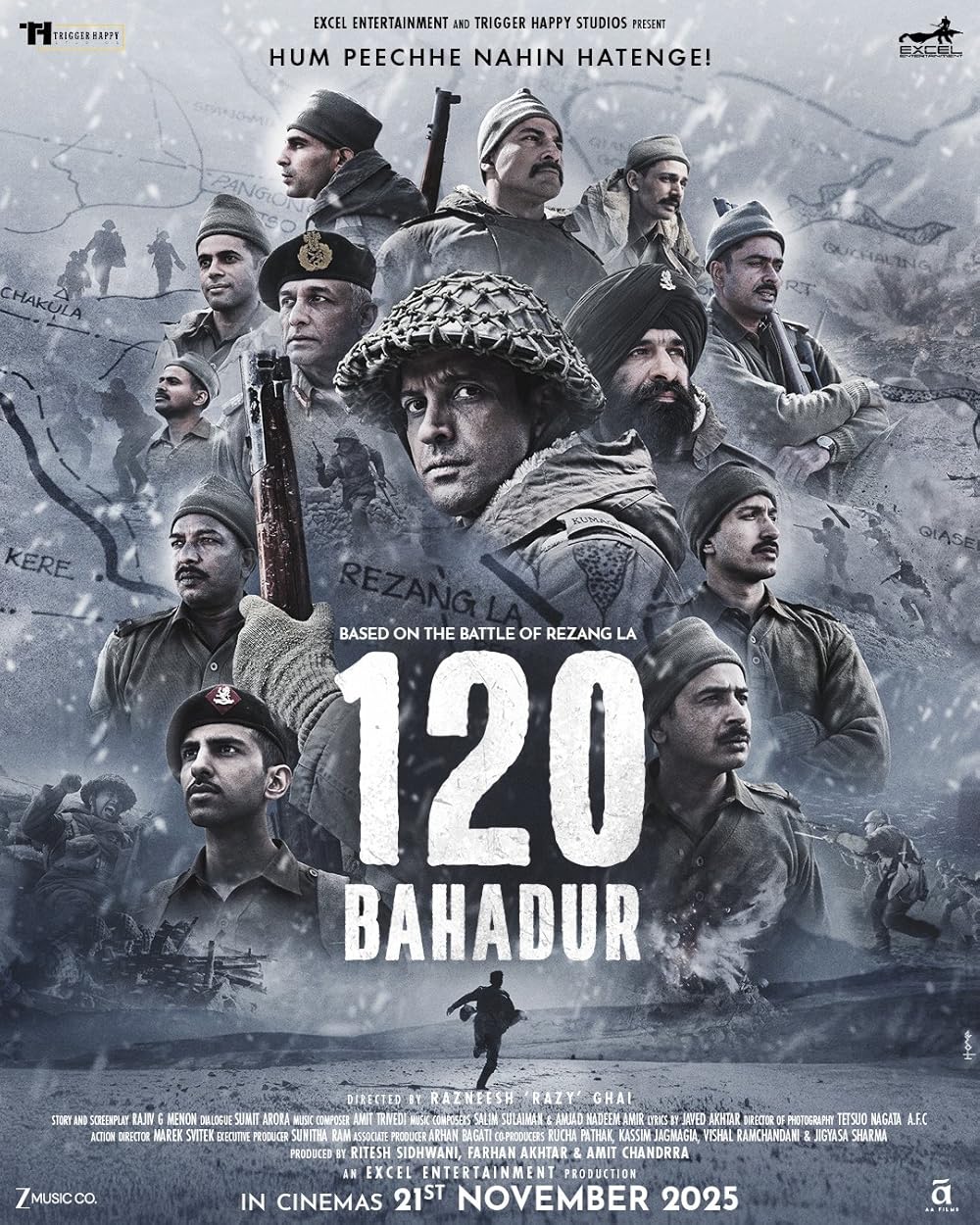
120 Bahadur 

Genre: War Drama Year: 2025 | Duration: 160 mins | Director: Razneesh Ghai|  Medium: Theatre (PVR Cinemas) | Trailer: HERE | Language: Hindi | Cast: Farhan Akhtar, Raashil Khanna, and others | My rating: 3.5/5

120 Bahadur is based on the real-life sacrifice of the 120 soldiers of Charlie Company, 13 Kumaon Regiment of the Indian Army at the Battle of Rezang La during the 1962 Sino-Indian War. It chronicles the extraordinary courage of 120 Indian soldiers who stood their ground against 3000 Chinese troops. The film focuses on Major Shaitan Singh Bhati (played by Farhan Akhtar), showcasing the grit, sacrifice, and valour of soldiers fighting in the brutal cold and high altitude of Ladakh. The story is narrated through the memories of a surviving soldier, and it unfolds as a tribute to the heroism of a band of brothers whose courage came at the highest cost.  

The film’s strongest suit is its war sequences and immersive realism. The battle sequences at Rezang La, rifle fire, bayonet charges, final close-quarters combat, the harsh terrain, bone-chilling cold, and the almost claustrophobic desperation when ammunition runs out are realised with a fierce intensity that’s rare for many modern Hindi war films.  The film features brilliant cinematography by Tetsuo Nagata, with breathtaking shots of snow-covered mountains, freezing desolation, and the starkness of high-altitude warfare.  The film mostly avoids glorifying war for its own sake and is a sober portrayal of the events. This sincerity gives the film humility as it doesn’t frame itself as a triumphant spectacle, but a respectful tribute and remembrance. 

Farhan Akhtar delivers a thoughtful performance. He largely avoids the larger-than-life histrionics often associated with Bollywood war heroes. Instead, he feels rooted, authoritative yet human, decisive yet burdened.  At the same time, the supporting cast, many of them lesser-known actors, bring the infantrymen to life with grit, camaraderie, humour, and vulnerability. Their messy friendships, small conversations, homesickness, and occasional fears humanise what might otherwise have been just a war drama with guns and trenches.  

However, the film seemed to have weak character development; their individual stories were barely sketched out. This makes certain deaths feel less impactful emotionally, more like casualties on a battlefield than deeply personal losses. Because of that, while the collective sacrifice hits home, personal grief and tragedy often don’t. The film’s narrative isn’t always smooth, as flashbacks to family life, interspersed with the lead-up to battle, sometimes break the tension. The prelude drags at times, and the buildup to the climax lacks the steady escalation that such stories need for maximum impact.  

I felt that the depiction of Chinese soldiers has been overly simplified and tends to lean towards caricature: monolithic, villainous, almost cartoonish, robbing them of nuance or complexity. This weakens the moral weight of the conflict and reduces it to a binary ‘good vs evil’ war movie. In parts, storytelling relies heavily on familiar Bollywood popular drama of last-minute motivational speeches, montage-heavy sequences, formula flashbacks and emotional beats, which keep the film from feeling fully original.  

120 Bahadur is not a perfect film, but it is an earnest, important one. It doesn’t glamourise war, and it doesn’t demand you leave the theatre cheering mindlessly. Instead, it makes you reflect on duty, courage, and sacrifice. As a cinematic recreation of a tragic but heroic moment in India’s history, the film succeeds more often than it fails. Its war sequences are unflinching and immersive; its portrayal of brotherhood and sacrifice is heartfelt; its lead performance is measured and credible.

But beneath the combat and solemn patriotism, it made me think that India’s rural society holds the backbone of India’s defence forces. The film also has a sociological moment where rural identity, class, caste, and nationhood intersect. The men of Charlie Company came largely from agrarian communities, especially the Ahir (Yadav) belt of Haryana and Western UP. Their lives before the war were shaped by farming cycles, monsoon anxieties, livestock, joint families, and deeply rooted village cultures. The film becomes a testament to how rural young men, in search of dignity, livelihood, and service, become the face of national defence but rarely the face of national storytelling.

Despite its narrative shortcomings, 120 Bahadur performs a cultural service of returning Rezang La to public consciousness.

The Rivered Earth

the-rivered-earthThe Rivered Earth

by Vikram Seth | 120 Pages | Genre: Poetry | Publisher: Hamish Hamilton | Year: 2011 | My Rating: 9/10

Recital of the poem ‘Fire’ by Vikram Seth HERE

Vikram Seth has written 4 libretti for 4 musical performances conducted over 4 years (2006 – 2009). A mix of original work and translation, they draw from three cultures – Indian, Chinese, and European – and are set to music by the composer Alec Roth and violinist Philippe Honoré. Titled ‘Songs in time of war’, ‘Shared Ground’, ‘The Traveller’, and ‘Seven Elements’, each of these four librettos in this book is presented with a foreword that provides a backdrop for the particular work. Exquisite pieces of calligraphy by Seth, in Chinese, English, Hindi and Arabic, prefaces each text.

In the first libretto, Songs in time of war, most of the poems are set during a terrible rebellion in the Tang dynasty, which caused vast devastation and famine. In the second libretto, Shared Ground, Seth moves from the Tang Dynasty to the Stuarts, to Salisbury, England, to the very house where the idea of the book of libretti was first born. In a delightful poem titled Host he recounts his admiration for his favorite Anglican poet, George Herbert,

“He’ll change my style.”
“Well, but you could do worse
Than rent his rooms of verse.”
Joy came, and grief; love came, and loss; three years –
Tiles down; moles up; drought; flood.
Though far in time and faith, I share his tears,
His hearth, his ground, his mud;
Yet my host stands just out of mind and sight,
That I may sit and write.”
 
 
The third libretto, The Traveller, which is about the stages of human life – unborn, childhood, youth, adulthood, old age, and death, is influenced by Rig Veda. Suitable texts for the stages were taken from various Indian languages – Tamil, Hindi, Brajbhasha, Urdu, and Bengali. And therefore the tone of the poems are playful, philosophical, contemplative, passionate, reminiscent, and yielding. The final libretto,Seven Elements, is inspired from all the three cultures, and thus its seven poems are based on seven element in nature, air, water, earth, fire, space, metal, and wood.

This deeply sensitive, appealing and seductive book about friendship, love, loss, drama, history, geography, literature and music is my Read of the Week.

The White Tiger

whiteThe White Tiger

by Aravind Adiga | 318 Pages | Genre: Fiction| Publisher: HarperCollins India| Year: 2008 | My Rating: 9/10

“You Chinese are far ahead of us in every respect, except that you don’t have entrepreneurs. And our nation, though it has no drinking water, electricity, sewage system, public transportation, sense of hygiene, discipline, courtesy, or punctuality, does have entrepreneurs. Thousands and thousands of them. Especially in the field of technology. And these entrepreneurs – we entrepreneurs – have set up all these outsourcing companies that virtually run America now.”

– Aravind Adiga, The White Tiger

In his debut novel, which won the Man Booker Prize in 2008, Aravind Adiga has brilliantly portrayed the modern India with its newfound economic prowess through its narrator, Balram Halwai aka Munna with an obsession for China, Chandeliers, and Corruption, rising from being a ‘country mouse’ from a nondescript village of Bihar to a business entrepreneur in technology driven Bangalore. Balram’s narrative is framed as a letter to the visiting Chinese Premier, written over seven nights while sitting at his office in Bangalore. In his letter he talks about the initial years of his life spent in Laxmangarh attending school for few years before moving to work with a tea stall, and later moving to Dhanbad with his brother Kishan, where he learnt how to drive and became a driver for a weak-willed son of a feudal landlord from his village. For him ‘the darkness’ represents the areas around river Ganges deep in the heartland marked by medieval hardship, where brutal landlords hold sway, children are pulled out of school into indentured servitude and elections are routinely bought and sold. Later he moved to Delhi with his employers, which he has described as moving from ‘darkness’ to ‘light’, and one rainy day he slit the throat of his employer with a broken bottle of Johnnie Walker Black, which he justifies as an act of class warfare, took seven hundred thousand rupees in cash and fled to Bangalore. His life in Delhi has taught him the corruption of government and politics, inequality between rich and poor, which he uses to set up his business of transportation for call centers with a motto of ‘driving technology forward’.

This novel as a penetrating piece of social commentary, attuned to the inequalities that persist despite India’s new prosperity is my Read of the Week.

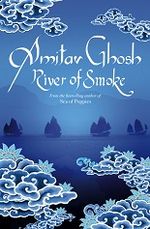
River of Smoke

150px-River_of_smoke“Opium is like the wind or the tides: it is outside my power to affect its course. A man is neither good nor evil because he sails his ship upon the wind. It is his conduct towards those around him – his friends, his family, his servants – by which he must be judged”

– Amitav Ghosh, River of Smoke

River of Smoke, is a novel on trade, empire, and cultural encounter in the age of the Opium Wars. The story is set in Canton in the 1830s, where the novel shifts from the sea-bound drama of Sea of Poppies (first in the Ibis trilogy ) to a more contemplative, cosmopolitan world shaped by commerce and ideas.

Canton, in this story is neither completely Chinese nor European, it’s a place where merchants, sailors, painters, and exiles coexist uneasily. Characters such as the opium trader Bahram Modi and the painter Robin Chinnery are not heroic figures but moral intermediaries, caught between profit and conscience. Through them, Ghosh explores how global capitalism takes root not only through violence, but also through everyday transactions, friendships, and compromises.

The novel is dense, patient, and immersive, demanding attentive reading. Historical detail is worn lightly, yet it is a critique of imperial greed and cultural misunderstanding. Unlike conventional historical fiction, River of Smoke resists dramatic climax, choosing instead to trace the slow, inexorable drift toward catastrophe.

‘River of Smoke’, a brilliant historical fiction set in late 19th century China is my “Read of the week”.

The World Bamboo Market

The world bamboo market is currently worth USD 7 Billion/year, of which China has USD 5.5 Billion. The largest markets are handicraft (USD 3 Billion), bamboo shoots (USD 1.5 Billion) and traditional furniture (USD 1.1 Billion). Traditional markets cover handicrafts, blinds, bamboo shoots, chopsticks and traditional bamboo furniture, which count for 95% of the market. Emerging bamboo markets are wood substitutes such as flooring, panels and non-traditional furniture. The growth of the global market is expected to grow to USD 15-20 Billion/year in 2017. Non-traditional markets are expected to claim 45% of the total bamboo market. 

Read the full article at: http://www.greenflip.in/blog/the-world-bamboo-market/