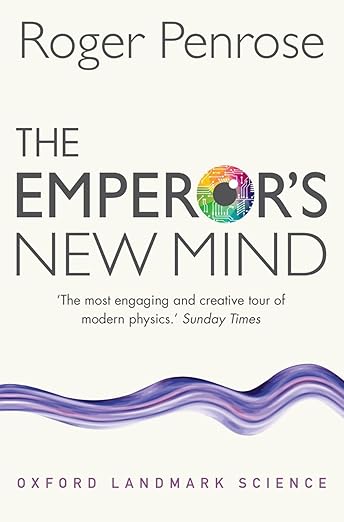
The Emperor’s New Mind

Author: Roger Penrose | 640 Pages | Genre: Non-Fiction | Publisher: Oxford University Press | Year: 1989 | My Rating: 10/10

I argue that the phenomenon of consciousness cannot be accommodated within the framework of present-day physical theory.”
― Roger Penrose, The Emperor’s New Mind

Sir Roger Penrose’s “The Emperor’s New Mind” is a captivating exploration of the intersection between mathematics, physics, consciousness, and the cognitive mind. Renowned for his contributions to theoretical physics and cosmology, Penrose brings his deep understanding of complex scientific concepts to the realm of cognition and artificial intelligence in this thought-provoking work. He covers a wide range of topics, from classical physics and Gödel’s incompleteness theorem to the puzzles of quantum mechanics and the philosophy of mind. He explains complex scientific ideas with remarkable clarity and delves into the question of what constitutes consciousness and the nature of human thought. He critiques the current state of artificial intelligence and posits that human understanding and awareness transcend mere computation. Through a blend of philosophical inquiry and scientific analysis, he argues against the idea that machines can fully replicate human cognitive processes. The book highlights the unique qualities of human thought, suggesting that there are aspects of consciousness that remain elusive to mechanistic interpretations.

Penrose also explores the implications of his theories for fields such as neuroscience and philosophy, offering insights into the workings of the human brain and the potential limitations of current scientific understanding. He integrates ideas from his previous works, such as the concept of objective reality and the nature of mathematical truths, providing a cohesive framework for his arguments.

The book is also notable for its engagement with the nature of mathematics and reality. Penrose argues that mathematics has an existence independent of the human mind, a stance known as mathematical Platonism. This perspective is central to his critique of artificial intelligence and his belief that the brain’s functioning may be linked to quantum processes. It truly is a profound and insightful exploration of consciousness and the nature of thought, bridging the gap between science and philosophy. It makes one ponder the complexities of the mind and the potential for understanding what makes us human in an age increasingly dominated by artificial intelligence.

This book is a must-read for anyone with a scientific temper, a love for complex and abstract ideas, and a deep interest in the fundamental questions of consciousness, cognitive science, and the philosophy of mind, offering an enriching perspective on the enduring mysteries of human existence.

The Photographer

9781596433755The Photographer: Into War-Torn Afghanistan with Doctors Without Borders

by Emmanuel Guibert, Frederic Lemercier and Didier Lefevre
267 Pages | Genre: Graphic Novel | Publisher: First Second | Year: 2009 | Rating: 8.5/10

In 1986, French photojournalist Didier Lefèvre documented the efforts of Médecins Sans Frontières (Doctors Without Borders) in Afghanistan, which was torn apart by a war with USSR. This graphic novel is a record of his arduous journey along with the Doctors across Afghanistan and presents a powerful story of a mission dedicated to mending the wounds of war. I like the presentation style of using real B/W photographs and comic book illustrations & dialogues by Emmanuel Guibert based on the notes taken during the journey.

This incredibly brilliant graphic novel is my “Read of the Week”.

The Sisters Brothers

9781847083180“Come with me into the world and reclaim your independence. You stand to gain so much, and riches are the least of it.”
– Patrick deWitt, The Sisters Brothers
This books made me laugh with its adroit humor and cringe at the same time. Delightful. The story is narrated by Eli Sisters, a hired killer on the American west coast in 1851, around the time of the Gold Rush in the Sierra Nevada mountains. However Eli barely gives the American landscape a glance, and people met along the way are simple figures in his moral drama. Nor does Eli have any larger philosophical or socio-historical insights to offer for the century this story is set in. This hilariously anti-heroic and relentlessly compelling novel is my “Read of the Week”.

The Tiger’s Wife

8366403When your fight has purpose—to free you from something, to interfere on the behalf of an innocent—it has a hope of finality. When the fight is about unraveling—when it is about your name, the places to which your blood is anchored, the attachment of your name to some landmark or event—there is nothing but hate, and the long, slow progression of people who feed on it and are fed it, meticulously, by the ones who come before them. Then the fight is endless, and comes in waves and waves, but always retains its capacity to surprise those who hope against it.”
― Téa Obreht, The Tiger’s Wife

This novel full of historic and human complexities of Balkans through its principal narrator, Natalia Stefanovic, a young doctor who lives with her mother, grandmother and grandfather in an unnamed Balkan city early in the 21st century, is my “Read of the Week”.

American Gods

113767203What I say is, a town isn’t a town without a bookstore. It may call itself a town, but unless it’s got a bookstore it knows it’s not fooling a soul.” ― Neil Gaiman, American Gods

American Gods is a masterful blend of mythology and existential questioning, crafted with the confidence of a storyteller who knows how to make the unreal feel intimately familiar. The novel follows Shadow Moon, a man adrift after personal tragedy, who becomes entangled in a looming war between the old gods brought to America by immigrants and the new gods born of technology, media, and modern obsession.

Gaiman uses this supernatural conflict to explore what a nation chooses to worship, and what those choices reveal about identity, belief, displacement, and memory. His America is vast, strange, melancholic, and quietly magical with a landscape where roadside attractions become sacred spaces and forgotten deities cling to survival.

What makes the novel enduring is its atmosphere: moody, mythic, and laden with symbolism. Shadow’s journey is both epic and introspective, revealing the cost of faith and the fragility of stories in a changing world.

While the pacing occasionally drifts, the richness of character, imagination, and cultural insight more than compensates. American Gods remains one of Gaiman’s most ambitious works, an absorbing, thought-provoking modern myth that lingers long after the final page.

 This dark, poetic and thrilling novel across an American landscape is my “Read of the Week”.