The Emperor’s New Mind
October 14, 2024 Leave a comment
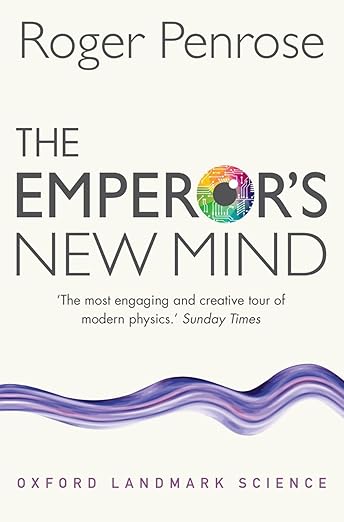
Author: Roger Penrose | 640 Pages | Genre: Non-Fiction | Publisher: Oxford University Press | Year: 1989 | My Rating: 10/10
“I argue that the phenomenon of consciousness cannot be accommodated within the framework of present-day physical theory.”
― Roger Penrose, The Emperor’s New Mind
Sir Roger Penrose’s “The Emperor’s New Mind” is a captivating exploration of the intersection between mathematics, physics, consciousness, and the cognitive mind. Renowned for his contributions to theoretical physics and cosmology, Penrose brings his deep understanding of complex scientific concepts to the realm of cognition and artificial intelligence in this thought-provoking work. He covers a wide range of topics, from classical physics and Gödel’s incompleteness theorem to the puzzles of quantum mechanics and the philosophy of mind. He explains complex scientific ideas with remarkable clarity and delves into the question of what constitutes consciousness and the nature of human thought. He critiques the current state of artificial intelligence and posits that human understanding and awareness transcend mere computation. Through a blend of philosophical inquiry and scientific analysis, he argues against the idea that machines can fully replicate human cognitive processes. The book highlights the unique qualities of human thought, suggesting that there are aspects of consciousness that remain elusive to mechanistic interpretations.
Penrose also explores the implications of his theories for fields such as neuroscience and philosophy, offering insights into the workings of the human brain and the potential limitations of current scientific understanding. He integrates ideas from his previous works, such as the concept of objective reality and the nature of mathematical truths, providing a cohesive framework for his arguments.
The book is also notable for its engagement with the nature of mathematics and reality. Penrose argues that mathematics has an existence independent of the human mind, a stance known as mathematical Platonism. This perspective is central to his critique of artificial intelligence and his belief that the brain’s functioning may be linked to quantum processes. It truly is a profound and insightful exploration of consciousness and the nature of thought, bridging the gap between science and philosophy. It makes one ponder the complexities of the mind and the potential for understanding what makes us human in an age increasingly dominated by artificial intelligence.
This book is a must-read for anyone with a scientific temper, a love for complex and abstract ideas, and a deep interest in the fundamental questions of consciousness, cognitive science, and the philosophy of mind, offering an enriching perspective on the enduring mysteries of human existence.


 Manu Mayank