Chinaman: The Legend of Pradeep Mathew
December 22, 2025 Leave a comment
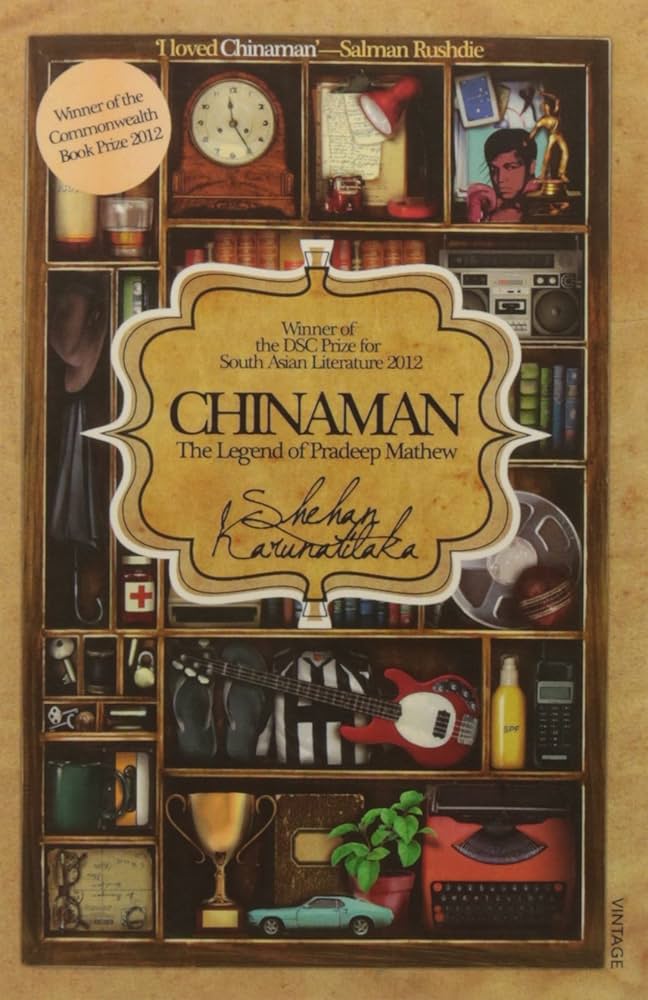
Author: Shehan Karunatilaka | 528 Pages | Genre: Fiction | Publisher: Random House India| Year: 2011 | My Rating: 9/10
“Sports can unite worlds, tear down walls and transcend race, the past, and all probability. Unlike life, sports matter.”-Shehan Karunatilaka, Chinaman
Chinaman: The Legend of Pradeep Mathew is one of those rare novels that begins as a playful, humorous love letter to cricket and gradually reveals itself as an exploration of obsession, loss, nationalism, truth, and the fragility of memory. The novel is both deeply local and universally resonant. While the novel has a story of sports mystery, its real subject is Sri Lanka’s beauty, contradictions, wounds, and unspoken histories. The story is narrated by Karunasena, a retired, alcoholic Sri Lankan sports journalist who spends his final years trying to piece together the fate, brilliance, and disappearance of Pradeep Mathew, a fictional left-arm spin bowler. Karunasena, physically failing and emotionally frayed, embarks on this investigation out of professional regret and to give his last days purpose, direction, and meaning.
At the heart of the novel is a brilliant structural trick: Mathew may or may not have existed. Karunatilaka plays with documentation, statistics, commentary, interviews, cricketing lore, and Karunasena’s alcohol-induced lapses so convincingly that you might end up Googling the character. In blurring fact and fiction, the novel not only mimics the texture of cricket fandom but also comments on the ways nations construct their narratives. Sri Lanka, recovering from war and silences, becomes a metaphorical parallel of a country with many missing pages.
Karunatilaka’s writing is witty, sharp, and deeply musical. The novel is filled with irreverent one-liners, drunken ramblings, philosophical musings, cricketing trivia, newspaper excerpts, statistics, and lists. It reads like a mashup of journalistic diary, sports documentary, and detective fiction. Although cricket drives the narrative, Chinaman is not even a cricket book. Cricket becomes an entry into race, caste, class, corruption, media ethics, and the politics of memory formation. Sri Lanka’s cricketing establishment becomes a microcosm of the island itself. Mathew, a Tamil, is hinted to be sidelined, unrecognised, erased. The mystery of why such a brilliant athlete disappeared becomes research on institutional prejudice, the violence of bureaucracies, and the quiet, everyday injustices that never make headlines. Karunatilaka never moralises; instead, he simply places cricket where it has always belonged in the South Asia of not just being a sport, but a sociological text.
The book’s experimental narrative may not resonate equally with everyone. Those unfamiliar with cricket’s technical language, historical rivalries, or South Asian cricketing culture might initially feel disoriented. The nonlinear storytelling, shifting formats, incomplete endings, and metafictional commentary demand patience. But these elements are intentional as they replicate the experience of uncovering a half-lost story, of living in a place where history itself is contested terrain.I thought the book was a triumph of narrative experimentation, cultural commentary, and emotional depth. It is funny without being frivolous, political without being didactic, tragic without losing hope. It is about cricket, but also about journalism, friendship, nationhood, obsession, and the human need to make meaning before time runs out.
Few novels manage to be simultaneously entertaining, intellectually provocative, and heartbreaking. For lovers of cricket, South Asian literature, postcolonial storytelling, or simply great fiction, Chinaman is a highly recommended read.


 Manu Mayank