Cloud Atlas
September 22, 2025 Leave a comment
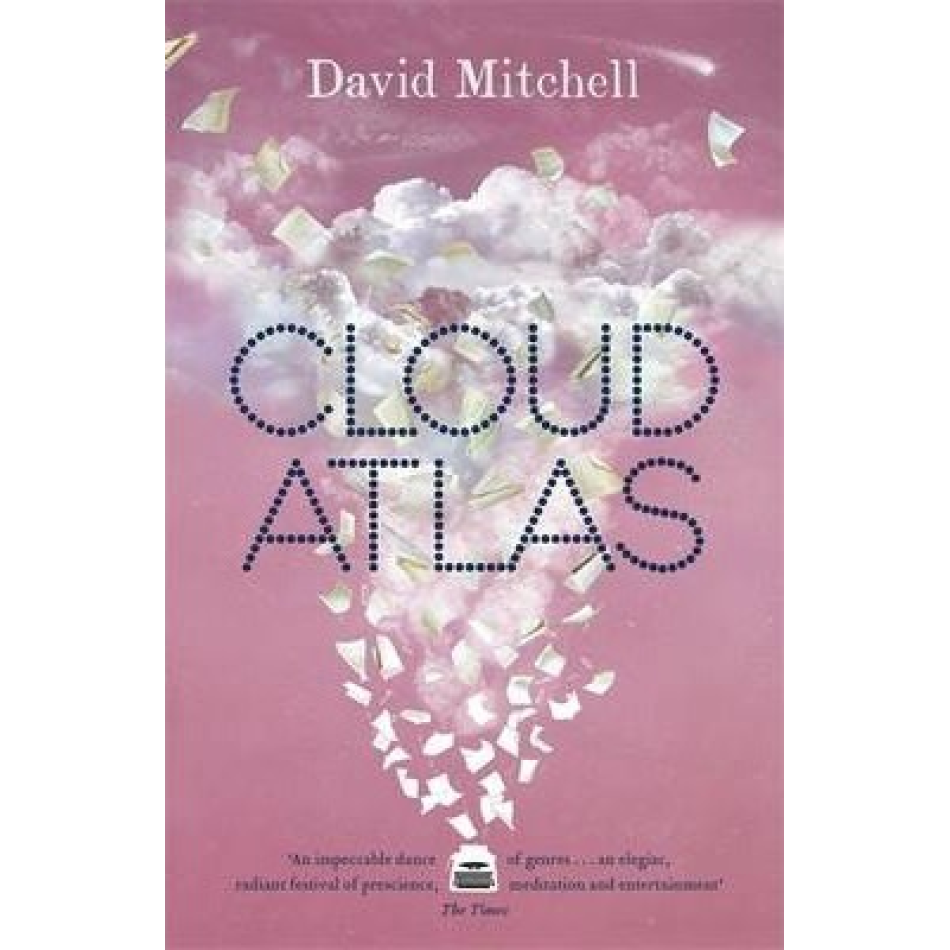
by David Mitchell | 544 Pages | Genre: Fiction | Publisher: Hodder & Stoughton | Year: 2004 | My Rating: 9.5/10
“A half-read book is a half-finished love affair.”
― David Mitchell, Cloud Atlas
Some novels entertain, others provoke. David Mitchell’s Cloud Atlas does both and then something rarer still, it bends the time itself! Since its publication in 2004, this novel has become a cult classic, not only for its intricate structure but also for its audacious attempt to string together the vast tapestry of human existence from past, present and future. The book is one of the most original, unusual, and polarising works on this century.
Mitchell presents us with six interconnected stories that span centuries and genres, a 19th-century Pacific voyage, letters from a young composer in Belgium, a taut thriller set in 1970s California, a satirical farce about a vanity publisher, the interrogation of a genetically engineered clone in a near-future Korea, and a tale told in a fractured dialect after civilization’s collapse. At first, these stories seem like discrete novellas. Yet as each thread is interrupted and later resumed, patterns begin to emerge, as symbols, names, and echoes that ripple across time.
Reading Cloud Atlas is like listening to a symphony in six movements. Each section has its own rhythm, its own instrumentation, yet together they build a haunting, resonant chorus about power, exploitation, love, and resilience. The stories have drama, thrill, humour and fantasy, and takes a deep look into the nature of humanity and moral choices. Mitchell’s message is clear but never heavy-handed, history is cyclical, cruelty and greed recur, but so too do acts of kindness, rebellion, and hope.
A movie was released in 2012 based on the adaptation of the book by the same name featuring Tom Hanks and Halle Berry. The main difference between the book and the movie is the structure and depth, with the book offering distinct, in-depth narratives and complexities, while the movie uses a faster, intercutting cinematic style that emphasizes visual connections and emotion over intellectual understanding, though sometimes oversimplifying plot points like Sonmi-451’s ending.
This brilliantly written book’s shift in style across the stories can be dizzying, and the patience it demands is substantial. But when the final notes fall into place, the reward is profound, a recognition that our lives, however fleeting, echo forward and backward, part of something infinitely larger.
Cloud Atlas is not just a novel, it is a meditation on the human nature, a daring cartography of time.
I am including some of my most favourite quotes from this book, which is totally worth mentioning with this review.
- “Power, time, gravity, love. The forces that really kick ass are all invisible.”
- “My life amounts to no more than one drop in a limitless ocean. Yet what is any ocean, but a multitude of drops?.”
- “Anticipating the end of the world is humanity’s oldest pastime.”
- “Nothing is as eloquent as nothing.”


 Manu Mayank