Project Hail Mary
April 13, 2026 Leave a comment
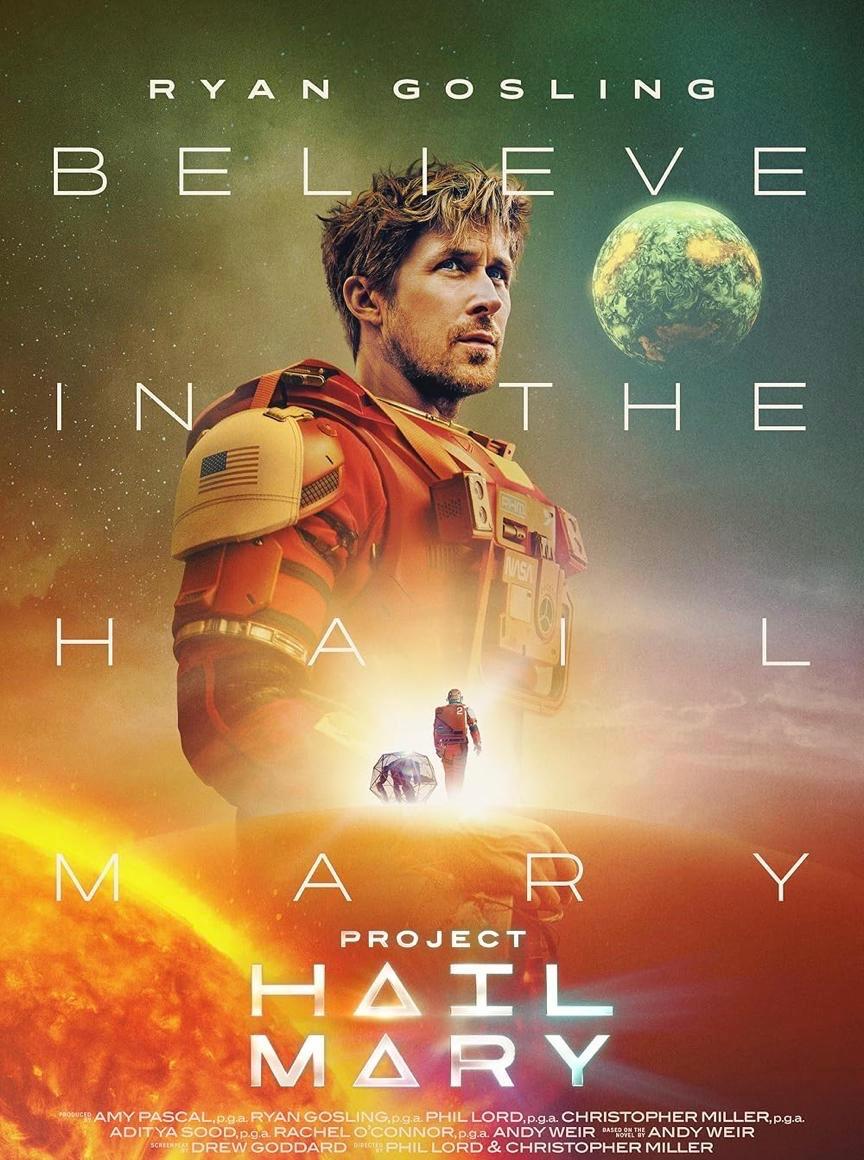
Genre: Space Sci-Fi | Year: 2026 | Duration: 157 mins | Director: Phil Lord and Christopher Miller| Medium: Theatre (PVR Cinemas) | Trailer: HERE | Language: English| Cast: Ryan Gosling, Sandra Huller, James Oritz, and others | My rating: 4.5/5
Favourite Dialogue:“Why, question? Evolution hate death.”
Project Hail Mary is adapted from the book ‘Project Hail Mary’ by Andy Weir. It is certainly among the best Sci-Fi movies I have watched in the last 10 years. The film is about survival, curiosity, friendship, and the stubbornness of hope. The film adaptation has not lost the magic of Andy Weir’s books, and leans heavily on problem-solving, intellect, and a deep sense of humour, and also explores further into emotional terrain that feels both intimate and cosmic.
The core of this layered film is deceptively simple, featuring a lone astronaut, Dr Ryland Grace (Ryan Gosling), who wakes up aboard a spacecraft with no memory of who he is or why he is there. As his memories gradually return, he realises that he may be humanity’s last hope to prevent extinction. This story of amnesia developing into purpose acts as a powerful storytelling engine. It enables the audience to rediscover the stakes alongside Grace, creating a layered tension that is both intellectual and emotional. Grace has been recruited by Eva Stratt (Sandra Huller) to save the world. He, along with many other scientists, has been told that an infection is affecting the sun. In the next few decades, life on the planet will cease to exist.
What distinguishes Project Hail Mary from many contemporary sci-fi films is its unapologetic embrace of science. This is not a film that glosses over the technicalities of astrophysics, microbiology, and orbital mechanics, which are all treated with a level of respect rarely seen in mainstream cinema. The film translates complexity into narrative urgency. Every equation solved, every experiment conducted, feels like a small step away from annihilation.
In many ways, the film follows in the lineage of The Martian, but it evolves beyond it. While The Martian was about one man surviving against the odds on Mars, Project Hail Mary expands the canvas to an interstellar scale. The stakes are existential and not personal, unlike The Martian. And yet, the film feels more personal because of an unexpected friendship that emerges in the vast emptiness of space between two different species. The relationship that develops between Grace and his unlikely counterpart, Rocky, is the soul of the film. It is here that Project Hail Mary transcends genre conventions. The film is no longer just about saving Earth, but more about connection across unimaginable divides of space. It explores communication not just as language but as intent, empathy, and trust.
The performance of Gosling carries much of the film’s weight. Ryland Grace is not a traditional hero. He is not a trained astronaut or a fearless explorer. He is, in many ways, an accidental saviour—reluctant, flawed, and often overwhelmed. This vulnerability makes him relatable. His fear is palpable, his humour disarming, and his determination deeply earned. The wry, self-deprecating, and occasionally absurd humour provides moments of levity that make the darker moments more impactful.
Project Hail Mary strikes a careful balance between realism and wonders visually. The spacecraft interiors are utilitarian, almost claustrophobic, reinforcing the isolation of Grace’s journey. In contrast, the depiction of vast, silent, and indifferent space serves as a constant reminder of the scale of the challenge. The film does not rely excessively on CGI spectacle, but when it does deploy visual effects, it does so with purpose. Each visual set-piece advances the narrative rather than distracting from it.
The narrative oscillates between past and present, gradually revealing how humanity arrived at this desperate moment. These flashbacks are integral to understanding the moral and ethical dilemmas that underpin the mission. Governments, scientists, and ordinary individuals are forced to make impossible choices. The film does not offer easy answers. Instead, it presents these decisions with a moral ambiguity that feels uncomfortably real.
Project Hail Mary grapples with questions of sacrifice, responsibility, and the collective versus the individual. It examines the idea of scientific progress not as an abstract pursuit but as a lifeline. In an era where science is often politicised or misunderstood, the film stands as a quiet testament to the power of human ingenuity. It suggests that our greatest strength lies in our ability to think, collaborate, and adapt.What I loved most about this non-linear film is that there are no explosive battles or dramatic confrontations in the traditional sense. The tension arises from equations, experiments, and the ticking clock of extinction. I found its intellectual core to be a deeply rewarding viewing experience. For those accustomed to more conventional sci-fi, this may require an adjustment in expectations.

 Manu Mayank