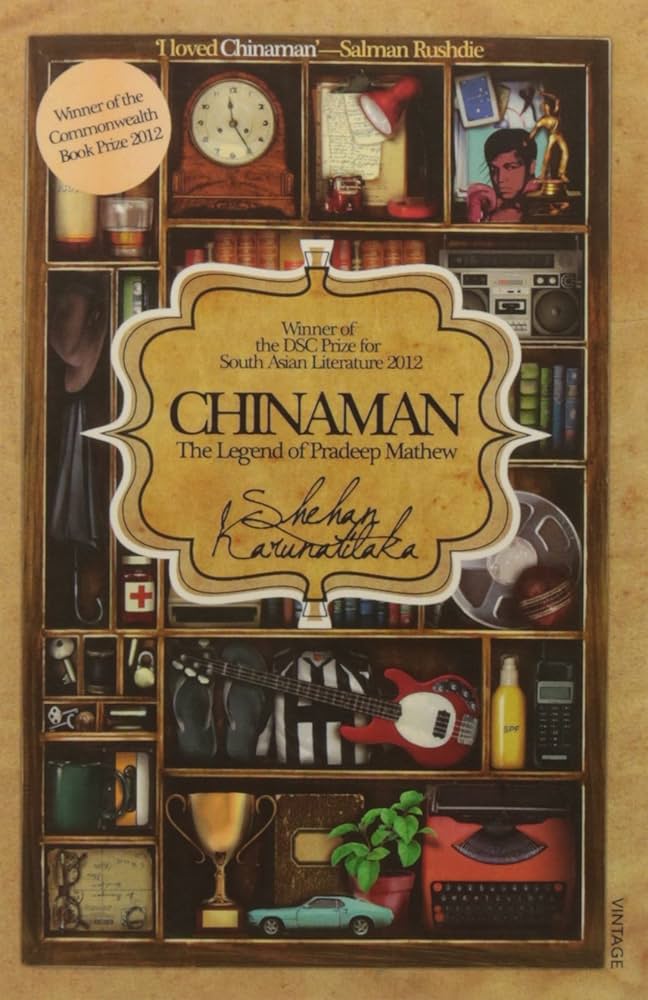
Author: Shehan Karunatilaka | 528 Pages | Genre: Fiction | Publisher: Random House India| Year: 2011 | My Rating: 9/10
“Sports can unite worlds, tear down walls and transcend race, the past, and all probability. Unlike life, sports matter.”-Shehan Karunatilaka, Chinaman
Chinaman: The Legend of Pradeep Mathew is one of those rare novels that begins as a playful, humorous love letter to cricket and gradually reveals itself as an exploration of obsession, loss, nationalism, truth, and the fragility of memory. The novel is both deeply local and universally resonant. While the novel has a story of sports mystery, its real subject is Sri Lanka’s beauty, contradictions, wounds, and unspoken histories. The story is narrated by Karunasena, a retired, alcoholic Sri Lankan sports journalist who spends his final years trying to piece together the fate, brilliance, and disappearance of Pradeep Mathew, a fictional left-arm spin bowler. Karunasena, physically failing and emotionally frayed, embarks on this investigation out of professional regret and to give his last days purpose, direction, and meaning.
At the heart of the novel is a brilliant structural trick: Mathew may or may not have existed. Karunatilaka plays with documentation, statistics, commentary, interviews, cricketing lore, and Karunasena’s alcohol-induced lapses so convincingly that you might end up Googling the character. In blurring fact and fiction, the novel not only mimics the texture of cricket fandom but also comments on the ways nations construct their narratives. Sri Lanka, recovering from war and silences, becomes a metaphorical parallel of a country with many missing pages.
Karunatilaka’s writing is witty, sharp, and deeply musical. The novel is filled with irreverent one-liners, drunken ramblings, philosophical musings, cricketing trivia, newspaper excerpts, statistics, and lists. It reads like a mashup of journalistic diary, sports documentary, and detective fiction. Although cricket drives the narrative, Chinaman is not even a cricket book. Cricket becomes an entry into race, caste, class, corruption, media ethics, and the politics of memory formation. Sri Lanka’s cricketing establishment becomes a microcosm of the island itself. Mathew, a Tamil, is hinted to be sidelined, unrecognised, erased. The mystery of why such a brilliant athlete disappeared becomes research on institutional prejudice, the violence of bureaucracies, and the quiet, everyday injustices that never make headlines. Karunatilaka never moralises; instead, he simply places cricket where it has always belonged in the South Asia of not just being a sport, but a sociological text.
The book’s experimental narrative may not resonate equally with everyone. Those unfamiliar with cricket’s technical language, historical rivalries, or South Asian cricketing culture might initially feel disoriented. The nonlinear storytelling, shifting formats, incomplete endings, and metafictional commentary demand patience. But these elements are intentional as they replicate the experience of uncovering a half-lost story, of living in a place where history itself is contested terrain.I thought the book was a triumph of narrative experimentation, cultural commentary, and emotional depth. It is funny without being frivolous, political without being didactic, tragic without losing hope. It is about cricket, but also about journalism, friendship, nationhood, obsession, and the human need to make meaning before time runs out.
Few novels manage to be simultaneously entertaining, intellectually provocative, and heartbreaking. For lovers of cricket, South Asian literature, postcolonial storytelling, or simply great fiction, Chinaman is a highly recommended read.
“Without debt, there would be no such thing as credit, and without credit, economies would not exist. But equally, without debt, there would be no such thing as forgiveness.”
-Margaret Atwood, Payback
Payback: Debt and the Shadow Side of Wealth was originally presented as the Massey Lectures in 2008. It is not a book about economics in the traditional sense, as it does not include balance sheets, market trends, or policy prescriptions. Instead, it is a work of literary and moral imagination, a wide-ranging meditation on what debt means, which is not only as a financial construct but as a moral, psychological, and even mythical one. Atwood has shared an idea that governs much of modern life, the idea of owing and being owed. The book’s tone is conversational yet filled with insights, blending history, literature, religion, and personal reflection. It says that debt is an idea that is created by humanity, and that it is closely connected to our concepts of justice, sin, and morality.
The book is structured into five chapters: Ancient Balances, Debt and Sin, The Shadow Side, Payback, and Payback: The Shadow Side. Each chapter explores debt from a different perspective—cultural, literary, economic, and ecological, slowly building toward a conclusion about the balance between taking and giving, destruction and renewal.
The book traces the origins of debt to ancient times, where it was not only a financial but also a moral and spiritual one. In many cultures, debt has been synonymous with guilt. For example, the language of ‘redemption’ and ‘forgiveness’ in Christianity has deep economic roots. This moral overlap is not accidental. Instead, it reflects a psychological need for balance, for settling accounts not only in terms of money but in life.
Ancient systems of justice were often modelled on an eye for an eye, or a life for a life. The idea of fairness was inherently transactional. Thus, debt becomes a metaphor for all human obligations, between individuals, between human beings and gods, and eventually between humanity and the planet. Therefore, economic debt, moral guilt, and ecological imbalance all stem from the same root: the failure to honour reciprocity.
Atwood moves seamlessly through the Bible, Shakespeare, Dickens, Marlowe, and even pop culture, treating each as a kind of moral ledger. Ebenezer Scrooge, the most famous debtor and creditor in fiction, becomes a recurring figure. She also references Dr. Faustus, who sells his soul to the devil as a literal debt contract. Debt stories are also about identity, who owes whom, and what kind of person it makes you to owe or to be owed. These examples highlight how debt has long served as a narrative to explore human frailty, justice, and redemption.
In the third chapter, ‘The Shadow Side,’ Atwood dives into the psychology of debt and how it can enslave, corrupt, and distort. She talks about Jung’s idea of the hidden moral darkness within every person and society. In this way, debt is like the shadow side of wealth, showing the unseen costs of accumulating riches. Atwood uses historical examples, from debtors’ prisons in Victorian England to the 2008 global financial crisis, to show how societies often ignore moral responsibility. When people or institutions borrow more than they can handle, they’re not just taking financial risks but moral ones too. The book, published just before the 2008 crash, eerily predicts the crisis that was about to happen. Modern capitalism relies on the constant creation of debt, which is both the system’s driving force and its curse. Debt is everywhere, yet we rarely stop to think about its harmful effects.
In the book’s final chapter, a contemporary ‘Scrooge Corporation’ is visited by the Spirit of Earth Day Future. This eco-fable weaves together Atwood’s arguments into a narrative of humanity’s reckoning with the natural world. The spirit unveils to Scrooge the dire consequences of his unbalanced ledger, which comprises a planet drained of resources, tainted by waste, and devoid of moral responsibility. By reinterpreting a well-known moral story through an ecological lens, the book compels the reader to understand that the language of debt is synonymous with the language of survival. When we speak of ‘owing the Earth’ or ‘repaying our debts to future generations,’ these expressions are not merely metaphorical, as they represent literal truths.
Atwood’s writing is witty, elegant, sharp and ironic. Her ability to seamlessly transition from ancient myths to modern finance is truly remarkable, and she always reminds the reader that behind every number, there’s a story. There are moments of satire, especially when she targets corporate greed or political hypocrisy, but also passages of lyrical reflection that showcase her poetic sensibility.
The book is a mix of essay, cultural history, and allegory. Its interdisciplinary approach mirrors the complexity of its subject. Debt isn’t just about economics; it shapes our moral and social worlds. However, Atwood’s digressions and literary references, while enlightening, can sometimes overwhelm readers who aren’t familiar with them. Each chapter feels like a conversation with a brilliant, slightly mischievous teacher who loves turning assumptions upside down. The book is a moral reckoning disguised as a literary essay. It’s a call to remember that every ledger, no matter how abstract, has a human cost. Atwood’s lesson through this book is that living ethically means recognizing one’s debts, not just in money, but in gratitude, care, and responsibility.
A few of my friends, family members, and a couple of my colleagues gift me books, often on my birthdays, and sometimes in between. I inherited a love for reading from my parents, especially my mother and my grandfather, both of whom have been voracious readers. I received my first book as a birthday gift from my father when I was in school. It was ‘The History of Western Philosophy’ by Bertrand Russel.
Few gifts in life feel as personal, thoughtful, and lasting as a book. When someone hands you a neatly wrapped rectangle hiding a world within its covers, the gesture means more than just the promise of pages. It carries thought, intimacy, and a recognition of who you are. A book is not merely a gift; it shows understanding. For a book lover like me, it has always represented one of the highest forms of affection, a conversation without words, a silent connection of minds and feelings.
Books reflect both the giver and the receiver. A book requires careful thought, unlike routine gifts like perfume, gadgets, clothes, or vouchers. This act of choosing is intimate, showing familiarity not just with the recipient’s reading habits but also with their inner lives, beliefs, and hidden thoughts. When a friend gives you a book, they often imply, “This reminded me of you.” That unspoken message carries emotional weight. It suggests that they have seen you through the lens of a character, a philosophy, or a poem. It’s like the giver is handing you a mirror showing part of yourself, which possibly one you hadn’t noticed before.
For avid readers, this connection is unmatched as a new book means a new journey and a new companionship. Receiving it as a gift indicates that someone cared enough to guide you toward that path. I have always viewed books as a form of emotional currency. They are not consumed quickly or superficially; they unfold over days or weeks, creating a lasting connection between the giver and receiver. Each time you open a gifted book, you also revisit the memory of the person who gave it to you.
A note inside the cover, like “Hope you love this as much as I did” or “Read and Reflect,” becomes an emotional bookmark for years. Even after the friendship has changed, the note remains, tangible and unforgettable. The book turns into a keepsake of that moment, of that relationship. In this way, books gather layers of meaning beyond their content; they absorb personal histories.
Unlike many modern gifts that can age or fade, books age gracefully. A book received in your twenties might reveal new insights in your forties. A book of poetry shared during a tough year can later offer comfort. In this way, books outlast their occasions; they evolve with the reader. I have re-read several books in my ever-growing collection over the last 20 to 30 years, and each time, I have gleaned a deeper understanding and gained more from the same pages.
Receiving books from family carries a sense of heritage, adding another layer of intimacy and history. Parents who give books to their children often share not just stories but also values and perspectives. When a parent gifts their favourite childhood novel or a worn copy of a classic, it reflects continuity. It communicates, “This shaped me, and I hope it shapes you too.”
Books create a kind of generational dialogue in many homes. A shelf represents a lineage of thought, with dog-eared pages and underlined passages marking the intellectual footprints of those before us. When you receive a book from a family member, you are essentially invited into their memory, to share their inner world for a while. I often have long conversations with my mother about a book, discussing its theme, author, and philosophy. For a book lover, inherited or gifted books become sacred objects. They may have notes in fading ink, dates marking birthdays or milestones, or the faint scent of another home. They are pieces of family history, connected not just by blood but also by shared words and ideas.
Books exchanged among colleagues hold a subtler but equally significant meaning. In professional settings often focused on efficiency and formality, a book gift feels almost revolutionary, reminding us of our shared humanity. When a colleague gives you a book, it usually reflects admiration or intellectual connection. It might be a management classic that inspired them, a work of fiction that echoes your discussions, or a slim volume of essays that reminds them of your curiosity. This gesture crosses the impersonal barriers of the workplace. It conveys, “I see more in you than just your title. I recognise a mind worth connecting with.”
At a time of emails and digital interactions, such gestures feel refreshingly real. A physical book on your desk serves as a reminder of shared curiosity and trust, sometimes sparking discussions that go beyond work. For a book lover, receiving books is like receiving invitations to journeys, friendships, and moments of reflection. The smell of new pages, the design of a cover, and the promise of a new story all bring joy that few other gifts can match. When people give books to an avid reader, they validate and celebrate a part of their identity. It’s as if they are saying, “I respect your passion enough to contribute to it.”
Book lovers often remember who gave them which book. Their collections become social maps, each title linked to a person, a moment, or a story. That book from a college friend, that poetry collection from a sister, that biography from a mentor—they all combine to create an autobiography of relationships. Every gifted book is also an act of trust. It assumes that the receiver will take the time, reflect, and engage. By giving a book, one offers not instant pleasure but delayed joy. This trust that the recipient will fully experience those pages is deeply personal. Unlike digital or temporary gifts, books require solitude and contemplation. Receiving one gently reminds us of the value of slowing down in a fast-paced world. Perhaps this is why books promote patience, reflection, and empathy.
Moreover, books can be challenging gifts as they can push the reader’s perspectives, encourage new ideas, or even provoke discomfort. A well-chosen book can disrupt complacency while still showing care. This balance between affection and intellectual challenge makes gifting books a refined art. Over time, a personal library becomes a mosaic of gifts and acquisitions, but the gifted ones stand out. They are the volumes we seldom lend or part with. They carry signatures, notes, or memories that root them in our emotional landscape. There’s something almost sacred about rereading a book that once came wrapped in the hands of someone dear to us. The words on the page remain constant, but their meaning shifts as our memories of the giver change. At times, after the giver is gone, the book transforms into a presence, a voice that still echoes in the silence of our shelves.
Therefore, books are not just gifts; they also extend the presence of people. They traverse time, holding fragments of affection, thought, and memory. A gifted book is both a message and a monument as it says, “I thought of you,” and continues to do so long after. For a book lover, each gifted book is a quiet act of love—sometimes romantic, sometimes platonic, sometimes familial, but always genuine. It is a gift that does not fade and grows richer with each reading. In giving and receiving books, we engage in a timeless exchange, not of objects but of selves. Ultimately, every gifted book conveys one simple yet profound message: I see you, and for any reader, there is no greater gift than that.
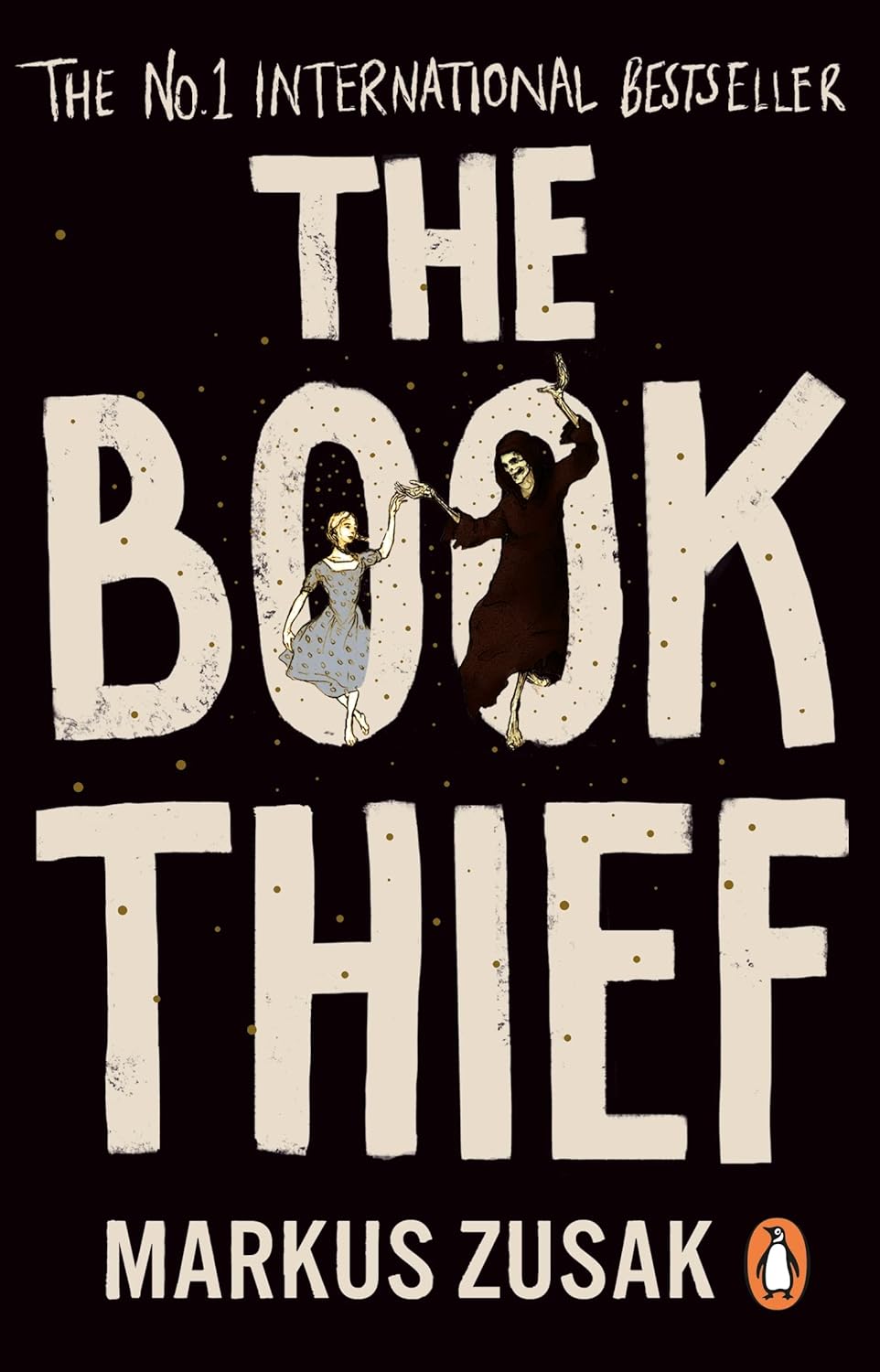
Author: Markus Zusak | 560 Pages | Genre: Historical Fiction | Publisher: First edition published by Alpha 2 Omega Books. My edition published by Penguin Random House (2018) | Year: 2005 | My Rating: 9/10
“The human heart is a line, whereas my own is a circle, and I have the endless ability to be in the right place at the right time. The consequence of this is that I’m always finding humans at their best and worst. I see their ugly and their beauty, and I wonder how the same thing can be both” ― Markus Zusak, The Book Thief
The Book Thief combines brutality and beauty with extraordinary grace, and I found it to be truly unique and spectacular. The novel is set in 1939 Nazi Germany, during World War II, where the story is a haunting exploration of love, loss, language, and the power of storytelling to preserve humanity. Narrated through the unexpected voice of Death, the novel redefines the familiar war narrative, which is both poetic and profoundly human.
The story centres on Liesel Meminger, a young girl sent to live with foster parents Hans and Rosa Hubermann in Molching, near Munich. After her brother dies en route to their new home in 1939, Liesel steals her first book, marking the beginning of her quiet rebellion through reading. Liesel’s foster father, Hans, patiently teaches her to read during late-night sessions in their basement. Liesel’s foster mother, Rosa, is gruff yet deeply protective. For Liesel, books become both a refuge and a means of resisting the Nazi regime’s manipulation of language.
When the Hubermanns shelter Max Vandenburg, a Jewish man fleeing Nazi persecution, Liesel’s world broadens. Her friendship with Max, rooted in fear and hope, highlights the power of imagination to endure hardship. Max’s stories, especially “The Word Shaker,” reinforce the novel’s central theme that ‘words can both harm and heal.’
The author’s decision to use Death as the narrator is both bold and effective. Death is portrayed as weary, compassionate, and reflective, observing humanity’s capacity for both cruelty and kindness. His tone shifts between irony and melancholy, providing both distance and intimacy. Death’s closing line, “I am haunted by humans,” underlines the novel’s meditation on human fragility and resilience.
Zusak removes sentimentality from tragedy through his narration by Death. I knew early in my reading that the story would end in loss, and Death tells plainly who will die, but this foreknowledge deepened rather than diminished my emotional investment. Zusak’s central theme of the power of language could not be more resonant. The Nazi regime weaponized words to manipulate a nation and justify genocide. In contrast, Liesel and Max reclaim language as a force for healing and remembrance. Books become tools of freedom, teaching Liesel not only literacy but empathy and defiance. There is also a profound theme of ordinary heroism. The Hubermanns, Liesel, and her friend Rudy Steiner resist in small, quiet ways, sharing bread with starving prisoners, hiding a Jew in their basement, refusing to let fear extinguish decency. These are acts of rebellion born not of ideology but of humanity.
The novel also explores how even in a time of death, there are moments of laughter, friendship, and love. It portrays war as a lived experience through the eyes of a child who learns too soon about loss but clings to hope through storytelling. Zusak’s prose is poetic, fragmented, and rhythmic, a departure from conventional realism. He uses vivid imagery and typographical experimentation, breaking the fourth wall and inserting short notes, sketches, and lists. These stylistic quirks mirror Death’s fragmented perception of events and add texture to the reading experience. Like his description of the sky as Death collects souls, “The sky was the colour of Jews.” It is shocking, ambiguous, and heartbreaking, capturing the moral weight of genocide in those six words. It made me pause at the sentence and page for a while, feeling the sentence rather than merely understanding. Liesel is one of contemporary literature’s most memorable protagonists, who is resilient, curious, and brave. Through her eyes, one can experience both the innocence of childhood and the disillusionment of war. Her evolution from an illiterate girl to a book thief who reads to others in bomb shelters symbolizes the redemptive arc of language.
The moral core of the novel, Hans Hubermann, embodies quiet courage. His act of painting over antisemitic graffiti and hiding Max is not grand heroism but the moral defiance of an ordinary man. Rosa, abrasive yet loving, offers a realism often absent in depictions of maternal figures. Rudy Steiner, Liesel’s best friend, brings youthful vitality and heartbreak into the story. His dream of kissing Liesel becomes a symbol of innocence stolen by war. Max, the Jewish fugitive, represents endurance and the power of imagination, writing his own story literally over the pages of “Mein Kampf,” transforming an instrument of hate into one of creation. Each character feels deeply human, flawed, frightened, and compassionate, and their relationships form the emotional spine of the novel.
The Book Thief focuses on ordinary citizens rather than soldiers or political figures. Zusak reminds us that history is lived by common people, those who make small moral choices every day. Since its first publication in 2005, The Book Thief has also been adapted into a film released in 2013. Its endurance over the years lies in its emotional honesty and narrative innovation. It teaches us that even in times of darkness, stories can keep the flame of humanity alive. The Book Thief is not just a story about war or death; it is about the defiance of the human spirit through words and empathy.
This novel reminded me that reading, too, is an act of resistance. It is a book that stays with you, not because of the horrors it depicts, but because of the beauty it finds amidst them. As Death himself observes, “It’s only small stories like this one that can make the bigger ones bearable.”
Social impact professionals face challenges that require both strategic thinking and deep empathy. Whether working in non-profits, CSR, philanthropy, development agencies, or social enterprises, professionals in these fields need to balance passion for change with evidence-based approaches to development. Books remain one of the most powerful ways to gain insight, inspiration, and tools for creating sustainable social impact.
I have put together a list of ten must-read books that every social impact professional should consider adding to their shelf, as they are on mine. These books are on leadership, systems thinking, innovation, fundraising, evaluation, and purpose. They provide both the vision and the practical tools needed to make a lasting difference.
1. “How to Change the World: Social Entrepreneurs and the Power of New Ideas” by David Bornstein
David Bornstein profiles pioneering social entrepreneurs who are solving some of the world’s toughest problems with creativity and determination. From rural health initiatives to innovative education programs; from rural poverty in India to discrimination against gypsies in Central Europe; from industrial pollution in the United States to child prostitution in Thailand, the book shows how individuals and organizations can catalyse systemic change. For social impact professionals, it provides concrete case studies and a roadmap for thinking beyond short-term solutions. It offers inspiration and practical lessons in scaling impact, showing how bold ideas combined with persistence can transform communities.
2. “The Blue Sweater: Bridging the Gap Between Rich and Poor in an Interconnected World” by Jacqueline Novogratz
Jacqueline Novogratz, founder of Acumen, blends personal narrative with the evolution of impact investing. Her journey from traditional philanthropy to patient capital investing shows how financial innovation can tackle poverty while respecting dignity. It challenges professionals to rethink charity and aid, emphasizing sustainable solutions that empower rather than create dependency.
3. “Creating a World Without Poverty: Social Business and the Future of Capitalism” by Muhammad Yunus
Nobel laureate Muhammad Yunus introduces the concept of “social business”, a business model designed not for profit maximization but for solving social problems. Drawing on his work with Grameen Bank and microfinance, Yunus presents a radical yet practical vision of blending entrepreneurship with social change. It inspires a new way of seeing markets and entrepreneurship as allies in social development, especially for professionals exploring hybrid models of impact.
4. “The Lean Startup” by Eric Ries
At first glance, this book seems more suited to tech entrepreneurs than social impact leaders. Yet, its core idea of test, learn, iterate has transformed the way many social innovations are designed and scaled. Social enterprises and NGOs increasingly use lean principles to reduce waste, validate solutions with communities, and adapt quickly. Because social impact efforts often operate under resource constraints, adopting lean experimentation can make interventions more effective and sustainable.
5. “Measuring What Matters: Tools for Aligning Capital and Impact” by Rodney Schwartz & Geoff Mulgan (or substitute with John Doerr’s “Measure What Matters” depending on focus)
Impact measurement remains one of the most pressing challenges for the field. This book provides frameworks and practical tools for defining, measuring, and aligning impact with mission. It explores case studies of organizations that have successfully embedded impact metrics in their operations. It equips professionals with methods to track progress, communicate value to funders, and ensure accountability without losing sight of mission.
6. “Switch: How to Change Things When Change Is Hard” by Chip Heath and Dan Heath
Social impact work is essentially about behaviour change, whether convincing communities to adopt healthier practices, companies to embrace sustainability, or policymakers to reform systems. “Switch” explains why people resist change and offers strategies to inspire collective action. It’s a practical guide to leading change management in complex social contexts, with evidence-based techniques that can be applied across sectors.
7. “Development as Freedom” by Amartya Sen
Economist and Nobel laureate Amartya Sen reframes development not simply as economic growth but as the expansion of human freedoms. He argues that true development empowers individuals with choices, agency, and opportunities. For anyone engaged in social impact, this book provides a philosophical foundation. It reminds professionals that the goal is not just programs or numbers, but human dignity and freedom.
8. “The Infinite Game” by Simon Sinek
Social impact work is not about short-term wins but about long-term transformation. In “The Infinite Game,” Sinek contrasts finite games (with fixed rules and winners) with infinite ones (driven by purpose and adaptability). Social impact is clearly an infinite game, requiring resilience and continuous rethinking. It equips leaders with the mindset needed to sustain impact, avoid burnout, and build organizations that thrive beyond immediate results.
9. “Winners Take All: The Elite Charade of Changing the World” by Anand Giridharadas
This provocative book critiques the global elite’s role in shaping the social impact landscape. Giridharadas argues that many wealthy philanthropists and corporations pursue impact while preserving the very systems that cause inequality. Even if one disagrees with all its conclusions, it challenges professionals to reflect critically on power, privilege, and accountability in the sector.
10. “The Systems Work of Social Change: How to Harness Connection, Context, and Power to Cultivate Deep and Enduring Change” by Cynthia Rayner and Francois Bonnici
Addressing complex issues like poverty or climate change requires a systems lens. This book offers practical insights into how organizations can shift from isolated interventions to systemic approaches that address root causes. It helps professionals understand complexity, collaborate across sectors, and design interventions that endure over time.
The work of social impact professionals is as inspiring as it is demanding. It calls for creativity, humility, persistence, and continuous learning. The ten books highlighted above represent a spectrum of ideas, from the visionary and philosophical to the highly practical. Together, they offer a toolkit for navigating the challenges of creating social good in a complex, globalized world.Reading these books won’t just sharpen your technical skills, they will also deepen your sense of purpose, expand imagination, and foster resilience. For professionals committed to solving humanity’s most pressing problems, these works serve as companions, guides, and sometimes challengers, reminding us that lasting change is possible when ideas, innovation, and values align.