Small Things Like These
March 23, 2026 Leave a comment
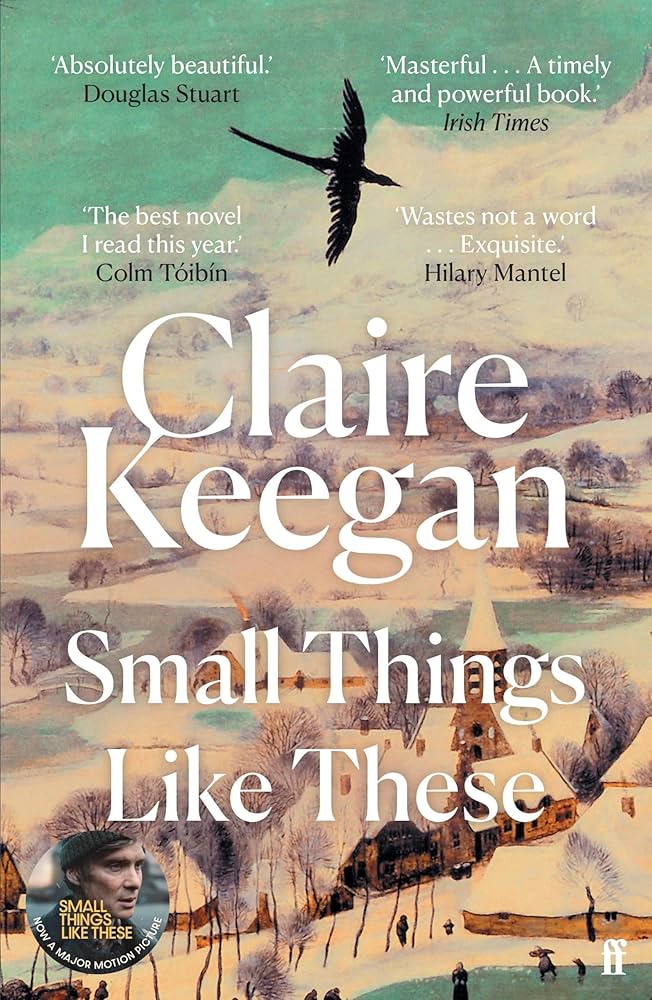
Author: Claire Keegan | 128 Pages | Genre: Historical Fiction | Publisher: Faber and Faber | Year: 2021 | My Rating: 8/10
“Do you mind telling me where this road will take me?’ “This road?” The man put down the hook and leant on the handle, and stared in at him. “This road will take you wherever you want to go, son.”
― Claire Keegan, Small Things Like These
Claire Keegan’s Small Things Like These is an unassuming and compassionate novella that explores moral courage within the mundane rhythms of everyday life. When you first hold the book, its title suggests humility as it refers to small acts and ordinary details that weave our lives together. Yet beneath this gentle exterior lies a story both sharp and deep, one that questions societal complicity, personal responsibility, and the price of kindness in a world full of indifference. A film was also released by the same name in 2024, directed by Tim Mielants.
Set in Ireland in the mid-1980s, the story follows Bill Furlong, a coal merchant and family man whose weekly routines revolve around delivering coal to his community in the run-up to Christmas. Bill is a practical, hardworking man with a keen eye for details—both in his business dealings and in the lives of those around him. Keegan’s prose is spare but richly textured as she describes the world through Bill’s grounded perspective, allowing the setting to emerge organically as both familiar and austere.
The power of this book lies in its focus on the ordinary. Bill’s days are a series of small tasks that include fetching sacks of coal, repairing fences, observing the changing weather, and spending evenings with his children. Yet it is precisely through these simple moments that Keegan reveals the deeper struggles of her characters and the moral quandaries they face. Her writing shimmeringly captures the texture of lives lived where dignity and survival are in constant negotiation.
The crux of the narrative begins when Bill, on his routine deliveries, encounters the Magdalene Laundry, which is an institution that, in real-world history, incarcerated thousands of women labelled as wayward or sinful, forcing them into unpaid labour. In Keegan’s fictional rendering, the institution stands as an imposing, monolithic presence with walls that seem to hold secrets as impenetrable as the silence that surrounds it. When Bill witnesses a young woman in distress, that unsettles him; he is forced to confront realities he has long chosen to ignore. What follows is a quiet yet wrenching moral reckoning.
Keegan doesn’t rely on grand gestures or dramatic flourishes to convey her message. Instead, she invites the reader into Bill’s personal life, which unfolds with the careful precision of a meditative revelation. Bill’s internal struggle between comfort and conscience, between the safety of silence and the peril of truth, is the emotional anchor of the story. In a world where systems of power routinely subjugate the vulnerable, Bill’s hesitations, doubts, and ultimately his decisions illuminate the complexity of acting with integrity.
One of the most remarkable aspects of Keegan’s writing is her ability to render deeply serious themes without didacticism. The novella grapples with historical injustices, patriarchal structures, and collective negligence, yet it never feels preachy. Keegan trusts her readers to recognise the moral gravity of the situation. Bill’s interactions with those around him further enrich the novella’s emotional landscape. His relationships with his wife, his children, and his neighbours are tenderly drawn, with each character feeling textured, whole, and real. Through these interactions, Keegan shows how communal life can be both nourishing and fraught, underscoring how easily people can slip into patterns of complacency when confronting uncomfortable truths. The warmth of Bill’s home life stands in stark contrast to the chilling secrecy of the laundry, amplifying the moral dissonance at the heart of the story.
Keegan’s storytelling is musical, and her sentences are shaped with an almost tactile precision. The Irish landscape, with its grey skies, barren fields, and wind-scoured streets, becomes more than a backdrop and a character in its own right, reflecting the internal desolation and flickers of hope within Bill’s journey. Reading this book is an immersive experience, inviting you to slow down, to notice the small details, to attend to the silences between the lines.
At its core, the novella asks a deceptively simple question that what does it mean to be a good person in a world that often rewards self-interest over compassion? Bill Furlong’s story suggests that there are no easy answers, but that even modest acts of courage like speaking up, offering help, acknowledging another’s suffering can ripple outward in ways that matter. This thematic focus on the ‘small things’ resonates with the narrative’s tonal restraint, generating a quiet but persistent emotional force.
Some readers may find the novella’s deliberate pacing and understated plot challenging, especially those accustomed to more overtly dramatic narratives. However, it is precisely this unhurried approach that allows Keegan’s thematic concerns to take root. The quiet accumulation of detail replicates the way real moral awakening often unfolds incrementally, through moments of discomfort and reflection rather than sudden epiphany.
This book is a remarkable work of moral fiction that lingers long after reading. Claire Keegan has crafted a narrative that is both intimate and expansive, one that honours the ordinary while confronting extraordinary ethical dilemmas. Through Bill Furlong’s quiet courage, Keegan reminds us that the small things, like acts of attention, care, and conscience, are often the ones that define us. It is a novella of great compassion and moral clarity, worthy of contemplation by anyone invested in the possibilities of human kindness amid enduring social wounds.
 About Manu Mayank
 Manu Mayank